

You’re standing in front of your engineering team, ready to approve specifications for a new heat exchange system. The technical drawings show two different flow configurations, and everyone’s waiting for your decision. Counter-flow or parallel-flow? The terms sound simple enough, but the implications stretch far beyond basic terminology. Choose wrong, and you’ll sacrifice thermal efficiency, waste energy, and potentially compromise your entire process operation.
This decision troubles engineers and plant managers across industries daily. Both configurations move heat from one fluid to another, yet their performance characteristics differ dramatically. Many businesses make choices based on initial cost or installation convenience without understanding the long-term operational implications. What seems like a minor technical detail during design becomes a permanent limitation affecting efficiency, operating costs, and system capacity for decades.
The stakes are higher than most people realize. A parallel-flow heat exchanger might cost less upfront but deliver 20-30% lower efficiency than its counter-flow equivalent in the same application. That efficiency gap translates directly into higher energy consumption, larger equipment sizes, and increased operational expenses. Understanding these fundamental differences empowers you to make informed decisions that optimize both performance and cost-effectiveness. Let’s break down exactly how these configurations work and when each design makes the most sense for your specific needs.
Understanding Flow Direction Fundamentals
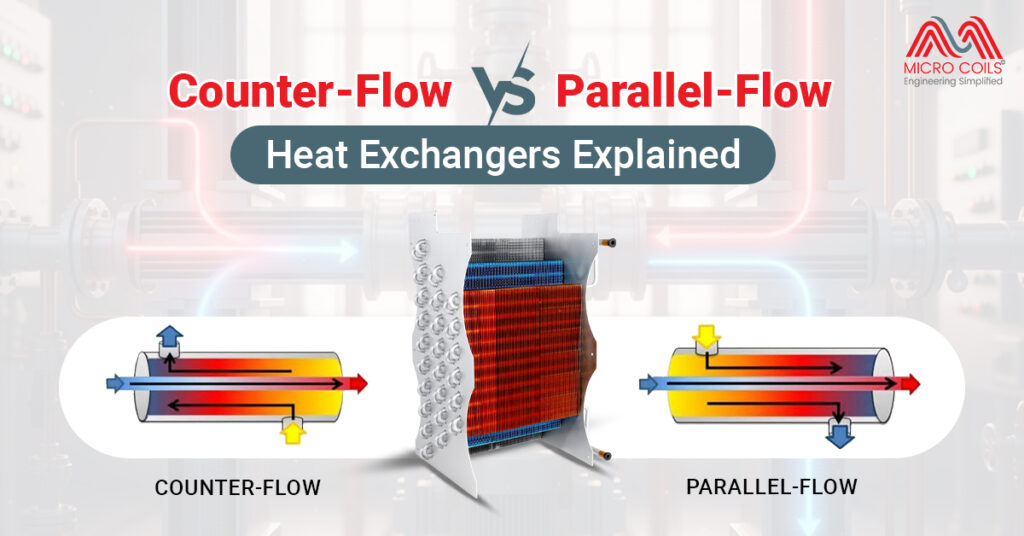
Flow configuration determines how hot and cold fluids move relative to each other inside the heat exchanger. In parallel-flow designs, both fluids enter at the same end and travel in the same direction through the unit. Hot fluid enters one side while cold fluid enters the opposite side, and they flow together toward the common exit end. This arrangement creates a specific temperature profile that limits the ultimate heat transfer potential.
Counter-flow configurations reverse this relationship completely. Hot fluid enters one end while cold fluid enters from the opposite end, creating flows that move in opposite directions. They pass each other throughout the entire heat exchanger length, maximizing the temperature difference between fluids at every point. This seemingly simple directional change produces profound effects on thermal performance and efficiency.
Temperature profiles reveal the key performance differences between these designs. In parallel-flow heat exchangers, the temperature difference between fluids starts high at the inlet and decreases progressively toward the outlet. Both fluids approach a common intermediate temperature as they exit, limiting how much heat can transfer. The outlet temperature of the cold fluid can never exceed the outlet temperature of the hot fluid in this configuration.
Counter-flow arrangements maintain higher average temperature differences throughout the exchanger length. The coldest portion of the cool fluid contacts the coolest section of the hot fluid, while the warmest cool fluid meets the hottest section of hot fluid. This arrangement allows the cold fluid outlet temperature to approach—and theoretically even exceed—the hot fluid outlet temperature, dramatically improving heat recovery potential.
Thermal Efficiency: The Critical Performance Difference
Effectiveness ratings quantify how well heat exchangers approach their theoretical maximum performance. Counter-flow designs consistently achieve higher effectiveness ratings than parallel-flow units of identical size and construction. A well-designed counter-flow heat exchanger might reach 85-90% effectiveness, while a comparable parallel-flow unit typically maxes out around 50-60% under similar conditions.
This efficiency advantage translates directly into practical benefits. When you need to cool a hot process stream to a specific temperature, counter-flow configuration accomplishes this with less heat transfer surface area. Alternatively, given identical physical dimensions, counter-flow designs transfer significantly more heat than parallel-flow alternatives. Every heat exchanger manufacturer understands these fundamental thermodynamic principles when designing systems for demanding applications.
Temperature approach limitations constrain parallel-flow performance permanently. The closest temperature approach between outlet streams in parallel flow exceeds the approach possible in counter-flow significantly. If your process requires tight temperature control or maximum heat recovery, parallel-flow simply cannot deliver the required performance regardless of how large you make it. Physics imposes hard limits that no amount of additional surface area can overcome.
Energy consumption differences compound over years of operation. A less efficient heat exchanger requires more energy input to achieve the same process results. In applications involving pumping, heating, or cooling, this inefficiency multiplies operational costs continuously. Calculate the energy cost difference over a twenty-year equipment life, and you’ll discover that initial savings on cheaper parallel-flow units evaporate quickly compared to lifetime operational expenses.
Key Differences at a Glance
Understanding the practical distinctions helps you make better equipment selections:
- Temperature Potential: Counter-flow allows cold fluid outlet to approach or exceed hot fluid outlet temperature, while parallel-flow limits cold outlet to always stay below hot outlet temperature
- Efficiency Rating: Counter-flow achieves 80-90% effectiveness typically, compared to 40-60% for parallel-flow designs under comparable conditions
- Size Requirements: Counter-flow needs 30-50% less heat transfer surface area to achieve identical thermal performance as parallel-flow configurations
- Temperature Profile: Counter-flow maintains more uniform temperature difference throughout, while parallel-flow shows dramatically decreasing temperature difference from inlet to outlet
- Heat Recovery: Counter-flow recovers significantly more waste heat, making it ideal for energy conservation applications where maximum recovery matters
- Exit Temperature Control: Counter-flow provides tighter control over outlet temperatures, critical for processes requiring precise thermal management
- Installation Complexity: Parallel-flow offers simpler piping arrangements sometimes, particularly in compact spaces with limited connection options
- Thermal Stress: Parallel-flow experiences lower thermal stress since maximum temperature difference occurs only at inlet, not throughout entire length
- Cost Consideration: Parallel-flow units cost less initially due to smaller size requirements for equivalent effectiveness levels
- Application Suitability: Counter-flow excels in heat recovery and high-efficiency applications, while parallel-flow works adequately for less demanding cooling tasks
When Parallel-Flow Makes Sense?
Certain applications actually benefit from parallel-flow characteristics despite lower efficiency. When thermal stress concerns outweigh efficiency considerations, parallel-flow’s gentler temperature gradients prevent damage to sensitive materials. The reduced temperature differential throughout most of the exchanger length minimizes expansion and contraction cycles that can fatigue metal components over time.
Space constraints sometimes favor parallel-flow configurations. The inlet and outlet connections on the same end simplify piping in tight installations where bringing pipes to opposite ends proves difficult or impossible. Manufacturing facilities retrofitting heat exchangers into existing process lines occasionally choose parallel-flow purely for installation convenience.
Lower precision requirements make parallel-flow acceptable in many applications. If you’re simply removing excess heat without targeting specific outlet temperatures, the reduced efficiency might not matter practically. Cooling solutions in telecom unit installations sometimes use parallel-flow for basic equipment cooling where maintaining temperatures below critical thresholds matters more than achieving maximum efficiency.
Cost-sensitive projects with moderate performance needs benefit from parallel-flow economics. When capital budget constraints exceed operational efficiency concerns, parallel-flow delivers adequate performance at lower initial investment. Small-scale applications where the absolute energy cost difference amounts to only dollars monthly rather than thousands might reasonably choose parallel-flow for budget reasons.
Why Counter-Flow Dominates Industrial Applications?
Maximum heat recovery drives most industrial heat exchanger selections toward counter-flow. Process industries constantly seek ways to recapture waste heat and reduce energy consumption. Counter-flow configuration extracts the maximum possible thermal energy from hot streams before discharge, directly reducing fuel costs and improving process economics. Every degree of additional heat recovery translates into measurable cost savings compounding over years of continuous operation.
Precise temperature control requirements mandate counter-flow in many chemical and pharmaceutical processes. When reactions depend on maintaining specific temperatures or product quality demands tight thermal management, counter-flow’s superior temperature approach capability becomes essential rather than optional. These applications cannot compromise efficiency for cost savings without risking product specifications or process stability.
Environmental regulations increasingly favor high-efficiency heat recovery. Waste heat discharge limits and energy efficiency standards push facilities toward maximum thermal recovery. Counter-flow heat exchangers help companies meet regulatory requirements while simultaneously reducing operating costs. Any reputable heat exchanger manufacturer in India or globally recognizes this trend and designs industrial systems around counter-flow principles primarily.
Compact installations benefit from counter-flow’s superior thermal performance. When physical space limits equipment size, achieving required heat transfer in minimal footprint demands maximum efficiency. Counter-flow delivers more thermal performance per square foot of heat transfer area, allowing smaller equipment that fits tight spaces while meeting full process requirements.
Material and Construction Considerations
Flow configuration influences material selection and construction methods. Counter-flow designs experience higher temperature differentials between adjacent fluid streams, creating greater thermal stress on separating walls. This necessitates materials with better thermal expansion characteristics and sometimes thicker construction to handle stress cycles. Premium materials increase costs but prevent premature failure in demanding applications.
Tube arrangement in shell-and-tube heat exchangers affects achievable flow patterns. True counter-flow requires careful baffle design and tube passes that maintain opposing flow directions throughout. Multiple tube passes can complicate achieving pure counter-flow, sometimes creating mixed flow patterns that reduce theoretical efficiency advantages. Working with experienced engineers ensures design execution matches theoretical performance expectations.
Plate heat exchangers naturally lend themselves to counter-flow configurations. The alternating plate arrangement channels fluids in opposite directions automatically, making counter-flow the default rather than an added complexity. This inherent design advantage explains why plate heat exchangers achieve such impressive thermal effectiveness despite compact sizes.
Cleaning and maintenance access varies between configurations. Parallel-flow units with connections on one end sometimes allow easier disassembly and cleaning access. Counter-flow shell-and-tube designs with connections on opposite ends might require more clearance and piping disconnection for maintenance. These practical considerations influence total cost of ownership beyond pure thermal performance.
Real-World Application Examples
Power plant condensers almost universally employ counter-flow principles for maximum efficiency. Cooling water flows opposite to condensing steam, extracting maximum heat and improving overall cycle efficiency. The massive scale of power generation makes even small percentage efficiency improvements economically significant, easily justifying counter-flow complexity.
HVAC systems frequently use counter-flow heat exchangers in energy recovery ventilators. Exhaust air transfers heat to incoming fresh air with minimal temperature loss, reducing heating and cooling loads substantially. Building energy codes increasingly mandate such recovery systems, making counter-flow selection standard practice rather than premium option.
Oil refineries depend on counter-flow heat exchangers throughout distillation and processing. Crude oil preheat trains use counter-flow to recover heat from hot product streams, reducing fired heater fuel consumption dramatically. These applications showcase counter-flow’s economic value in continuous high-volume industrial operations where efficiency directly impacts profitability.
Food processing applications balance efficiency against sanitary requirements. Counter-flow provides better heat recovery for pasteurization and sterilization processes, but cleaning accessibility sometimes favors simpler parallel-flow designs. Each manufacturer weighs these competing factors based on specific process needs and regulatory requirements.
Making the Right Choice for Your Application
Evaluate your actual performance requirements before defaulting to either configuration. Calculate required heat duty, desired outlet temperatures, and acceptable temperature approaches. These specifications reveal whether parallel-flow can meet your needs adequately or counter-flow becomes necessary. Don’t over-specify efficiency if your application truly doesn’t require maximum performance.
Consider lifetime operating costs versus initial capital investment. Model energy consumption under both configurations across expected equipment life. Include energy price escalation assumptions and maintenance cost differences. This comprehensive financial analysis often justifies higher upfront investment in counter-flow for its superior long-term economics.
Consult with engineering experts who understand your specific industry and application. Generic advice fails to account for unique process requirements, space constraints, or operational preferences that influence optimal configuration selection. Experienced professionals help navigate tradeoffs and identify solutions balancing performance, cost, and practical considerations.
Request detailed performance guarantees from manufacturers. Specify exactly what thermal performance you require and hold vendors accountable for delivering it. Reputable manufacturers stand behind their designs with performance guarantees that protect your investment and ensure equipment meets process needs.
Conclusion
Flow configuration represents a fundamental design choice affecting heat exchanger performance for its entire operational life. Counter-flow delivers superior thermal efficiency, tighter temperature control, and better heat recovery than parallel-flow alternatives. These advantages make counter-flow the preferred choice for most industrial applications where efficiency and performance matter. However, parallel-flow retains value in specific situations where simplicity, lower cost, or reduced thermal stress outweigh efficiency considerations.
Your optimal choice depends on carefully evaluating application requirements against configuration strengths and limitations. Don’t let initial cost differences drive decisions without considering lifetime operational economics. The most efficient heat exchanger isn’t always the most expensive one—it’s the configuration that delivers required performance at the lowest total cost of ownership. Understanding these fundamental principles empowers you to make informed decisions that optimize both immediate and long-term value for your specific thermal management needs.
Counter-flow heat exchangers deliver higher thermal effectiveness, reducing required surface area and energy consumption. This lowers operating costs and long-term energy spend. Parallel-flow designs may have lower upfront complexity but often result in higher lifecycle costs due to reduced efficiency.
Counter-flow exchangers scale more efficiently for high-duty applications because they maintain a consistent temperature driving force along the length. This enables compact designs at higher capacities. Parallel-flow exchangers typically require increased length or surface area, limiting scalability in space-constrained plants.
Counter-flow exchangers provide tighter outlet temperature control, which is critical for downstream process consistency. The gradual temperature gradient improves predictability. Parallel-flow exchangers experience rapid initial heat transfer, making precise control more challenging in continuous industrial operations.
Parallel-flow exchangers reduce thermal stress at the inlet, extending component life in temperature-sensitive systems. Counter-flow designs operate with higher gradients but fewer required units. B2B buyers must balance durability versus efficiency based on operating cycles and maintenance strategies.
For energy-intensive sectors, counter-flow exchangers maximize heat recovery and reduce utility dependence, supporting sustainability targets. Parallel-flow units suit applications prioritizing material safety or rapid heating. Procurement decisions should align exchanger selection with process efficiency goals and long-term energy optimization.

