

Your air conditioner has stopped cooling effectively, and the HVAC technician delivers the news: you need a new evaporator coil. But then comes the question that catches most homeowners off guard—”Do you want cased or uncased?” You nod uncertainly, wondering what the difference is and whether your choice will cost you hundreds of rupees unnecessarily or leave you with subpar cooling for years to come.
This decision isn’t trivial. The type of evaporator coil you choose affects installation costs, system efficiency, future maintenance accessibility, and how well your air conditioner performs in your specific home setup. Yet most homeowners make this choice with minimal understanding of what distinguishes these two configurations or why it matters for their particular situation.
The confusion is understandable. HVAC terminology feels deliberately obscure, and contractors sometimes rush through explanations, leaving you to make expensive decisions based on incomplete information. Some homeowners overpay for cased coils they don’t need. Others choose uncased coils to save money, only to face installation complications that erase any initial savings. HVAC stands for Heating, Ventilation, and Air Conditioning, which is the full form of HVAC.
This comprehensive guide eliminates the guesswork. You’ll discover exactly what cased and uncased evaporator coils are, understand the practical differences that affect your daily life and wallet, learn which situations demand one type over the other, and gain the knowledge to make confident decisions when replacement time arrives. Whether you’re facing an immediate replacement decision or planning ahead for eventual system upgrades, these insights ensure you choose wisely.
What Are Evaporator Coils and Why Do They Matter?
Before comparing cased and uncased versions, understand what evaporator coils actually do. The AC cooling coil sits inside your home’s air handler or furnace, hidden from view but absolutely critical to cooling performance. As warm air from your home blows across this coil, refrigerant inside absorbs the heat, cooling the air that then circulates back through your living spaces.
This heat absorption process is what makes air conditioning possible. Without a functioning evaporator coil, your AC system is just an expensive fan circulating warm air. The coil’s condition directly determines cooling capacity, energy efficiency, indoor air quality, and system reliability.
Most evaporator coils last 10-15 years under normal conditions, though this varies based on maintenance quality, operating hours, and environmental factors. When they fail—typically due to refrigerant leaks, corrosion, or fin damage—replacement becomes necessary. This is when the cased versus uncased decision emerges.
What are Cased Evaporator Coils?
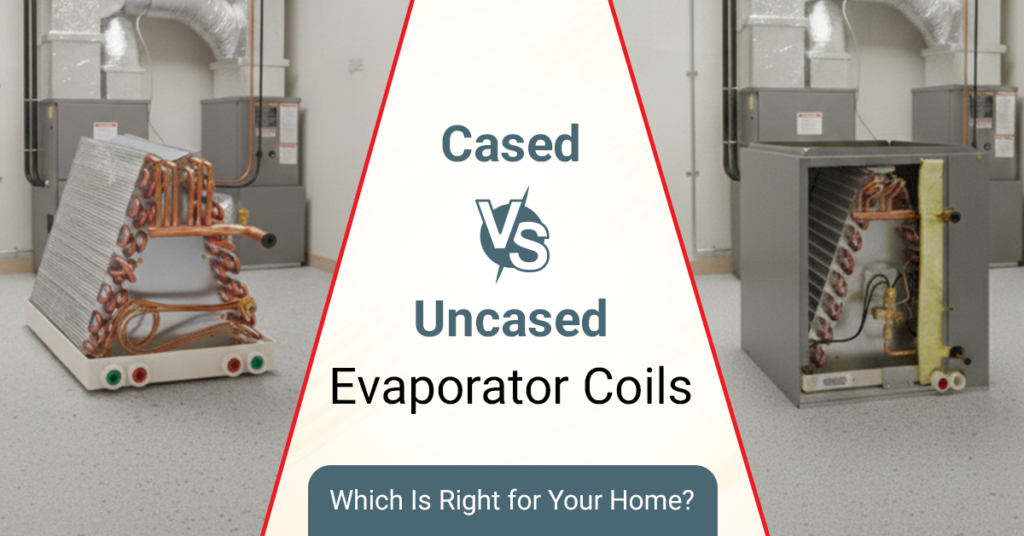
Cased evaporator coils come enclosed in their own metal cabinet or housing. Think of it as a complete, self-contained unit with the coil protected inside a purpose-built enclosure. This enclosure includes an insulated cabinet, connection points for ductwork, a drain pan to collect condensation, and sometimes additional features like built-in filters or access panels.
When you purchase a cased coil, you’re buying a ready-to-install package. The manufacturer has already addressed airflow optimization, condensation management, and structural support. The unit arrives as a complete assembly that connects to your existing ductwork and refrigerant lines.
Key Features of Cased Coils
- Complete enclosure: The metal housing fully surrounds the coil, protecting it from physical damage, debris, and environmental exposure. This protection extends coil lifespan by preventing accidental damage during maintenance or other work near the air handler.
- Integrated drain pan: Cased coils include factory-installed drain pans designed specifically for that coil’s dimensions and condensate production. The pan is properly sized, correctly positioned, and includes appropriate drain connections—all engineered together rather than field-adapted.
- Insulation: Most cased coils feature insulation built into the cabinet walls. This insulation prevents condensation from forming on the exterior cabinet surface when cold refrigerant circulates through the coil. Without proper insulation, moisture dripping from the cabinet exterior creates water damage and promotes mold growth.
- Easier installation: The self-contained nature simplifies installation. Technicians connect ductwork to the cabinet’s inlet and outlet openings, attach refrigerant lines, and connect the drain—significantly faster than custom-fitting an uncased coil.
- Better air distribution: The enclosure is engineered to distribute airflow evenly across the coil’s entire surface. This optimized airflow improves heat transfer efficiency and prevents hot spots where air bypasses the coil without adequate cooling.
Advantages of Cased Evaporator Coils
- Faster installation time: Pre-assembled components mean technicians spend 2-4 hours on installation instead of 4-6+ hours building custom enclosures. Reduced labor time translates directly to lower installation costs despite higher equipment prices.
- Reduced installation errors: Factory assembly eliminates field construction mistakes. There’s no risk of improper insulation installation, inadequate drain pan sizing, or airflow restrictions from poorly designed custom enclosures.
- Cleaner appearance: The finished cabinet looks professional and intentional rather than improvised. For systems visible in basements, utility rooms, or closets, aesthetic considerations might matter.
- Enhanced protection: The sturdy enclosure shields the delicate coil fins from accidental damage during routine maintenance, filter changes, or other work in the mechanical room.
- Warranty considerations: Some manufacturers offer better warranty terms on cased coils since installation variables are controlled. The factory assembly ensures the coil operates within designed parameters.
Disadvantages of Cased Evaporator Coils
- Higher upfront cost: Cased coils typically cost more than equivalent uncased coils. This premium pays for the cabinet, insulation, integrated components, and factory assembly labor.
- Larger physical footprint: The enclosure adds several inches to the overall dimensions. Tight installation spaces might not accommodate cased coils that would fit without the cabinet.
- Limited customization: The fixed cabinet dimensions and connection points might not align perfectly with existing ductwork, requiring additional transition pieces or modifications.
- Replacement challenges: If your existing system uses an uncased coil in a custom or OEM air handler, replacing with a cased coil might require significant ductwork modifications to accommodate the different configuration.
What are Uncased Evaporator Coils?
Uncased evaporator coils are bare coil assemblies without surrounding cabinets. They consist of the refrigerant tubing, aluminum or copper fins for heat transfer, and connection points for refrigerant lines—nothing more. The AC evaporator coil arrives as just the coil itself, requiring installers to provide all enclosure, insulation, and drainage components.
Installation of uncased coils involves placing the bare coil inside an existing air handler cabinet or furnace, or building a custom enclosure to house it. Technicians must fabricate or adapt all surrounding infrastructure including insulation, drain pans, ductwork connections, and structural support.
Key Features of Uncased Coils
- Minimal packaging: The coil ships without cabinet, insulation, or accessories. You’re purchasing purely the heat exchange component.
- Installation flexibility: Without predetermined dimensions from an enclosure, uncased coils can fit into spaces where cased versions won’t. Technicians can orient and position them to match existing configurations.
- Lower equipment cost: Without the expense of factory cabinets, insulation, and assembly, uncased coils cost significantly less to manufacture and purchase.
- Compatibility with existing systems: When replacing coils in established air handlers or furnaces, uncased coils often match original equipment better since they can install directly into existing enclosures.
Advantages of Uncased Evaporator Coils
- Cost savings: The lower equipment cost appeals to budget-conscious homeowners or situations where multiple units need replacement simultaneously.
- Space efficiency: Without added cabinet dimensions, uncased coils fit into tighter spaces. For cramped mechanical rooms, attics, or closet installations, this compactness proves essential.
- Perfect for existing air handlers: If your current system has a well-designed air handler with proper insulation and drainage, simply replacing the coil inside that existing enclosure makes logical and economic sense.
- Customizable configurations: Technicians can orient uncased coils to accommodate unusual ductwork layouts, non-standard ceiling heights, or unique architectural constraints that standardized cased coils can’t address.
Disadvantages of Uncased Evaporator Coils
- Complex installation: Building proper enclosures, installing insulation, fabricating drain pans, and ensuring adequate airflow requires skilled technicians and significant labor time. Poor installation negates any equipment cost savings.
- Higher labor costs: The additional 2-4 hours of installation labor often costs more, potentially exceeding the equipment savings from choosing uncased over cased.
- Installation quality variability: Final performance depends heavily on installer skill and thoroughness. Rushed or inexperienced installation creates problems including condensation leaks, inadequate drainage, poor insulation, and restricted airflow.
- Potential warranty issues: Some manufacturers void warranties if uncased coils aren’t installed according to strict specifications. Field-built enclosures might not meet these requirements.
- Maintenance accessibility challenges: Depending on how enclosures are constructed, accessing uncased coils for cleaning or inspection might be difficult. Poorly designed access panels complicate routine maintenance.
Installation Scenarios: Which Type Makes Sense When
Replacing a Coil in an Existing Air Handler
Best choice: Uncased
When your air handler cabinet is in good condition with functional insulation, proper drainage, and adequate space, installing an uncased coil inside this existing enclosure makes perfect sense. You’re leveraging infrastructure that’s already paid for and working correctly.
This scenario is common with newer systems (less than 10 years old) where the air handler remains in excellent condition but the coil has failed prematurely due to refrigerant leaks or manufacturing defects. Replacing just the coil component costs less and avoids discarding a perfectly functional cabinet.
Complete System Replacement
Best choice: Cased
When replacing both outdoor condenser unit and indoor components, cased coils typically prove superior. The complete installation allows contractors to design the entire system from scratch without working around existing constraints.
The integrated design of cased coils ensures all components work together optimally. Modern cased coils match current efficiency standards and incorporate advanced features like enhanced dehumidification or variable-speed compatibility that uncased coils might lack.
Upgrading Older Systems with Custom Installations
Best choice: Depends on existing setup quality
Older homes often have custom HVAC installations built by long-gone contractors using non-standard configurations. If the existing custom enclosure is well-built with quality insulation and drainage, an uncased coil makes sense. If it’s deteriorated, poorly designed, or inadequate, investing in a cased coil provides a fresh start with known quality.
Evaluate the existing enclosure critically. Signs of good quality include intact insulation without moisture damage, functioning drain pans without rust or cracks, secure mounting, and easy access for maintenance. Poor quality indicators include water stains, rust, inadequate insulation, difficult access, or makeshift construction.
Tight Space Installations
Best choice: Uncased
Attics, crawlspaces, closets, and other confined areas sometimes can’t accommodate cased coils’ larger dimensions. Uncased coils’ compact footprint enables installation where cased versions simply won’t fit.
However, tight space installations demand experienced technicians who can build proper enclosures despite limited working room. Poor workmanship in confined spaces creates long-term problems difficult and expensive to correct.
New Construction or Major Renovations
Best choice: Cased
When building new homes or completely renovating HVAC systems, cased coils deliver better long-term value. The controlled quality, faster installation, and optimized performance justify slightly higher costs when you’re investing in systems meant to last 15-20 years.
New construction allows proper planning around cased coil dimensions, eliminating space constraints. The cleaner installation and professional appearance align with the quality expectations of new construction.
Making Your Decision: Key Questions to Ask
Before choosing between cased and uncased evaporator coils, answer these critical questions:
- What’s the condition of my existing air handler or furnace?
If excellent, consider uncased. If poor or outdated, lean toward cased or complete replacement.
- How much space is available for installation?
Measure carefully. Cased coils need several additional inches clearance. Tight spaces might require uncased options.
- What’s my budget for total installation, not just equipment?
Get quotes for both options including labor. Sometimes the “cheaper” uncased option costs more installed.
- How skilled and reputable is my HVAC contractor?
Top-tier contractors can install uncased coils beautifully. Less experienced technicians might struggle, making cased coils safer choices.
- How long do I plan to keep this system?
For 10+ year ownership, the quality and reliability advantages of cased coils justify minimal cost differences. For short-term (5-7 years), economical uncased installations make sense.
- Are there any warranty implications?
Check manufacturer requirements. Some warranties depend on specific installation types.
- Do I value easier future maintenance?
Cased coils with proper access panels simplify future cleaning and inspection, reducing long-term maintenance hassles.
Conclusion
The cased versus uncased evaporator coil decision ultimately comes down to your specific situation rather than one option being universally superior. Cased coils excel in new installations, complete system replacements, and situations where installation quality and long-term reliability justify modest cost premiums. Uncased coils make sense when existing air handlers are sound, space is limited, or budget constraints are paramount—provided you have access to skilled installers.
Don’t let initial equipment price differences drive your decision exclusively. Consider total installed costs, contractor expertise, existing system condition, space constraints, and long-term maintenance implications.
Yes, but it’s not always straightforward. Replacing cased with uncased requires building or adapting an enclosure to house the bare coil—adding significant labor cost and complexity. Replacing uncased with cased often requires ductwork modifications to accommodate the different dimensions and connection points. Both conversions are possible but may cost more than like-for-like replacement. Consult with your HVAC contractor about the specific requirements and costs for your system.
Both types have similar lifespans when properly installed and maintained—typically 10-15 years. The coil type matters less than installation quality, maintenance frequency, operating conditions, and refrigerant chemistry. Cased coils might last slightly longer due to better protection from physical damage and more consistent installation quality, but well-installed uncased coils in quality enclosures perform equally well. Factors like refrigerant leaks, corrosion, and fin damage affect both types similarly.
Not inherently. Cooling performance depends on coil size, design, airflow, and refrigerant charge—not whether it’s cased or uncased. However, cased coils’ engineered enclosures often provide better airflow distribution across the coil surface, potentially improving heat transfer efficiency. Poorly installed uncased coils with airflow restrictions will cool less effectively than properly installed cased coils. When both are correctly installed, comparable-sized coils deliver similar cooling performance regardless of casing.
Generally yes, if they include proper access panels. Quality cased coils feature removable panels that expose coil surfaces for cleaning without disassembling ductwork or surrounding components. Uncased coils’ accessibility depends entirely on how the custom enclosure was built—some provide excellent access, others require extensive disassembly. When purchasing cased coils, verify they include adequate access panels for maintenance. When installing uncased coils, insist contractors include proper access points.
While technically possible for mechanically skilled homeowners with proper tools, professional installation is strongly recommended for both types. Installation requires refrigerant handling (requiring EPA certification), proper brazing techniques, vacuum pumps, refrigerant recovery equipment, and detailed knowledge of airflow, drainage, and safety codes. Improper installation voids warranties, creates safety hazards, and often costs more to fix than professional installation would have cost initially. Save DIY efforts for maintenance tasks like filter changes and drain line flushing.

