

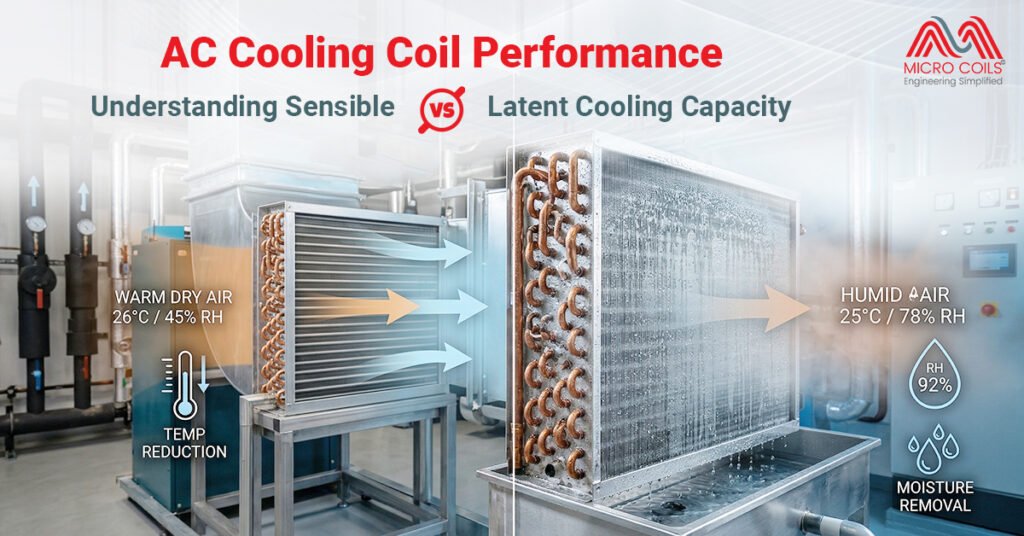
When you walk into a cool, comfortable room on a hot summer day, your AC cooling coil is doing two important jobs at once—lowering the temperature and removing humidity from the air. These two functions represent sensible and latent cooling capacity, and understanding how they work together determines whether your air conditioning system truly keeps you comfortable or just moves air around.
Many people assume air conditioning only cools air, but the reality is more complex. Your comfort depends equally on temperature and humidity levels. A room at 75°F with 80% humidity feels miserable, while the same temperature at 45% humidity feels pleasant. This is where the dual nature of cooling capacity becomes critical for anyone selecting, maintaining, or optimizing HVAC systems.
What Is Sensible Cooling Capacity?
Sensible cooling capacity refers to the cooling you can actually feel and measure with a thermometer. When your AC cooling coil removes sensible heat, it lowers the air temperature without changing moisture content. This is the straightforward part of air conditioning that most people understand intuitively.
Think of sensible cooling as the difference between air entering your cooling coil at 85°F and leaving at 55°F. That 30-degree temperature drop represents sensible heat removal. The air molecules slow down, the space feels cooler, and your thermometer confirms the change. Every air conditioning system must provide adequate sensible cooling to meet the temperature demands of the space it serves.
Sensible cooling becomes the dominant requirement in dry climates where humidity levels stay naturally low. Desert regions, high-altitude locations, and areas with arid conditions need air conditioning primarily for temperature reduction. The air already contains minimal moisture, so the cooling system focuses its capacity on lowering temperature rather than fighting humidity.
The adiabatic cooling heat exchanger manufacturer in India market recognizes this principle in their designs. Adiabatic systems leverage water evaporation to enhance sensible cooling efficiency, particularly effective in hot, dry conditions where the process doesn’t add problematic humidity. These systems pre-cool air before it reaches the main cooling coil, reducing the sensible load and improving overall system efficiency.
What Is Latent Cooling Capacity?
Latent cooling capacity addresses the hidden heat contained in moisture. When your AC cooling coil removes humidity from air, it must extract the latent heat that keeps water in vapor form. This cooling process doesn’t change air temperature directly—instead, it removes moisture that makes air feel sticky and uncomfortable.
The term “latent” means hidden or concealed, and that perfectly describes this type of cooling. You cannot measure latent heat removal with a thermometer. Instead, you measure it through humidity reduction—air enters the coil at 70% relative humidity and exits at 50% relative humidity, even if temperature change is minimal during this specific phase of the process.
Latent cooling happens when water vapor in air contacts the cold surface of your cooling coil. The vapor condenses into liquid water, releasing its latent heat to the coil in the process. This condensed water drips into the drain pan and exits your building through condensate lines. Every pint of water removed from your air represents significant latent cooling capacity at work.
Coastal regions, tropical climates, and humid continental zones require substantial latent cooling capacity. In Mumbai during monsoon season or Chennai in summer, humidity often matters more than temperature for comfort. An AC cooling coil must remove gallons of water daily from indoor air while simultaneously providing sensible cooling.
How AC Cooling Coils Handle Both Types of Cooling?
Your AC cooling coil manages sensible and latent cooling simultaneously through a carefully orchestrated process. Warm, humid air passes over the cold coil surface. The temperature difference between air and coil drives sensible heat transfer, cooling the air. Simultaneously, the coil surface temperature stays below the dew point of the incoming air, causing moisture to condense and removing latent heat.
The coil design directly influences how effectively it balances these two cooling modes. Fin spacing, row depth, and surface area all affect the ratio of sensible to latent cooling. Tightly spaced fins with multiple rows create more surface contact, enhancing both temperature reduction and moisture removal. However, this same configuration increases air resistance and requires more powerful fans to maintain airflow.
Pillow plate manufacturers create specialized heat exchangers using a unique embossed design that increases surface area without traditional fins. These pillow plates form raised patterns that enhance heat transfer while maintaining structural strength. In cooling applications, this design offers advantages for controlling the sensible heat ratio while managing condensate effectively.
The refrigerant temperature inside your cooling coil determines the split between sensible and latent capacity. Colder coil surfaces enhance moisture removal but may overcool air temperature. Warmer coil surfaces prioritize temperature reduction but may leave humidity higher than desired. System designers carefully select refrigerant temperatures and expansion valve settings to achieve the optimal balance for each application.
Factors Affecting Sensible vs. Latent Cooling Balance
Climate and Geographic Location
- Coastal and humid regions require AC cooling coils optimized for latent capacity, often needing SHR values below 0.75 to handle moisture loads effectively
- Desert and arid climates benefit from high sensible capacity systems with SHR above 0.85, where temperature reduction takes priority over dehumidification
- Monsoon-affected areas experience seasonal variations, requiring flexible systems that adjust capacity ratios as outdoor conditions shift dramatically
- High-altitude locations typically need greater sensible cooling since lower atmospheric pressure reduces humidity even in otherwise moist climates
- Urban heat islands increase sensible loads as concrete and asphalt radiate stored heat, while vegetation loss reduces natural moisture that would increase latent loads
- Industrial zones near water bodies face combined challenges of high temperature and humidity, demanding balanced cooling capacity from properly designed systems
Building Occupancy and Use Patterns
- High-density occupancy spaces like theaters, classrooms, and transportation terminals generate substantial latent heat from human respiration and perspiration
- Kitchens and food service areas produce both sensible heat from cooking equipment and massive latent loads from boiling, steaming, and dishwashing operations
- Indoor pools and spas create extreme latent loads requiring specialized AC cooling coil designs with enhanced moisture removal capacity
- Gyms and fitness centers combine body heat with perspiration moisture, typically requiring SHR around 0.65 to maintain comfort
- Data centers and server rooms generate purely sensible heat with minimal moisture, often specifying SHR above 0.90 for optimal efficiency
- Retail spaces with frequently opening doors introduce outdoor air continuously, shifting the sensible-latent balance based on exterior conditions
- Museums and galleries require precise humidity control for preservation, often prioritizing latent capacity even when sensible loads seem minimal
Equipment and System Design
Manufacturers, including pillow plate manufacturers, engineer cooling equipment with specific SHR targets based on application requirements. The physical design of heat exchangers determines how effectively they balance temperature reduction against moisture removal.
Coil surface temperature represents the primary control variable. Lowering refrigerant temperature increases both sensible and latent capacity, but latent capacity increases more dramatically. The coil surface must drop below the incoming air’s dew point temperature to trigger condensation and moisture removal.
Airflow velocity across the coil affects the balance significantly. Slower airflow allows more contact time between air and cold surfaces, enhancing both heat transfer and condensation. However, excessively slow airflow reduces overall system capacity and may cause comfort problems from inadequate air circulation.
Face area and row depth configuration determine total heat transfer surface available. Multiple-row coils with deep configurations provide more cooling capacity overall and generally enhance latent capacity more than sensible capacity due to progressively colder surfaces in downstream rows.
Real-World Applications and Selection Criteria
Selecting the right AC cooling coil configuration requires matching sensible and latent capacity to actual building loads. Engineers perform detailed calculations considering climate data, building construction, occupancy patterns, and equipment heat generation to determine the required SHR.
Healthcare facilities demand precise control over both temperature and humidity. Operating rooms require specific humidity ranges to prevent static electricity and maintain sterile conditions. Patient rooms need comfort cooling that removes moisture without over-drying air. These varying requirements within a single building necessitate multiple AC cooling coil selections with different SHR capabilities.
Manufacturing environments present unique challenges. Electronics assembly requires extremely low humidity to prevent condensation and static damage, demanding systems with low SHR. Food processing facilities need both temperature control and moisture removal to prevent bacterial growth. Textile manufacturing often adds humidity intentionally while removing heat, requiring sensible-focused cooling.
The adiabatic cooling heat exchanger manufacturer in India sector serves markets where outdoor conditions vary dramatically. Pre-cooling ambient air through water evaporation reduces the mechanical cooling load while naturally addressing part of the sensible requirement. This hybrid approach optimizes energy efficiency while maintaining the precise SHR needed for comfort.
Maintenance Considerations for Optimal Performance
Dirty AC cooling coils lose both sensible and latent capacity, but latent capacity suffers more dramatically. Dirt and debris on coil surfaces insulate against heat transfer, reducing temperature change effectiveness. More critically, contamination blocks the intimate air-to-surface contact necessary for moisture condensation.
When coil surfaces become fouled, air passes over rather than through the fin spaces. This reduced contact prevents adequate cooling and almost eliminates dehumidification. The system runs longer to achieve temperature setpoints while never properly removing moisture. Energy consumption soars while comfort plummets.
Regular cleaning restores designed capacity ratios. Professional coil cleaning removes accumulated dirt, biological growth, and mineral deposits. The restored surface area allows proper heat transfer and moisture condensation. Systems often show dramatic performance improvements immediately after thorough cleaning.
Condensate drainage maintenance matters equally for latent capacity preservation. Clogged drain lines cause water to back up into the coil area. This standing water becomes a breeding ground for mold and bacteria that further contaminate coil surfaces. Proper drainage ensures removed moisture exits the system rather than recirculating.
Air filter maintenance protects cooling coils from contamination. Clean filters capture airborne particles before they reach coil surfaces. However, filters themselves create resistance to airflow. Excessively dirty filters reduce air volume across the coil, altering the designed sensible-latent balance and reducing both capacity types.
Matching Cooling Capacity to Building Needs
Every building has a unique fingerprint of sensible and latent loads determined by its purpose, location, and construction. Understanding these loads allows proper AC cooling coil selection that delivers comfort efficiently. Mismatched systems waste energy while failing to maintain ideal conditions.
Calculate sensible loads by accounting for heat gain through walls, roofs, windows, and floors, plus heat generated by lighting, equipment, and occupants. These calculations vary with building orientation, insulation quality, window size and type, and internal equipment density.
Latent loads come primarily from outdoor air infiltration, occupant respiration and perspiration, and moisture-generating processes like cooking or manufacturing. High-traffic areas with frequently opened doors carry substantial latent loads from humid outdoor air entering continuously.
System designers use psychrometric analysis to plot these loads and determine the required cooling coil performance. The charts show how air conditions change as it passes through the coil, revealing the necessary sensible and latent capacity split. This analytical approach prevents guesswork and ensures optimal system selection.
The adiabatic cooling heat exchanger manufacturer in India market provides solutions particularly suited to hot, dry climates where sensible loads dominate. These systems reduce mechanical cooling requirements through natural evaporative processes, lowering operating costs while maintaining designed capacity ratios.
Future Trends in Cooling Capacity Management
Advanced control systems now monitor both temperature and humidity in real-time, adjusting AC cooling coil operation to maintain optimal conditions. These smart systems learn building patterns and anticipate loads rather than simply reacting to current conditions. The result is improved comfort with reduced energy consumption.
Variable refrigerant flow technology allows precise capacity modulation. Instead of simple on-off cycling, these systems adjust cooling output continuously. This capability enables dynamic SHR adjustment as conditions change throughout the day or season. Buildings in mixed climates particularly benefit from this flexibility.
Dedicated outdoor air systems separate ventilation from space conditioning. Fresh air receives treatment specifically designed for its high latent content, while recirculated air gets tempered for sensible loads. This approach optimizes each cooling coil for its specific duty rather than compromising with a one-size-fits-all solution.
Enhanced materials from pillow plate manufacturers and other heat exchanger innovators improve heat transfer efficiency. Better thermal conductivity and increased surface area allow smaller, lighter coils to deliver equivalent capacity. These advances enable more compact equipment with lower refrigerant charges and reduced environmental impact.
Understanding the difference between sensible and latent cooling capacity transforms how you think about air conditioning. Your AC cooling coil isn’t just a temperature-changing device—it’s a sophisticated component managing the complex relationship between heat and moisture that defines human comfort. Proper selection, installation, and maintenance of these systems ensures efficient operation that keeps spaces comfortable regardless of outdoor conditions or internal loads.
Yes, you can enhance latent capacity by lowering the refrigerant temperature through thermostat adjustments or adding a subcooling circuit. Installing a bypass damper reduces airflow slightly, increasing coil contact time for better moisture removal. However, these modifications have limits—severely undersized systems require coil replacement for adequate dehumidification performance.
Your AC cooling coil has excessive sensible capacity relative to latent capacity for your climate. The system reaches temperature setpoints quickly and shuts off before removing sufficient moisture. Oversized equipment, high airflow settings, or warm refrigerant temperatures cause this imbalance, requiring adjustments to fan speed or thermostat settings for proper dehumidification.
Stainless steel systems are more corrosion-resistant but can suffer from stress corrosion cracking in chloride environments – watch for hairline cracks near welds. Exotic materials like titanium or Hastelloy are highly resistant to chemical attack but may show different thermal expansion behaviors. Adjust your baseline parameters accordingly. The key is understanding your specific material’s vulnerabilities and focusing inspection efforts there. Document material specifications when purchasing from pillow plate manufacturers so your maintenance team knows exactly what they’re working with.
Adiabatic cooling systems from an adiabatic cooling heat exchanger manufacturer in India handle sensible loads through water evaporation, reducing the burden on your mechanical AC cooling coil. This allows the main coil to focus capacity on latent removal. The approach works excellently in dry climates but adds humidity in already-moist environments, potentially worsening latent loads.
Commercial kitchens require SHR between 0.60 and 0.70 due to massive latent loads from cooking, dishwashing, and steam. Standard AC cooling coils designed for office spaces with SHR around 0.80 fail miserably in food service. Specify equipment explicitly rated for high-moisture environments, and consider dedicated makeup air systems to handle ventilation loads separately from space conditioning.
Yes, designs from pillow plate manufacturers provide enhanced surface area and turbulent flow patterns that improve both sensible and latent heat transfer. The embossed structure promotes better condensation while maintaining efficient temperature exchange. This design flexibility allows engineers to optimize cooling coils for specific SHR requirements without dramatically increasing physical size or refrigerant charge amounts.

