

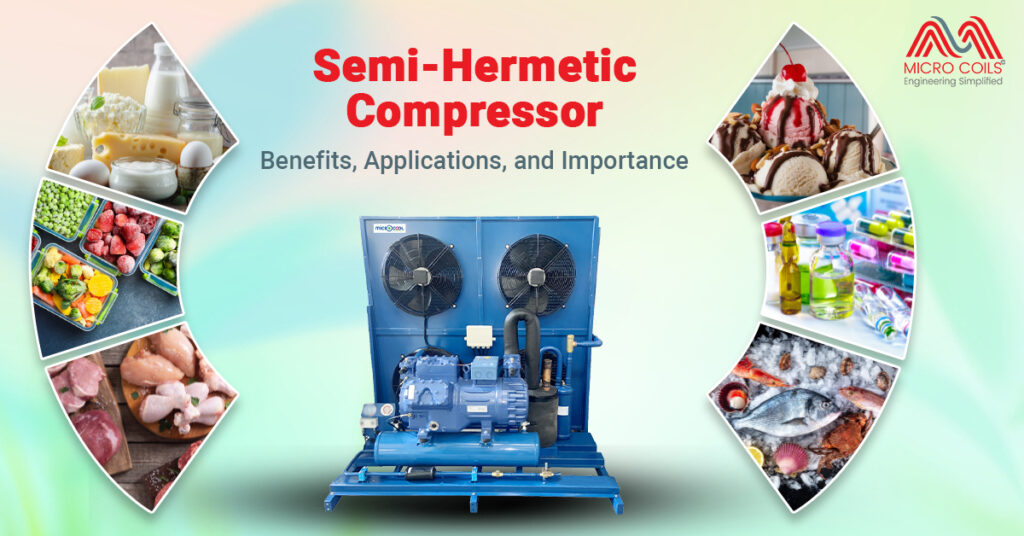
A semi-hermetic compressor is a refrigeration compressor designed with a bolted housing that allows technicians to access internal components for inspection, repair, and maintenance. Unlike fully hermetic compressors, which are sealed and generally replaced when they fail, semi-hermetic models can be opened and serviced. This makes them a practical choice for commercial refrigeration, industrial cooling, cold storage, food processing, and HVAC systems.
Their combination of serviceability, durability, efficiency, and flexible capacity options makes semi-hermetic compressors an important component in many modern refrigeration systems. They can operate across demanding temperature ranges and are available in configurations suited to different refrigerants and operating conditions.
This article explores how semi-hermetic compressors work, their major benefits, applications, maintenance requirements, and factors to consider when selecting one for a refrigeration system.
What Is a Semi-Hermetic Compressor?
A semi-hermetic compressor is a mechanical device that compresses refrigerant and circulates it through a refrigeration or air-conditioning system. Its motor and compressor mechanism are housed within a common casing. However, unlike a fully sealed hermetic compressor, the casing can be opened by removing bolts or covers.
This design provides an important advantage: technicians can access components such as valves, pistons, bearings, crankshafts, and motor assemblies when servicing is required.
Semi-hermetic compressors are commonly available as reciprocating or screw designs, although reciprocating models are widely used in commercial refrigeration applications. The compressor may have multiple cylinders, allowing it to deliver the required capacity for different cooling loads.
How Does a Semi-Hermetic Compressor Work?
The basic refrigeration cycle begins when low-pressure refrigerant vapor enters the compressor through the suction line. The compressor increases the refrigerant’s pressure and temperature before sending it to the condenser.
The high-pressure refrigerant then releases heat in the condenser and changes into a high-pressure liquid. It passes through an expansion device, where its pressure drops. The low-pressure refrigerant then enters the evaporator and absorbs heat from the surrounding space.
The resulting vapor returns to the compressor, and the cycle repeats.
A semi-hermetic compressor therefore plays a central role in maintaining continuous refrigerant circulation and supporting heat transfer throughout the system.
Key Components of a Semi-Hermetic Compressor
Understanding its major components helps explain why this compressor design is so widely used.
Compressor Housing
The housing contains the motor and compression mechanism. Since the casing is bolted rather than permanently welded shut, technicians can open it when internal inspection or repair is necessary.
Electric Motor
The motor drives the compressor mechanism. It operates inside the refrigerant environment, which also helps provide cooling under suitable operating conditions.
Pistons and Cylinders
In reciprocating semi-hermetic compressors, pistons move inside cylinders to compress refrigerant vapor. The number and arrangement of cylinders influence the compressor’s capacity and operating characteristics.
Suction and Discharge Valves
These valves control refrigerant movement into and out of the compression chamber. Their condition directly affects compressor efficiency and performance.
Crankshaft
The crankshaft converts the motor’s rotary movement into the reciprocating movement required by the pistons.
Bearings
Bearings support rotating components and reduce friction. Proper lubrication is essential to prevent premature wear.
Oil System
Compressor oil lubricates moving components and helps reduce friction and heat generation. Oil management becomes particularly important in systems operating under demanding conditions.
Benefits of Semi-Hermetic Compressors
Semi-hermetic compressors offer several advantages over other compressor designs. Their suitability depends on system requirements, but the following benefits explain their widespread use.
1. Easy Maintenance and Repair
The serviceable housing is one of the biggest advantages of a semi-hermetic compressor.
Technicians can open the compressor to inspect internal components, replace worn parts, clean components, and perform repairs. This can extend equipment life and reduce the need to replace the entire compressor after a mechanical failure.
For commercial and industrial installations, serviceability can be especially valuable because unexpected equipment replacement can result in downtime and additional costs.
2. Long Operating Life
When properly selected, installed, lubricated, and maintained, semi-hermetic compressors can provide reliable service over extended operating periods.
Their robust construction makes them suitable for applications where refrigeration equipment must operate continuously or for long periods. Regular maintenance can help identify bearing wear, valve problems, oil issues, and other conditions before they cause major failures.
3. Suitable for High-Duty Applications
Many commercial and industrial refrigeration systems operate under demanding conditions. Semi-hermetic compressors can be configured for different operating pressures, refrigerants, temperature ranges, and capacity requirements.
This makes them suitable for applications such as cold rooms, supermarkets, food processing plants, refrigerated warehouses, and industrial cooling systems.
4. Flexible Capacity Options
Semi-hermetic compressors are available in different sizes and configurations. Multi-cylinder models can provide higher refrigeration capacity, while systems can also use multiple compressors to match changing load requirements.
This flexibility allows system designers to select compressor capacity according to the application’s heat load rather than relying on a single standardized configuration.
5. Improved Serviceability Compared With Hermetic Designs
A fully hermetic compressor is sealed during manufacturing. If a major internal failure occurs, replacing the complete compressor is often the practical solution.
Semi-hermetic compressors provide greater accessibility. Internal parts can be inspected and replaced where economically and technically appropriate.
This feature can be particularly useful for larger refrigeration systems where compressor replacement is expensive and downtime can affect operations.
6. Versatility
Semi-hermetic compressors can be used in a wide range of refrigeration and cooling applications. Depending on the compressor design, they can support low-, medium-, or high-temperature applications.
They may also be designed for different refrigerants and system configurations. However, compatibility should always be verified against the manufacturer’s specifications.
7. Potentially Lower Lifecycle Costs
Initial purchase price is only one part of refrigeration equipment cost. Maintenance, repairs, energy consumption, downtime, and replacement requirements can have a significant impact on total ownership costs.
Because semi-hermetic compressors can often be repaired rather than discarded after certain failures, they may offer favorable lifecycle economics in appropriate applications.
Applications of Semi-Hermetic Compressors
Semi-hermetic compressors are used across several industries where dependable refrigeration is essential.
Commercial Refrigeration
Supermarkets, grocery stores, restaurants, convenience stores, and food retailers use refrigeration systems to maintain products at controlled temperatures.
Semi-hermetic compressors can support:
- Refrigerated display cases
- Freezers
- Walk-in coolers
- Cold rooms
- Beverage coolers
- Food storage systems
- Central refrigeration systems
Their serviceability is valuable in retail environments where refrigeration failures can result in product loss.
Cold Storage Facilities
Cold storage warehouses require continuous temperature control to preserve food, pharmaceuticals, and other temperature-sensitive products.
Semi-hermetic compressors can be integrated into refrigeration systems designed for different temperature zones. Multiple compressor configurations may also help accommodate varying cooling loads.
Food Processing
Food processing facilities often require refrigeration during processing, storage, and distribution. Meat, seafood, dairy, frozen foods, fruits, and vegetables may require controlled temperatures at different stages.
Refrigeration systems equipped with semi-hermetic compressors can provide the required cooling capacity while allowing maintenance teams to service critical components.
Industrial Refrigeration
Industrial facilities may use refrigeration for process cooling, equipment temperature control, storage, and manufacturing operations.
Semi-hermetic compressors can be selected for systems where durability and serviceability are important operational requirements.
HVAC Systems
Although many air-conditioning systems use scroll or other compressor technologies, semi-hermetic compressors remain relevant in certain commercial and industrial HVAC applications.
They can support large systems where compressor serviceability, capacity, and operating flexibility are important considerations.
Ice-Making Systems
Commercial ice machines require reliable refrigeration to remove heat from water and produce ice efficiently. Semi-hermetic compressors can be used in larger ice-making systems where continuous operation is required.
Semi-Hermetic Compressor vs Hermetic Compressor
Both compressor types have their place in refrigeration systems, but their construction and maintenance characteristics differ.
Feature | Semi-Hermetic Compressor | Hermetic Compressor |
Housing | Bolted and serviceable | Permanently sealed |
Internal access | Possible | Generally not possible |
Repairability | Higher | Limited |
Maintenance | Internal servicing possible | Usually requires replacement |
Typical use | Commercial and industrial systems | Many smaller refrigeration and HVAC systems |
Initial design complexity | Generally higher | Generally simpler |
Component replacement | Often possible | Usually limited |
The right option depends on the application’s capacity, operating conditions, maintenance strategy, installation environment, and total cost requirements.
Role of the Compressor in the Refrigeration Cycle
A refrigeration system cannot transfer heat effectively without a pressure difference between the low-pressure and high-pressure sides. The compressor creates this pressure difference by taking in low-pressure refrigerant vapor and compressing it into high-pressure vapor.
The compressor therefore supports several essential functions:
- It draws refrigerant vapor from the evaporator.
- It compresses the refrigerant.
- It increases refrigerant pressure and temperature.
- It moves refrigerant toward the condenser.
- It maintains refrigerant circulation throughout the system.
The compressor works alongside components such as condensers, expansion valves, evaporators, receivers, filters, and refrigerant piping. System performance depends on how well these components work together.
For example, an appropriately sized AC condenser coil can help reject heat efficiently, while properly selected refrigeration components help maintain the required operating conditions.
Importance of Proper Compressor Sizing
Choosing a compressor based only on its nominal horsepower can result in poor system performance. Compressor selection should consider the complete operating environment.
Important factors include:
- Required refrigeration capacity
- Evaporating temperature
- Condensing temperature
- Refrigerant type
- Suction pressure
- Discharge pressure
- Ambient temperature
- Electrical supply
- Operating hours
- Expected load variations
- Compressor efficiency
- Oil requirements
An undersized compressor may struggle to maintain the required temperature. An oversized compressor may experience inefficient cycling, higher initial costs, or operating conditions that do not suit the application.
Correct sizing therefore requires calculating the actual cooling load and matching the compressor to the system’s operating envelope.
Factors to Consider When Selecting a Semi-Hermetic Compressor
Refrigerant Compatibility
The compressor must be compatible with the refrigerant used in the system. Refrigerant properties influence pressure, temperature, lubrication, capacity, and compressor operating conditions.
Always verify compatibility using the manufacturer’s technical documentation.
Cooling Capacity
Determine the required cooling capacity under the actual design conditions rather than selecting a compressor based solely on rated horsepower.
Operating Temperature
Applications such as freezing require different operating conditions from medium-temperature food storage or air-conditioning.
The compressor should be rated for the intended evaporating and condensing temperatures.
Energy Efficiency
Energy consumption can represent a significant portion of refrigeration operating costs. Look for compressor designs and operating configurations that provide suitable efficiency at the expected load profile.
Service Requirements
Consider how frequently the equipment will operate and how easily technicians can access the compressor. A serviceable design can be particularly useful in facilities where downtime has significant operational consequences.
Electrical Requirements
Check voltage, frequency, phase, starting current, motor protection, and other electrical characteristics before selecting the compressor.
Maintenance Practices for Semi-Hermetic Compressors
Regular maintenance can help improve reliability and identify problems before they develop into major failures.
Monitor Operating Pressures
Abnormal suction or discharge pressures may indicate problems with refrigerant charge, airflow, condenser performance, expansion devices, or system load.
Check Oil Condition
Oil level and condition should be monitored according to manufacturer recommendations. Poor lubrication can increase friction and accelerate component wear.
Inspect for Refrigerant Leaks
Leaks can reduce system performance and may cause the compressor to operate under unfavorable conditions. Regular inspection of connections, valves, seals, and piping can help identify problems.
Maintain Condenser Performance
A dirty or poorly ventilated condenser can increase condensing pressure and place additional stress on the compressor.
Keeping condenser surfaces clean and ensuring adequate airflow can support efficient operation.
Check Electrical Components
Technicians should inspect terminals, wiring, contactors, overload protection, and other electrical components as part of scheduled maintenance.
Listen for Unusual Noise
Changes in operating sound can indicate mechanical wear, liquid return, bearing problems, or other system issues. Unusual vibration or noise should be investigated promptly.
Common Problems With Semi-Hermetic Compressors
Even durable compressors can experience operational problems.
High Discharge Temperature
High discharge temperature may result from excessive compression ratios, inadequate cooling, incorrect refrigerant conditions, or other system issues.
Low Suction Pressure
Low suction pressure can be associated with insufficient refrigerant flow, restricted components, low system load, or evaporator-related problems.
Excessive Vibration
Unusual vibration may indicate mechanical wear, mounting problems, imbalance, or other faults.
Oil-Related Problems
Incorrect oil levels, oil migration, poor oil return, or unsuitable lubricant can affect compressor reliability.
Motor Overheating
Electrical faults, high operating pressures, inadequate cooling, or excessive load can contribute to motor overheating.
Proper diagnosis should be performed by a qualified refrigeration technician using the manufacturer’s specifications and appropriate testing procedures.
Semi-Hermetic Compressors and Modern Cooling Systems
Today’s refrigeration systems increasingly focus on energy efficiency, reliability, refrigerant management, and precise temperature control. Semi-hermetic compressors continue to have a role in these systems because their serviceable construction combines durability with repairability.
Modern installations may use multiple compressors, capacity control, variable-speed technology, electronic controls, and monitoring systems to respond to changing refrigeration loads.
When integrated with appropriately sized refrigeration coils, condensers, expansion devices, controls, and piping, a semi-hermetic compressor can form part of an efficient and reliable refrigeration system.
Why Semi-Hermetic Compressors Remain Important?
The refrigeration industry serves applications where temperature control is not simply a matter of comfort. Food safety, pharmaceutical storage, manufacturing processes, logistics, and commercial operations can all depend on reliable cooling.
A compressor failure can therefore have consequences beyond the equipment itself. It can interrupt production, compromise stored products, increase energy consumption, and create costly downtime.
Semi-hermetic compressors address some of these challenges through their serviceable construction. Technicians can access internal components, diagnose failures, replace selected parts, and restore equipment without necessarily replacing the complete compressor.
This makes them particularly relevant for installations where long-term maintainability matters.
How to Improve Refrigeration System Performance?
The compressor is only one part of an effective refrigeration system. A well-designed system requires the correct interaction between every major component.
Businesses can improve system performance by:
- Selecting equipment based on calculated cooling loads
- Maintaining clean condenser and evaporator surfaces
- Checking refrigerant charge regularly
- Monitoring suction and discharge pressures
- Maintaining proper airflow
- Inspecting insulation and refrigerant piping
- Scheduling preventive maintenance
- Monitoring compressor operating conditions
- Replacing worn components promptly
- Using controls appropriate to the system design
These practices can help reduce unnecessary energy consumption and improve equipment reliability.
Conclusion
Semi-hermetic compressors remain an important choice for commercial, industrial, and specialized refrigeration applications because they combine robust construction with serviceability. Their accessible housing allows technicians to inspect and repair internal components, while their broad range of capacities makes them suitable for different cooling requirements.
When a semi-hermetic compressor is correctly matched with condensers, evaporators, expansion devices, controls, and other components, it can contribute to dependable and efficient cooling solutions across a wide range of applications.
A semi-hermetic compressor is a refrigeration compressor in which the motor and compressor mechanism share a bolted housing. The housing can be opened, allowing technicians to inspect, repair, or replace internal components.
The primary advantage is serviceability. Unlike a fully sealed hermetic compressor, a semi-hermetic model can be opened for internal inspection and repairs, which can help extend equipment life.
They are commonly used in commercial refrigeration, cold storage, food processing, supermarkets, industrial refrigeration, HVAC systems, and other applications requiring reliable temperature control.
Service life depends on operating conditions, installation quality, maintenance, lubrication, refrigerant conditions, electrical supply, and system loading. Regular preventive maintenance can help extend operating life.
Selection should consider cooling capacity, refrigerant, evaporating and condensing temperatures, electrical requirements, expected load, operating environment, efficiency, and manufacturer specifications.

