

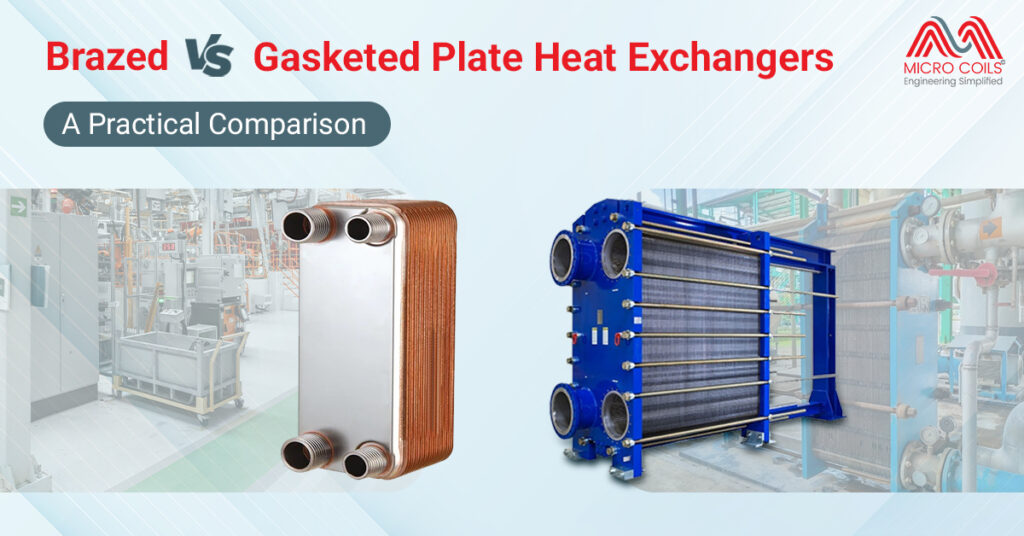
When it comes to selecting the right heat exchanger for your application, the choice between brazed and gasketed plate heat exchangers is one of the most important decisions you’ll make. It affects performance, maintenance, cost, and long-term reliability. Yet many engineers and procurement managers struggle with this choice — not because the technology is too complex, but because the differences aren’t always clearly explained.
This guide breaks it all down in plain language. By the end, you’ll know exactly which type suits your needs, what tradeoffs to expect, and what to look for when working with a supplier.
Understanding the Basics First
Both brazed and gasketed plate heat exchangers belong to the same family — the plate heat exchanger. Unlike shell and tube designs, plate heat exchangers use a series of thin, corrugated metal plates stacked together to transfer heat between two fluids. The fluids flow on either side of each plate, and heat passes through the plate material from the hotter fluid to the cooler one.
It’s an efficient, compact design that has largely replaced older technologies in many industries. But how those plates are held together — and sealed against leakage — is where brazed and gasketed designs diverge significantly.
What Is a Brazed Plate Heat Exchanger?
A brazed plate heat exchanger (BPHE) is made by stacking corrugated stainless steel plates and permanently bonding them together using a brazing material — most commonly copper or nickel — at extremely high temperatures in a vacuum furnace. There are no gaskets. No bolts holding a frame together. The entire unit is one solid, fused piece.
This makes BPHEs incredibly compact and pressure-resistant. They’re typically small enough to hold in one hand for smaller capacities, yet capable of handling surprisingly high pressures and temperatures. Because there are no gaskets to degrade or leak, they’re considered a very low-maintenance option once installed.
However, “low maintenance” comes with a caveat — brazed units are essentially non-serviceable. If something goes wrong internally, you replace the entire unit rather than repair it. That’s an important distinction we’ll return to shortly.
What Is a Gasketed Plate Heat Exchanger?
A gasketed plate heat exchanger (GPHE) uses the same corrugated plate design, but the plates are sealed with rubber or elastomeric gaskets and held together in a frame by a series of bolts and tie rods. The frame can be opened, plates can be added or removed, and gaskets can be replaced.
This modularity is the gasketed design’s greatest strength. Need more capacity? Add plates. Gasket worn out? Replace it. Fluid fouling the plates? Pull the unit apart, clean it, and reassemble. GPHEs are the workhorses of large industrial applications precisely because they can be maintained, modified, and scaled without replacing the entire unit.
The tradeoff is size and complexity. Gasketed units are significantly larger than brazed ones for equivalent capacity. They also require periodic gasket replacement, and improper reassembly can lead to leaks.
The Key Differences Between Brazed vs. Gasketed Heat Exchangers
1. Size and Compactness
Brazed plate heat exchangers win decisively here. Their permanent bond allows the plates to be pressed closer together, resulting in a much smaller footprint. For applications where space is limited — refrigeration systems, small HVAC units, residential heating — this compactness is invaluable.
Gasketed units require additional space for the frame, the bolts, and — critically — clearance on one end to pull plates out during maintenance. In large industrial facilities, this is rarely a problem. But in tight mechanical rooms or compact installations, it matters a great deal.
2. Pressure and Temperature Handling
Here’s where things get nuanced. Brazed plate heat exchangers can handle higher pressures relative to their size — often up to 30-45 bar depending on the design. Because the entire unit is one fused structure, there are no gasket failure points under pressure.
Gasketed units, on the other hand, are limited by their gasket material. Standard EPDM or NBR gaskets handle moderate temperatures well, but at very high temperatures — above 180-200°C in many cases — gasket degradation becomes a real concern. Specialized high-temperature gaskets exist but add cost.
For extreme temperature applications, brazed units with nickel brazing (rather than copper) can handle temperatures exceeding 400°C, making them suitable for demanding industrial processes.
3. Maintenance and Serviceability
This is where gasketed plate heat exchangers shine. The ability to open the unit completely changes the maintenance equation. Technicians can inspect individual plates for cracks or pitting, replace worn gaskets, clean fouled surfaces mechanically, and even swap out damaged plates individually.
Brazed units offer none of this. Once fouled or damaged, the options are limited to chemical cleaning — which doesn’t always work — or outright replacement. For applications with fluids that tend to foul or scale heavily, this is a serious limitation.
Any reputable heat exchanger manufacturer will tell you upfront: if your process fluid has high fouling potential, a gasketed unit is almost always the smarter long-term investment, even if the upfront cost is higher.
4. Fluid Compatibility
Brazed plate heat exchangers using copper brazing have a well-known limitation — they cannot be used with ammonia-based fluids or certain corrosive chemicals. Copper reacts with ammonia, compromising the integrity of the brazed joints over time. This rules out BPHEs for many refrigeration applications that use ammonia as the refrigerant.
Nickel-brazed units solve this problem to some extent, but they’re more expensive. Gasketed units, depending on plate material (stainless steel, titanium, or other alloys), offer far greater fluid compatibility. Titanium plate GPHEs, for example, handle highly corrosive seawater and aggressive chemical streams that would destroy most other designs.
5. Upfront Cost vs. Lifecycle Cost
Brazed plate heat exchangers are generally less expensive to purchase initially. Their simpler construction and smaller size translate to lower material and manufacturing costs. For low-fouling, clean fluid applications, this cost advantage holds up over time since maintenance needs are minimal.
Gasketed units cost more upfront — the frame, the plates, the gaskets, and the assembly all add to the price. But over a 15-20 year lifespan, the ability to replace only gaskets or add plates (rather than buying a whole new unit) often makes them more economical for large-scale industrial use.
When evaluating cost, always think in terms of total cost of ownership — not just the purchase price on the invoice.
6. Scalability and Flexibility
Gasketed plate heat exchangers are inherently scalable. If your process requirements change — higher flow rates, different temperature targets, expanded production capacity — you can modify the unit by adding or removing plates within the same frame. This flexibility is invaluable in industries where processes evolve frequently.
Brazed units are fixed. What you buy is what you get. If capacity requirements change significantly, you’re looking at purchasing an additional or replacement unit entirely. For stable, predictable applications this isn’t a problem. For dynamic industrial environments, it can be a significant constraint.
Which Industries Use Which?
Understanding real-world applications makes the choice clearer.
- Brazed plate heat exchangers are commonly found in residential and commercial HVAC systems, small-scale refrigeration, heat pump systems, district heating networks, domestic hot water systems, and hydraulic oil cooling in machinery. These are applications where the fluid is clean, conditions are relatively stable, and compactness is a priority.
- Gasketed plate heat exchangers dominate in large-scale industrial settings — chemical processing plants, food and beverage production, pharmaceutical manufacturing, power generation, marine applications, and heavy HVAC systems in large commercial buildings. Anywhere that large flow volumes, aggressive fluids, or frequent maintenance access is needed, the gasketed design prevails.
India’s growing industrial sector has significantly increased demand for both types. As a leading heat exchanger manufacturer in India, suppliers here serve everything from dairy processing plants in Punjab to petrochemical facilities in Gujarat — each requiring a completely different heat exchanger approach.
Common Mistakes When Choosing Between the Two
- Choosing brazed to save money in a high-fouling application. This is perhaps the most costly mistake. The initial savings evaporate quickly when the unit fouls, chemical cleaning fails, and the entire exchanger needs replacement after just a few years.
- Over-specifying a gasketed unit for a simple, clean application. Not every application needs the serviceability of a gasketed design. Using a large framed unit where a compact brazed exchanger would work perfectly fine adds unnecessary cost and complexity.
- Ignoring fluid compatibility. Specifying a copper-brazed unit for an ammonia refrigeration system is a serious engineering error. Always verify brazing material and plate material compatibility with your process fluids before ordering.
- Underestimating installation space for gasketed units. Remember that gasketed units need plate-pulling clearance during maintenance. Failing to account for this during facility design creates headaches later.
What to Look for in a Heat Exchange Manufacturer?
Whether you’re buying brazed or gasketed, the quality of manufacturing makes an enormous difference in performance and longevity. Plate geometry, brazing quality, gasket material grade, and pressure testing protocols all vary between manufacturers.
Look for suppliers who offer ASME or equivalent pressure vessel certifications, who conduct helium leak testing on brazed units, and who can provide detailed thermal and hydraulic calculations to verify the unit is properly sized for your application.
The best cooling solutions don’t just come from picking the right type of heat exchanger — they come from working with a manufacturer who understands your process deeply and engineers the unit accordingly. A supplier who simply quotes a standard catalog product without asking about your fluid properties, fouling tendency, and operating conditions is one to approach cautiously.
A Quick Decision Framework for Choosing Between Brazed vs. Gasketed Heat Exchangers
Still unsure which to choose? Run through these questions:
- Is your process fluid clean and non-fouling? — Brazed may work well.
- Does your fluid contain ammonia or aggressive chemicals? — Gasketed with appropriate plate material is safer.
- Is space severely limited? — Lean toward brazed.
- Do you need the ability to expand capacity later? — Gasketed gives you that flexibility.
- Is this a critical, continuous-operation system where downtime is very costly? — Gasketed’s serviceability is a major advantage.
- Is this a smaller, stable, low-maintenance application? — Brazed offers simplicity and cost efficiency.
Final Thoughts
Brazed and gasketed plate heat exchangers are both excellent technologies — in the right context. Neither is universally superior. The right choice depends entirely on your specific application, fluid characteristics, maintenance capabilities, and long-term operational goals.
What’s clear is that this decision deserves careful thought. Rushing into a purchase based purely on upfront cost or what’s readily available often leads to performance problems, unexpected maintenance costs, and premature replacements.
Take the time to evaluate your application thoroughly. Work with experienced engineers. Ask detailed questions. And partner with a manufacturer who treats your process requirements seriously — not just your purchase order.
The heat exchanger sitting in your facility will likely be there for a decade or more. Choosing the right one from the start is always worth the extra effort.
Looking for expert guidance on selecting the right plate heat exchanger for your application? Connect with our qualified heat exchanger specialist who can evaluate your specific process requirements and recommend the best solution.
Switching fluids in a gasketed unit is possible but risky without proper cleaning between changeovers. Residual fluid contamination can compromise the new process — especially critical in food, beverage, or pharmaceutical applications. You’d need a full mechanical strip-down, plate inspection, and thorough cleaning before switching. Some facilities maintain dedicated units for each fluid type to avoid cross-contamination entirely. Always consult your manufacturer before attempting fluid changeovers in any plate heat exchanger.
Gasket lifespan depends heavily on operating temperature, fluid type, and how often the unit is opened for maintenance. Under normal conditions, standard EPDM gaskets last anywhere between 5 to 10 years. However, frequent thermal cycling — repeated heating and cooling — accelerates gasket hardening and cracking significantly. Aggressive chemicals can degrade gaskets even faster. A good rule of thumb: inspect gaskets every time the unit is opened, and never reuse a gasket that shows any signs of flattening, cracking, or surface deterioration.
Both scenarios cause real problems. An oversized unit creates low fluid velocity across the plates, which dramatically increases fouling and scaling since there isn’t enough turbulence to keep deposits from settling. An undersized unit simply can’t transfer enough heat, forcing your system to compensate elsewhere — often overloading pumps or compressors. Proper sizing requires accurate data on flow rates, inlet and outlet temperatures, fluid viscosity, and fouling factors. This is why thermal sizing calculations matter far more than simply matching capacity numbers on a datasheet
Standard plate heat exchangers — both brazed and gasketed — are poorly suited for fluids carrying suspended solids. The narrow gap between plates gets clogged quickly, causing severe fouling and pressure drop issues. For such applications, wide-gap or free-flow plate heat exchangers are specifically designed with larger plate spacing to accommodate particulate-laden fluids. Alternatively, a scraper or spiral heat exchanger might be a better fit altogether. Always disclose the presence of solids, fibers, or slurries to your manufacturer during the selection process — it fundamentally changes the recommended design.
Yes, and it’s more important than most buyers realize. Vertical installation is generally preferred because it promotes better fluid distribution across all plates and allows air bubbles or vapor pockets to escape naturally upward without getting trapped. Horizontal installation can cause uneven flow distribution, particularly with two-phase fluids or low-viscosity liquids, leading to hot spots and reduced efficiency. Some applications require horizontal mounting due to space constraints — in those cases, the manufacturer should account for orientation during the thermal design phase to compensate for distribution challenges.

