

When an air conditioner stops cooling the way it should, most people immediately assume the refrigerant is low or the thermostat is faulty. But in many cases, the real issue lies in one of the two most important parts of the system the evaporator coil or the condenser coil. And replacing either one can feel like a major decision, especially when you’re unsure which one is more expensive and why.
In India, where ACs run for long hours through humid summers, both coils undergo significant wear. Still, the replacement cost of each coil differs for very practical reasons. Let’s break down the differences in a clear, easy way so you can understand where your money actually goes when a coil fails.
First, What Do These Two Coils Do?
Even though both coils work with refrigerants, their jobs are completely different.
Evaporator Coil – The Cooling Side
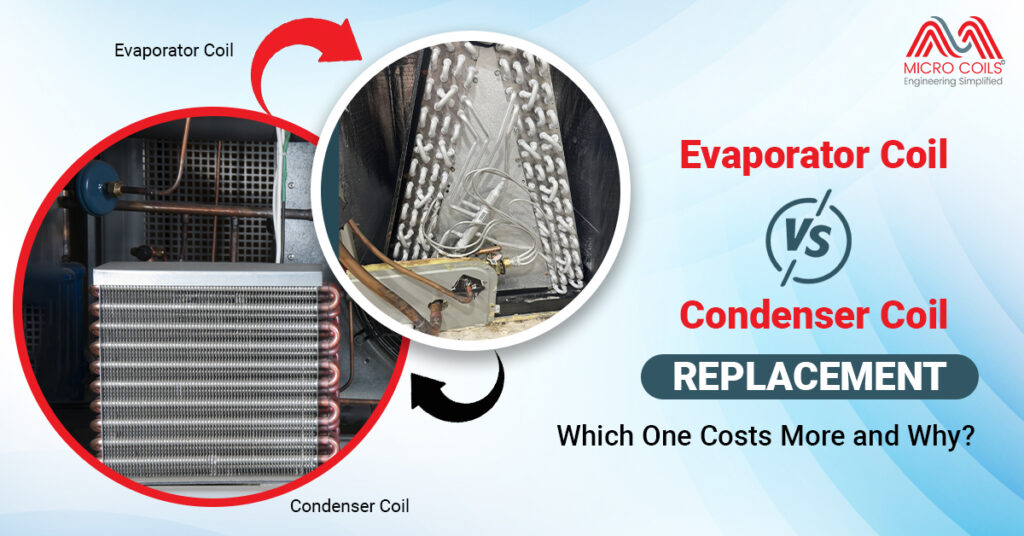
Placed inside the indoor unit, the ac evaporator coil absorbs heat from your room. It stays cold, collects moisture, and cools the air that your fan pushes over it.
Condenser Coil – The Heat Removal Side
Located in the outdoor unit, the condenser coil throws heat into the outside environment. It works under higher pressure and deals with dust, rain, sunlight, and outdoor pollution.
Both coils are part of a closed refrigerant cycle. If one struggles, the entire system loses efficiency.
So, Which One Usually Costs More to Replace?
Generally, replacing a condenser coil often ends up costing more than replacing an indoor coil. But this is not a fixed rule — it depends on several factors. Some evaporator coils, especially advanced or imported ones, can also turn out expensive depending on design and compatibility.
Still, when you look at typical situations across Indian households, condenser coil replacement tends to be the heavier expense.
Let’s understand the reasons.
Reason 1: Material and Construction Complexity
Outdoor coils face harsher conditions. Heat, humidity, rain, chemical pollutants, and constant exposure push manufacturers to use stronger materials or special designs.
Some units use microchannel coils, some use copper tubing, and others use aluminium fins. This complexity in construction often reflects in the final price because producing these coils demands precision processes often handled by a heat exchanger manufacturer.
Indoor coils, on the other hand, mostly follow simpler geometries and are shielded from external weather. That generally reduces material complexity.
Reason 2: Labour and Installation Difficulty
Replacing the indoor coil is usually straightforward. It involves opening the indoor unit, removing the panel, unsoldering the old coil, installing the new one, sealing the joints, and recharging the refrigerant.
Replacing the outdoor coil is a different story.
It may require removing the entire outdoor cover, disconnecting multiple pipes, carefully lifting components, cleaning the surrounding system, and sometimes even dismantling the outdoor unit from its mount. This takes more time, more skill, and more effort — and naturally the labour cost increases.
Also, outdoor units mounted on high-rise balconies or external walls need extra safety equipment, which adds to the final billing.
Reason 3: Pressure Levels and System Sensitivity
The condenser coil works under higher refrigerant pressure.
This means:
- More care during installation
- More precision while brazing joints
- More thorough vacuuming
- Additional leak testing
Because the coil handles high pressure, even a minor installation error can cause leakage, noise, or reduced cooling. The level of accuracy required adds to both labour effort and replacement complexity.
Indoor coils, though important, are less stressed and therefore slightly simpler to replace.
Reason 4: Design Differences Between Brands
Indian AC brands use different coil structures.
Some coils:
- Use U-bend designs
- Have denser fin configurations
- Include special protective coatings
- Are designed for high-humidity regions
These variations influence the final replacement cost. Condenser coils often have more complex engineering because they deal with heat rejection and exposure to environmental factors.
Reason 5: Location and Accessibility
Indoor units are easy to reach. Outdoor units are not.
An outdoor AC unit placed:
- On a terrace
- Outside a window
- On a narrow balcony
- Or mounted high on an exterior wall
…can make replacement more complicated .Indoor coil changes rarely involve such challenges, which is why they commonly cost a little less.
Why Do Evaporator Coils Fail More Often?
Even though the condenser coil can be expensive to replace, the indoor coil usually fails more frequently in India. The reason is simple: indoor air is loaded with dust, cooking fumes, moisture, and chemical vapours from cleaners, perfumes, paints, and adhesives.
These contaminants accumulate on the surface and create an environment that slowly degrades the evaporator coil. Sometimes, formicary corrosion or micro-leaks appear, causing gradual refrigerant loss.
And once the coil has deep internal corrosion, replacement becomes unavoidable.
Why Do Condenser Coils Fail?
Outdoor units face their own set of threats:
- Pollution in cities
- Salt air in coastal regions
- High heat during summers
- Debris blocking airflow
- Heavy rain and moisture
Metals weaken over time, fins get clogged, and corrosion begins. Over the years, these factors lead to reduced heat rejection and system strain, eventually pushing homeowners toward coil replacement.
Replacement Decision: Repair or Replace?
Before choosing replacement, many people ask a common question:
Can a coil be repaired instead of replaced?
Minor leaks in indoor coils can sometimes be repaired temporarily, but these fixes rarely last. Once corrosion begins, new leaks appear elsewhere.
Outdoor coil leaks can be more challenging because of difficult access and thicker tubing. Repairs are possible but not always practical.
This is why technicians usually recommend replacement when the coil structure has weakened or when leak points are too many.
At this stage, homeowners start searching for the cost to change ac coil, and that’s when the difference between evaporator and condenser coil pricing becomes clear.
Practical Tips Before Replacing a Coil
1. Match the Coil to the System
Never install a mismatched coil. It reduces efficiency and shortens system life.
2. Ensure Proper Refrigerant Procedures
Vacuuming, pressure testing, and correct charging are essential.
3. Check Warranty
Some brands cover coil failures separately. Always confirm before paying.
4. Inspect the Entire System
A failing coil may indicate other issues like airflow obstruction, poor maintenance, or compressor stress.
5. Ask About Coil Coatings
Anti-corrosion coatings can help in coastal or polluted areas.
Which Coil Should You Replace First If Both Are Weak?
If the indoor and outdoor coils are both in poor condition, prioritize the evaporator coil.
Why?
Because your AC depends on heat absorption to cool the room. A weak indoor coil immediately affects comfort, efficiency, and humidity control.
However, if the outdoor coil is severely damaged, clogged, or corroded, then replacing it becomes equally important to protect the compressor. In many older AC units, replacing both coils together ensures better long-term performance.
Final Thoughts: Choosing Smart and Saving More
Both coils play crucial roles. Both can fail. And both require careful attention.
But understanding why one coil may cost more than the other helps you make informed decisions — especially in India, where operating conditions are tough and AC usage is heavy. Indoor coils fail more often, but outdoor coils usually cost more to replace.
The difference comes from complexity, labour effort, outdoor exposure, and system sensitivity. If your AC technician suggests coil replacement, don’t decide instantly. Ask the right questions, confirm the diagnosis, and choose high-quality parts from trusted suppliers.
A well-installed coil, whether indoor or outdoor, can restore cooling performance, reduce electricity use, and help your AC run smoothly for years.
Yes, in many cases. Older coils are not always compatible with modern refrigerants because of differences in pressure levels and lubrication requirements. Using an incompatible coil can reduce cooling efficiency or damage the compressor.
It can, depending on age and compatibility. A new coil paired with an old one may create imbalance in heat exchange, airflow, or system pressure. While it usually works, the AC might not achieve peak efficiency unless both coils are designed to match each other.
Absolutely. When airflow drops due to clogged filters, blocked ducts, or dirty blowers, the coils operate under abnormal temperature conditions. This stress accelerates wear, increases moisture buildup, and makes coil failure more likely.
Yes, especially in coastal or industrial areas. Protective coatings help resist salt, acidic pollutants, and chemical vapours. They don’t make the coil indestructible, but they significantly slow down corrosion and improve long-term reliability.
With regular maintenance, balanced airflow, and clean indoor air, most coils can last several years without major issues. Their actual lifespan depends on usage conditions, environmental exposure, and the quality of materials used in manufacturing.

