

Refrigeration has changed in big ways over the last few decades. Systems that once depended on large, heavy coil structures now use compact, efficient designs. One of the most important developments in this space is microchannel coil technology. These coils may look small, but their performance is powerful. They help systems cool faster, use less refrigerant, and save energy. This shift has encouraged many manufacturers to replace traditional refrigeration coils with microchannel designs.
Every technology brings advantages and challenges. Microchannel coils are no different. They deliver strong efficiency but also have limitations that users must understand. Knowing where this coil type works best helps engineers, facility managers, and business owners make the right decision.
Let’s explore the working principle, benefits, limitations, and practical applications of microchannel coil technology.
What Are Microchannel Coils?
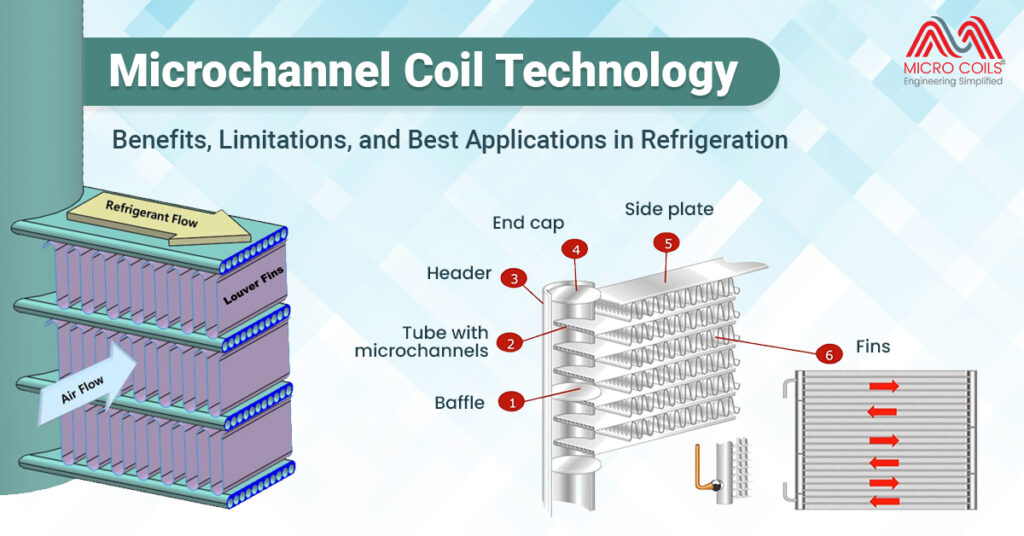
A microchannel coil is a heat exchanger used in refrigeration and HVAC systems. Unlike a traditional evaporator coil, which uses round copper tubes, a microchannel coil uses flat aluminum tubes that contain several tiny channels inside. Refrigerant moves through these channels. As air passes over aluminum fins attached to the tubes, heat is transferred.
The secret to the technology is simple:
smaller channels → increased contact area → faster and more efficient heat exchange.
Because the refrigerant spreads thinly inside the microchannels, it touches more metal surface, improving heat transfer. The result is a more efficient cooling process in a smaller design.
Microchannel coils typically provide:
- Higher heat transfer performance
- A reduction in refrigerant volume
- A compact and lightweight structure
How Microchannel Coils Work?
The principle is the same as any coil-based heat exchanger: moving heat between refrigerant and air. What changes is the geometry and the material.
Microchannel coils use:
- Flat aluminum tubes
- Multiple internal microchannels
- Bonded aluminum fins
- Manifolds for refrigerant distribution
Refrigerant enters the manifold, splits into many tiny streams, and flows through the channels. Air passes across the fins, pulling heat away from the refrigerant.
Because the refrigerant film inside the channels is thin, heat transfers quickly. This leads to:
- Faster cooling
- Lower thermal resistance
- More efficient system performance
By design, microchannel coils deliver strong results even in small spaces.
Benefits of Microchannel Coil Technology
Microchannel coils offer many advantages that make them popular in modern cooling systems.
1. Strong Heat Transfer Efficiency
Efficiency is the biggest advantage. Microchannels create a larger surface area for the refrigerant to touch. More surface contact means faster heat exchange.
This improves:
- Cooling capacity
- Temperature pull-down speed
- Overall system performance
Systems that work in limited space—like small chillers or compact display coolers—benefit greatly from this efficiency.
2. Lower Refrigerant Requirement
Microchannel coils often need 30–40% less refrigerant compared to traditional coils. The smaller internal volume reduces how much refrigerant the system must hold.
This brings several advantages:
- Lower operating cost
- Faster servicing
- Better compliance with environmental regulations
As refrigerant prices increase and global rules become stricter, this benefit is becoming more important.
3. Lightweight, Compact Construction
Because microchannel coils use flat tubes and aluminum fins, they weigh less than older coil designs. Lightweight components make transportation easier and reduce structural load on equipment.
Compactness also frees up internal space inside the system.
4. Improved Corrosion Resistance
Since the entire coil is made of aluminum, galvanic corrosion between copper and aluminum is eliminated. When protective coatings are added, the coil resists environmental damage in coastal, industrial, and humid conditions.
This helps extend equipment life and reduce maintenance costs.
5. Lower Airside Pressure Drop
The airflow path in microchannel coils is smooth and optimized. Air passes through with less resistance, which reduces:
- Fan energy consumption
- Noise levels
- Overall system strain
Even small reductions in fan power can lead to meaningful energy savings over time.
6. Long Operating Life (With Proper Care)
Microchannel coils are structurally strong. Their solid aluminum construction helps them withstand vibration and thermal cycles. With regular cleaning and proper system filtration, they offer a long service life.
Limitations of Microchannel Coils
Although microchannel coils offer many benefits, they also come with certain drawbacks.
1. Difficult to Repair
The microchannels are extremely small. If a leak occurs, repairing the exact point is difficult. In many cases, technicians must replace the entire coil instead of patching it.
This may increase maintenance cost in some applications.
2. Sensitive to Contamination
Because the internal channels are narrow, small particles or moisture can block the flow. This means:
- Strong filtration is necessary
- Assembly must be clean
- Regular maintenance becomes important
Any blockage can affect performance and cooling capacity.
3. Risk of Fin Damage
Aluminum fins are light but delicate. Improper handling during installation or cleaning can bend them, reducing airflow and heat transfer.
Technicians must follow the correct methods when maintaining these coils.
4. Limited Refrigerant Compatibility in Some Systems
Although microchannel coils work well with many modern refrigerants, not every refrigerant suits this design. Pressure constraints, material compatibility, and application temperature range must be considered before selecting this coil type.
Best Applications of Microchannel Coils in Refrigeration
Microchannel coils perform best in applications where efficiency, weight reduction, and lower refrigerant usage are important.
1. Commercial Refrigeration Systems
Supermarket coolers, refrigerated display cases, and cold rooms benefit from the efficiency and compactness of microchannel coils. Businesses save energy, improve cooling speed, and reduce refrigerant costs.
2. Air Conditioning Systems
From residential units to industrial HVAC systems, microchannel coils are now widely used. Their lightweight structure and high thermal performance make them suitable for AC condenser coils and AC cooling coil applications.
This shift helps manufacturers improve system ratings and meet energy standards.
3. Automotive Cooling
Vehicles need compact cooling systems that withstand vibration. Microchannel coils are ideal because they offer high performance in tight spaces and resist mechanical stress.
They are now common in car air-conditioning and engine cooling modules.
4. Industrial Process Cooling
Industries like pharmaceuticals, food processing, and electronics manufacturing use microchannel coils for stable temperature control. Their efficiency helps keep processes consistent and energy consumption low.
5. Refrigerated Transport
Refrigerated trucks, vans, and containers depend on lightweight and reliable coils. Microchannel coils help reduce vehicle weight and maintain temperature during long transport cycles.
6. Energy-Efficient Building Systems
Green building projects focus on lowering energy usage. Microchannel coils support these goals by reducing refrigerant volume, improving heat transfer, and cutting overall power consumption.
They are often preferred in systems designed for sustainability certifications.
Future Direction of Microchannel Coil Technology
As refrigerant rules tighten and the industry pushes for higher energy efficiency, microchannel coils will continue to grow in popularity. We can expect innovations such as:
- More durable protective coatings
- Smarter airflow designs
- Stronger leak-resistant joints
- Better compatibility with low-GWP refrigerants
Manufacturers are also improving fin shapes, tube thickness, and anti-corrosion materials to extend coil life even further.
In the coming years, these advances will make microchannel coils more adaptable and reliable across different cooling environments.
Conclusion
Microchannel coil technology is shaping the future of cooling and HVAC systems. It offers strong efficiency, reduced refrigerant use, and lightweight construction. These advantages give it a clear edge over traditional coil designs in many applications.
At the same time, microchannel coils demand proper filtration, careful handling, and clean system environments. They also pose challenges when repairs are needed.
Still, when used in the right applications, microchannel coils deliver long-term value, stable performance, and significant cost savings. As refrigeration technology continues to evolve, microchannel coils will play a central role in creating efficient, environmentally friendly cooling systems.
Yes. Microchannel coils work well in variable-speed systems because their uniform aluminum structure responds quickly to changing refrigerant flow. This rapid thermal response helps compressors modulate more efficiently, reduces cycling losses, and maintains tighter temperature control during fluctuating cooling loads in both commercial and industrial environments.
They do. Microchannel coils should be cleaned with low-pressure water and non-acidic cleaners to avoid damaging their thin fins. High-pressure washing can deform the coil surface. A soft-bristle brush or foam-based cleaner is often recommended to remove debris without restricting airflow or harming surface coatings.
Microchannel coils handle cold climates effectively, but they may need defrost strategies tailored to aluminum structures. Their compact geometry sheds frost quickly, yet consistent monitoring ensures frost doesn’t accumulate in low-airflow conditions. Proper defrost cycles and coil placement help maintain stable performance in sub-zero environments.
Yes. Their efficient heat exchange allows compressors to reach target temperatures faster, minimizing runtime. Lower operating pressures also contribute to reduced mechanical strain. Over time, this lighter workload can support longer compressor life and help refrigeration systems maintain performance under heavy or continuous cooling demands.
They are. Microchannel coils can integrate with heat recovery designs because their flat-tube construction supports rapid heat absorption and rejection. This makes them effective in systems that reclaim waste heat for preheating water or air, improving overall energy utilization and lowering operational costs in mixed-use environments.

