

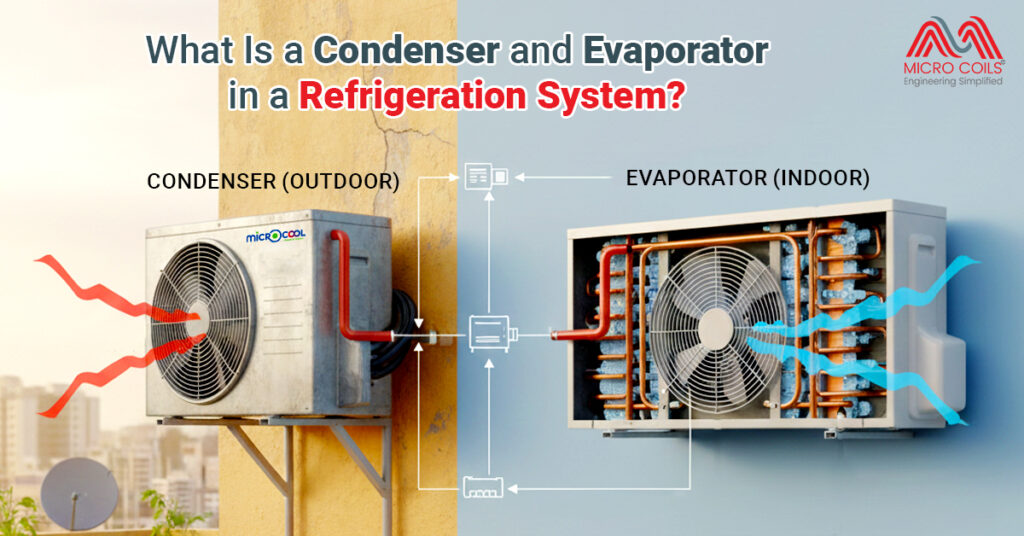
Refrigeration systems support modern life by preserving food, medicines, and temperature-sensitive products. They operate continuously in homes, supermarkets, factories, and hospitals without drawing much attention. At the core of these systems are components that manage heat movement rather than creating cold directly. Among them, the condenser and evaporator play the most critical roles.
To understand refrigeration, it helps to think of cooling as heat removal. Heat is taken from one place and released into another using a circulating refrigerant. This refrigerant changes pressure and physical state as it moves through the system. The condenser and evaporator are the stages where this heat transfer actually takes place.
Many people confuse the functions of these two components because both involve coils and refrigerant flow. However, they serve opposite purposes in the refrigeration cycle. One removes heat from the cooled space, while the other releases that heat outside. Knowing how they work makes it easier to understand system efficiency and performance.
A refrigeration system depends on balance. If either the condenser or evaporator does not work correctly, cooling becomes inefficient. Energy consumption increases and equipment stress rises. That is why these components are considered the backbone of refrigeration technology.
Basics of the Refrigeration Cycle
The refrigeration cycle follows a closed loop that repeats continuously. It includes compression, condensation, expansion, and evaporation of a refrigerant. Each step prepares the refrigerant for the next stage. Together, they enable consistent and controlled cooling.
The refrigerant enters the evaporator at low pressure and low temperature. It absorbs heat from the surrounding space and evaporates into a gas. This heat absorption is what creates the cooling effect. The refrigerant then moves toward the compressor.
Inside the compressor, the refrigerant gas is pressurized. This increases both its temperature and pressure significantly. The hot, high pressure gas then flows into the condenser. At this stage, the refrigerant is ready to release heat.
After releasing heat in the condenser, the refrigerant turns into a liquid. It then passes through an expansion device, where pressure drops suddenly. This prepares the refrigerant to absorb heat again in the evaporator. The cycle continues as long as cooling is needed.
What Is a Condenser in a Refrigeration System?
The condenser is responsible for rejecting heat absorbed from the cooled space. It receives high temperature refrigerant vapor from the compressor. The condenser allows this heat to escape into the surrounding environment. As heat is released, the refrigerant changes from vapor to liquid.
In simple terms, the condenser in the refrigeration system acts as a heat disposal unit. It ensures that unwanted heat does not remain trapped inside the system. Without proper heat rejection, the refrigerant cannot condense fully. This directly affects cooling efficiency.
Condensers are typically located outside the area being cooled. This placement allows heat to be released into open air or water sources. In domestic refrigerators, the condenser is often visible at the back. In air conditioners, it is usually placed outdoors.
Efficient condenser operation depends on proper airflow or water flow. Dust, debris, or scaling can reduce heat transfer. When this happens, system pressure rises and energy use increases. Regular maintenance helps keep the condenser functioning properly.
Types of Condensers Used in Refrigeration
Condensers come in different types based on how they release heat. The most common varieties are air cooled, water cooled, and evaporative condensers. Each type suits specific environments and system sizes. Choosing the right one improves performance and reduces operating costs.
- Air cooled condensers use fans to move air across condenser coils. Heat is transferred from the refrigerant to the air and released outside. These systems are simple and widely used. They are common in residential and small commercial applications.
- Water cooled condensers rely on water to absorb heat from the refrigerant. The heated water is then cooled through cooling towers or external systems. These condensers are efficient for large installations. However, they require more infrastructure and water management.
- An evaporative condenser is used when both air and water cooling benefits are needed together. Water sprayed over the coils evaporates and removes heat effectively. This reduces energy consumption compared to air cooled systems. Such condensers are often used in industrial refrigeration plants.
Construction and Working of Condenser Coils
The condenser is built using tubes and fins that maximize surface area. Refrigerant flows through the tubes while air or water removes heat from the outside. This design ensures efficient heat transfer. Materials like copper and aluminum are commonly used.
The refrigeration condenser coil is where heat exchange primarily occurs. Hot refrigerant vapor enters the coil and gradually cools down. As heat leaves the refrigerant, it condenses into liquid form. This phase change is essential for completing the refrigeration cycle.
Coils may be straight, serpentine, or finned depending on design needs. Fins increase surface area and improve airflow contact. Proper coil spacing prevents airflow restriction. Clean coils maintain consistent system performance.
If condenser coils become dirty, heat transfer efficiency drops. This forces the compressor to work harder. Over time, this leads to higher energy bills and equipment wear. Routine cleaning helps prevent these issues.
What Is an Evaporator in a Refrigeration System?
The evaporator is the component where actual cooling takes place. It absorbs heat from the space or product being cooled. The refrigerant enters the evaporator at low pressure and low temperature. As it absorbs heat, it evaporates into a gas.
The evaporator in the refrigeration system acts as a heat absorber. It pulls warmth out of air, water, or stored products. This process lowers the temperature of the surrounding environment. The absorbed heat is later rejected by the condenser.
Evaporators are placed inside the cooled space. In refrigerators, they are inside the cabinet walls. In air conditioners, they are located indoors. Their placement ensures direct heat absorption from the desired area.
Efficient evaporator performance depends on airflow and proper refrigerant distribution. Ice buildup or dirt can reduce heat transfer. When heat absorption drops, cooling becomes uneven. Regular defrosting and maintenance help avoid these problems.
Design and Types of Evaporators
Evaporators are designed to match the cooling load of the system. They come in different shapes such as plate, finned tube, and shell and tube designs. Each type suits specific applications. Proper sizing ensures stable temperature control.
- Finned tube evaporators are common in air cooling applications. The fins increase surface area for better heat absorption. Fans help circulate air across the coils. This design is widely used in refrigerators and air conditioners.
- Plate evaporators are often used in compact systems. They provide uniform cooling across flat surfaces. These are commonly found in freezers and cold storage units. Their simple design allows efficient heat transfer.
- Shell and tube evaporators are used in industrial refrigeration. They handle large volumes of refrigerant and cooling medium. These evaporators offer durability and efficiency. They are suitable for process cooling and large scale applications.
Heat Transfer Role of Condenser and Evaporator
The condenser and evaporator work together to move heat through the system. The evaporator absorbs heat from the cooled space. The condenser releases that heat into the environment. This continuous transfer keeps temperatures stable.
Heat transfer depends on temperature difference. The evaporator works at lower temperatures than the cooled space. The condenser operates at higher temperatures than the surrounding air or water. This temperature gradient drives heat movement.
If either component fails to maintain proper heat transfer, system performance drops. Cooling becomes slow and inconsistent. Energy consumption rises as the compressor works harder. Balanced operation ensures efficiency and reliability.
Both components rely on clean surfaces and proper airflow. Obstructions reduce heat exchange. This affects system pressure and refrigerant flow. Preventive maintenance keeps heat transfer efficient.
Key Difference Between Condenser and Evaporator
- The difference between condenser and evaporator lies mainly in how they handle heat within the refrigeration cycle.
- The condenser releases heat from the refrigerant to the surroundings, while the evaporator absorbs heat from the space being cooled.
- The condenser works with high pressure refrigerant, whereas the evaporator functions under low pressure conditions.
- Together, they maintain balance by removing heat from one area and releasing it into another.
Common Problems and Maintenance Considerations
Condensers often face issues related to airflow blockage. Dust and debris reduce heat rejection efficiency. This causes higher operating pressures. Regular cleaning helps prevent such problems.
Evaporators commonly suffer from ice buildup. This restricts airflow and heat absorption. Poor defrost cycles worsen the issue. Proper temperature control helps avoid freezing.
Refrigerant leaks affect both components. Low refrigerant levels reduce cooling capacity. This forces longer operating cycles. Leak detection and repair are essential.
Maintenance ensures longer system life. Clean coils, proper airflow, and correct refrigerant charge matter. Neglect leads to higher costs. Preventive care improves reliability.
Importance of Condenser and Evaporator in System Efficiency
System efficiency depends heavily on these two components. The evaporator determines how effectively heat is absorbed. The condenser determines how efficiently heat is rejected. Both influence energy consumption.
Poor condenser performance raises system pressure. This increases compressor workload. Energy usage rises as a result. Efficient heat rejection reduces operating costs.
A poorly performing evaporator leads to uneven cooling. Products may not reach desired temperatures. This affects storage quality. Proper evaporator design ensures consistent cooling.
Together, they define system performance. Balanced operation improves reliability. Energy efficiency improves overall sustainability. This makes them critical in refrigeration design.
Conclusion
The condenser and evaporator are the foundation of every refrigeration system. They manage heat movement through controlled absorption and release. Without them, cooling would not be possible. Their roles are distinct yet deeply interconnected.
Understanding how these components work helps improve system usage. It also highlights the importance of proper maintenance. Efficient heat transfer saves energy and extends equipment life. This knowledge is valuable for both users and professionals.
Whether in homes or industries, refrigeration relies on these components daily. Their design and performance affect comfort and safety. Reliable cooling depends on their efficiency. That is why they remain central to refrigeration technology.
By appreciating the function of the condenser and evaporator, we better understand cooling itself. Heat movement becomes clearer and more logical. This insight helps in better system care. Ultimately, it leads to smarter and more efficient refrigeration use.
Both components are essential because refrigeration works by moving heat, not creating cold. The evaporator absorbs heat from the cooled space, while the condenser releases that heat outside. If either component fails, the heat transfer process breaks, and effective cooling cannot occur.
No, an inefficient condenser prevents proper heat rejection. This causes high system pressure, increased compressor load, and poor cooling performance. Over time, it can lead to higher energy consumption, frequent breakdowns, and reduced equipment lifespan, making efficient condenser operation critical.
Frequent evaporator freezing restricts airflow and reduces heat absorption. This leads to uneven cooling and longer running cycles. Causes may include low refrigerant levels, poor airflow, or incorrect temperature settings. Regular defrosting and maintenance help prevent repeated freezing issues.
Airflow plays a major role in heat transfer. In the evaporator, good airflow helps absorb heat efficiently. In the condenser, proper airflow helps release heat effectively. Blocked or weak airflow reduces efficiency, increases energy use, and puts additional strain on the compressor.
Coil cleaning frequency depends on usage and environment. In dusty or industrial settings, cleaning may be needed every few months. For residential systems, annual cleaning is often sufficient. Clean coils improve heat transfer, reduce energy consumption, and help maintain consistent cooling performance..

