

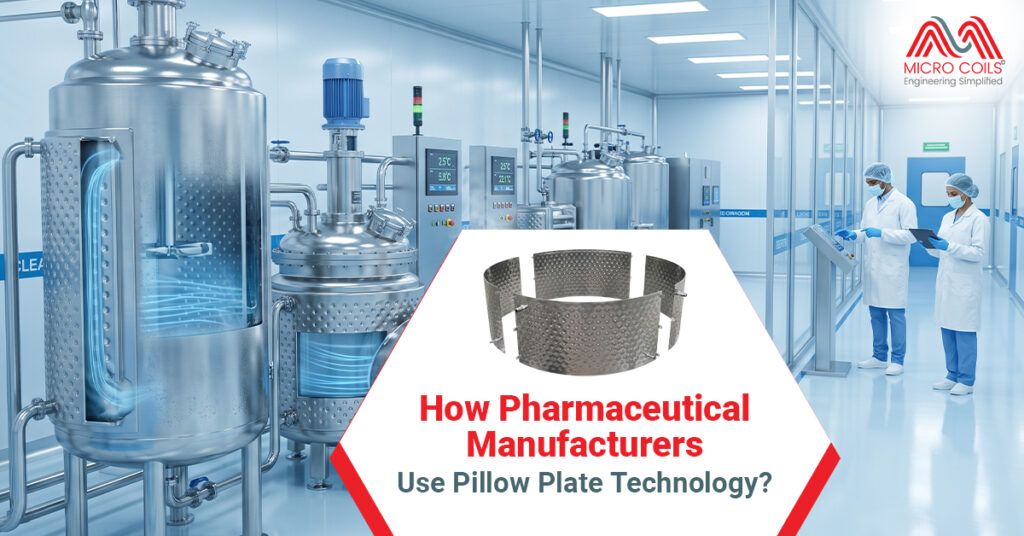
Temperature control sits at the heart of nearly every pharmaceutical process, from fermentation to final formulation. Even small fluctuations in heating or cooling can affect product quality, batch consistency, and regulatory compliance. This is why pharmaceutical manufacturers continue searching for heat transfer solutions that are efficient, hygienic, and easy to maintain. Pillow plate technology has emerged as one of the most reliable answers to this ongoing challenge.
What is a Pillow Plate?
A pillow plate is a type of heat exchanger made by welding two metal sheets together and inflating the space between them under high pressure. This process creates a series of raised channels that resemble an inflated pillow, giving the technology its name. The resulting surface allows fluid to flow evenly across the plate, transferring heat with minimal dead zones. In pharmaceutical settings, this design offers a combination of hygiene, durability, and thermal performance that traditional exchangers often struggle to match.
How Pillow Plate Technology Works?
The manufacturing process behind pillow plates begins with two flat metal sheets, usually stainless steel, welded together at specific spot points in a grid pattern. High pressure fluid or air is then injected between the sheets, causing the metal to expand outward at the unwelded sections. This inflation creates a network of raised channels through which heating or cooling fluid can circulate. The finished plate can be flat, coiled around a tank, or shaped to fit curved vessel surfaces.
Once installed, the pillow plate functions as a jacket around a tank, reactor, or vessel, allowing indirect heat transfer without direct contact between the process fluid and the heating or cooling medium. This separation protects the integrity of sensitive pharmaceutical formulations during processing. The channel design promotes turbulent flow, which improves heat transfer efficiency compared to smooth jacketed surfaces. Because the plates can be custom fabricated to match a vessel’s exact shape, they provide full surface coverage that flat panel jackets often cannot achieve.
Why Pharmaceutical Manufacturers Choose Pillow Plates?
Pharmaceutical production demands equipment that meets strict hygiene standards while still delivering consistent thermal performance. Pillow plates are typically constructed from high grade stainless steel, which resists corrosion and withstands repeated cleaning cycles required in regulated environments. Their smooth, crevice free surfaces reduce the risk of bacterial growth or product buildup, a critical factor when handling sterile formulations. This combination of durability and cleanliness makes pillow plates a natural fit for facilities operating under strict quality guidelines.
Beyond hygiene, manufacturers value the space and weight savings that pillow plates offer compared to traditional coil or dimple jackets. Because the plates can be welded directly onto a vessel’s exterior, they eliminate the need for bulky external piping systems. This compact footprint is especially useful in facilities where floor space and vessel real estate are limited. Faster heating and cooling cycles achieved through improved fluid turbulence also help manufacturers reduce batch processing times, which can translate into meaningful gains in overall production output.
Applications of Pillow Plates in Pharmaceutical Processing
- Reactor Vessel Cooling and Heating
Maintain precise temperatures during pharmaceutical reactions to ensure product quality and process consistency. - Mixing Tank Temperature Control
Provide uniform heating or cooling for blending active pharmaceutical ingredients (APIs) and excipients. - Fermentation Process Control
Regulate temperatures in biopharmaceutical fermentation tanks to support optimal microbial growth and product yield. - Crystallization Systems
Ensure accurate temperature control during crystallization to achieve the desired crystal size and purity. - Solvent Recovery Units
Improve heat transfer efficiency during solvent evaporation and condensation, reducing energy consumption. - Storage Tank Temperature Maintenance
Keep sensitive pharmaceutical liquids and chemicals at stable temperatures during storage. - Vacuum Drying Equipment
Deliver controlled heating for drying pharmaceutical powders and granules without compromising product integrity. - Distillation Processes
Support efficient heating and cooling in pharmaceutical distillation systems for high-purity separation. - Clean-in-Place (CIP) Systems
Maintain the required temperatures for cleaning solutions, ensuring effective equipment sanitization. - Water for Injection (WFI) Systems
Assist in maintaining precise temperatures during the production and storage of pharmaceutical-grade water. - API Manufacturing
Provide reliable thermal management throughout active pharmaceutical ingredient production for consistent processing conditions. - Batch Processing Equipment
Ensure accurate temperature regulation across different production batches, improving repeatability and product quality.
Pillow Plates Compared to Traditional Heat Exchangers
Feature | Pillow Plates | Traditional Heat Exchangers |
Heat Transfer Efficiency | High heat transfer due to turbulent flow and dimpled design | Moderate to high, depending on the exchanger type |
Space Requirements | Compact, space-saving design | Typically requires more installation space |
Customisation | Easily fabricated to fit tanks, vessels, and reactors | Limited to standard configurations in many applications |
Cleaning and Maintenance | Smooth surface allows easier cleaning and reduced maintenance | May require more frequent cleaning due to complex internal passages |
Pressure Handling | Suitable for high-pressure and high-temperature applications | Varies by design and model |
Corrosion Resistance | Available in stainless steel and specialty alloys for corrosive environments | Depends on material selection; may require additional protective coatings |
Energy Efficiency | Optimised heat transfer helps reduce energy consumption | Can be less energy efficient in certain industrial processes |
Installation | Simple integration into tanks, vessels, and process equipment | Installation can be more complex, especially for large systems |
Application Flexibility | Suitable for heating, cooling, evaporation, condensation, and reactor temperature control | Best suited for specific heat exchange applications based on design |
Operating Costs | Lower long-term operating and maintenance costs due to efficient performance | May have higher maintenance and operating costs over time |
Scalability | Easy to customise for new or expanding process requirements | Expansion often requires additional equipment or system modifications |
Common Industries | Pharmaceutical, food processing, chemical, dairy, beverage, and HVAC | Power generation, petrochemical, manufacturing, refrigeration, and HVAC |
Hygienic Design and Regulatory Compliance
Pharmaceutical manufacturing operates under strict guidelines set by regulatory bodies, and equipment design plays a direct role in meeting these standards. Pillow plates support compliance by offering smooth, polished surfaces that are easy to clean and inspect during routine audits. Welds are carefully finished to avoid crevices where residue or bacteria could accumulate over repeated use. This attention to surface quality helps facilities pass good manufacturing practice inspections without needing frequent equipment modifications.
Material certifications also matter greatly in this industry, and reputable suppliers provide full documentation for the stainless steel grades used in their pillow plates. Traceability records allow manufacturers to confirm that every component meets pharmaceutical grade requirements before installation. Surface finish specifications, often measured in microinches of roughness, are tailored to match the sensitivity of the product being processed. These layers of documentation and quality control give pharmaceutical companies confidence that their heat transfer equipment will not compromise product safety or regulatory standing.
The Role of Dry Coolers in Pharma Cooling Systems
Pillow plates rarely operate in isolation, since they depend on a broader cooling infrastructure to supply chilled fluid throughout a facility. A dry cooler is often paired with pillow plate systems to reject heat from the cooling loop without relying on water intensive evaporative methods. This equipment circulates a coolant, typically a glycol mixture, through a series of finned coils where ambient air removes the absorbed heat. Using a dry cooler alongside pillow plates allows facilities to maintain stable process temperatures while reducing overall water consumption.
This pairing proves especially valuable in regions facing water scarcity or strict environmental regulations on water discharge, since dry cooling systems operate as closed loops. Pharmaceutical facilities benefit from the reduced maintenance burden as well, since dry coolers avoid the scaling and biological growth issues associated with open cooling towers. Energy efficiency also improves when dry coolers are properly sized to match the thermal load generated by pillow plate jacketed vessels. Together, these two technologies create a cooling system that supports both operational reliability and sustainability goals within pharmaceutical production facilities.
Choosing the Right Pillow Plate Manufacturer
Selecting a supplier for pharmaceutical-grade pillow plates requires careful evaluation beyond simple price comparisons. Experienced pillow plate manufacturers understand the specific hygiene, material, and documentation requirements that pharmaceutical clients demand. They should be able to provide detailed fabrication drawings, pressure testing certificates, and material traceability records for every plate produced. Facilities should also confirm that a potential supplier has prior experience working with pharmaceutical or food grade clients, since general industrial fabricators may lack familiarity with these stricter standards.
Communication and customization capabilities also matter when evaluating suppliers. A good manufacturer works closely with engineering teams to design plates that match specific vessel geometries, whether cylindrical, conical, or irregularly shaped. Turnaround time and after sales support become especially important for facilities planning expansions or equipment replacements on tight schedules. Reviewing case studies or references from other pharmaceutical clients can help confirm that a manufacturer consistently delivers equipment that meets both performance and compliance expectations.
Growth of Pillow Plate Manufacturers in India
India has become an increasingly important hub for pharmaceutical equipment fabrication, supplying both domestic manufacturers and export markets worldwide. Rising demand from the country’s large generic drug and biologics sectors has encouraged local fabricators to invest in advanced pillow plate production capabilities. Several pillow plate manufacturers in India now offer pharmaceutical-grade plates that meet international quality standards while remaining competitively priced compared to equipment sourced from Europe or North America. This growth has made India an attractive sourcing option for companies looking to balance cost efficiency with regulatory compliance.
Government initiatives supporting domestic pharmaceutical manufacturing have further accelerated this trend, encouraging investment in specialized fabrication facilities across the country. Indian suppliers have also improved their export documentation and certification processes, making it easier for international pharmaceutical companies to source equipment confidently. Proximity to major pharmaceutical manufacturing clusters within India provides additional logistical advantages for domestic buyers. As quality standards continue rising across the industry, India’s role in the global pillow plate supply chain is expected to expand further in the coming years.
Material Selection for Pharma Grade Pillow Plates
Choosing the correct material is one of the most important decisions in specifying a pillow plate for pharmaceutical use. Stainless steel grades such as 316L are commonly selected for their superior corrosion resistance, particularly when handling aggressive cleaning agents or acidic process fluids. The low carbon content in this grade reduces the risk of sensitization during welding, which helps maintain the material’s corrosion resistant properties over time. Facilities processing highly corrosive substances may require even more specialized alloys to ensure long term equipment reliability.
Surface finishing also plays a significant role in material selection, since polished surfaces reduce the likelihood of product adhesion or microbial harborage points. Electropolishing is a common final step that removes microscopic surface irregularities left behind by mechanical polishing alone. Manufacturers must balance these finishing requirements against cost, since higher polish grades typically increase fabrication expenses. Working with suppliers who understand these tradeoffs helps pharmaceutical facilities select materials that satisfy both budget constraints and regulatory expectations.
Tips for Selecting a Pillow Plate System
Facilities evaluating pillow plate technology for pharmaceutical applications should consider several practical factors before finalizing a purchase.
- Confirm the plate’s pressure rating matches the vessel’s operating and testing requirements.
- Request material certificates and surface finish documentation for regulatory audit purposes.
- Evaluate the supplier’s experience with pharmaceutical or biotech industry projects specifically.
- Ask about lead times and after sales support for future maintenance needs.
Taking time to review these details before installation helps prevent costly delays or compliance issues later. Vessel geometry should be assessed early in the design process, since retrofitting plates onto existing equipment can be more complex than incorporating them into new builds. Coordinating closely with process engineers ensures the cooling or heating capacity matches actual production demands. This upfront diligence ultimately supports smoother installation and more reliable long term performance.
Maintenance and Longevity of Pillow Plate Systems
Pillow plates are generally low maintenance compared to other heat exchanger designs, but routine inspection remains important for pharmaceutical facilities. Operators should periodically check for signs of corrosion, pitting, or weld degradation, particularly in facilities handling aggressive cleaning chemicals. Monitoring fluid pressure and flow rates helps identify early signs of blockage or scaling within the plate’s internal channels. Catching these issues early prevents more significant downtime during scheduled production runs.
Cleaning protocols should follow the same rigorous standards applied to other pharmaceutical processing equipment. Facilities typically incorporate pillow plate jacketed vessels into their existing clean in place systems, allowing thorough sanitation without disassembly. Proper documentation of inspection and maintenance activities supports audit readiness and demonstrates ongoing compliance with quality standards. With consistent care, pharmaceutical grade pillow plates can deliver reliable performance for many years of continuous operation.
Conclusion
Pillow plate technology has become an important part of modern pharmaceutical manufacturing, offering hygienic, efficient, and space saving heat transfer solutions across a wide range of applications. From fermentation tanks to water for injection systems, these plates support the precise temperature control that pharmaceutical processes demand. Pairing pillow plates with supporting equipment like dry coolers further enhances system efficiency while addressing water conservation goals. As global sourcing options expand, including growing capabilities among Indian fabricators, pharmaceutical manufacturers have more opportunities than ever to find reliable, high quality pillow plate solutions for their facilities.
Pillow plates are commonly manufactured from stainless steel, duplex steel, titanium, or other corrosion-resistant alloys based on the application.
Yes. Their smooth, weld-sealed construction makes them suitable for hygienic industries with strict cleanliness standards.
Yes. They are designed to withstand demanding temperatures and pressures in industrial heating and cooling applications.
They are compatible with water, steam, glycol, refrigerants, thermal oils, and other process fluids, depending on system design.
Yes. They can be custom-designed in different sizes, shapes, thicknesses, and flow patterns to meet specific process requirements.

