

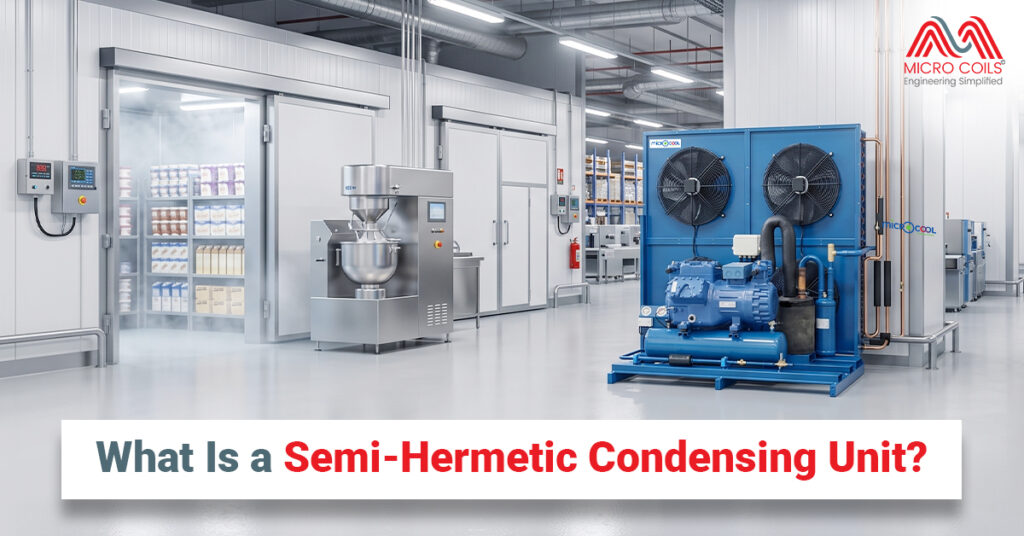
Refrigeration and air-conditioning systems rely on several critical components to maintain precise temperatures. Among them, the condensing unit plays a central role in removing heat from the refrigerant and ensuring continuous cooling performance. In commercial refrigeration, cold storage facilities, food processing plants, pharmaceutical warehouses, and industrial cooling applications, one type of condensing unit is especially popular because of its durability and serviceability: the semi-hermetic condensing unit.
Many business owners hear the term during equipment selection but are not entirely sure what it means. They often compare hermetic, semi-hermetic, and open-type compressors without understanding the practical differences. Choosing the wrong configuration can affect maintenance costs, downtime, energy efficiency, and long-term reliability.
This guide explains what a semi-hermetic condensing unit is, how it works, where it is used, its advantages and limitations, maintenance requirements, and how it compares with other compressor types.
What is a Condensing Unit?
A condensing unit is an assembly that contains the compressor, condenser, condenser fan, controls, and associated piping. Its primary function is to compress refrigerant vapor and reject heat to the surrounding environment.
In a refrigeration system, the evaporator absorbs heat from the refrigerated space. The refrigerant leaves the evaporator as a low-pressure vapor and enters the compressor. After compression, the refrigerant becomes a high-pressure, high-temperature vapor. The condenser then removes heat from the refrigerant, causing it to condense into a liquid before it returns to the expansion device and evaporator.
Because these components are mounted together as a factory-built package, condensing units simplify installation and ensure compatible performance.
What Does “Semi-Hermetic” Mean?
The term semi-hermetic refers specifically to the compressor construction. In a semi-hermetic compressor, the motor and compressor mechanism are enclosed within the same housing, but the housing can be opened for service and repair.
This design sits between two other common compressor types:
- Hermetic compressor: Fully sealed housing that is not intended to be opened.
- Open compressor: Compressor shaft extends outside the housing and is driven by an external motor.
A semi-hermetic compressor combines the compact sealed design of a hermetic compressor with the serviceability of an open compressor. Technicians can open the compressor casing, inspect internal components, replace valves, bearings, gaskets, or other parts, and reassemble the unit without replacing the entire compressor.
How a Semi-Hermetic Condensing Unit Works?
The operating principle is similar to most vapor-compression refrigeration systems.
Step 1: Suction
Low-pressure refrigerant vapor enters the compressor through the suction line.
Step 2: Compression
The compressor increases the refrigerant pressure and temperature.
Step 3: Discharge
High-pressure vapor flows from the compressor to the condenser.
Step 4: Heat Rejection
The condenser removes heat from the refrigerant and converts it into a high-pressure liquid.
Step 5: Expansion and Evaporation
The liquid refrigerant passes through an expansion device, its pressure drops, and it enters the evaporator where it absorbs heat and evaporates again.
This cycle repeats continuously to maintain the desired refrigeration temperature.
Main Components of a Semi-Hermetic Condensing Unit
A typical unit includes several integrated components.
Compressor
The semi-hermetic compressor is the core component. It may be reciprocating, screw, or scroll type, though reciprocating designs are especially common in medium-temperature and low-temperature refrigeration.
Condenser
The condenser removes heat from the refrigerant. Air-cooled condensers are most common, while water-cooled condensers are used in certain industrial applications.
Condenser Fan
The fan draws air across the condenser coil to improve heat transfer.
Receiver
Some systems include a liquid receiver to store refrigerant and ensure a steady liquid supply.
Controls
Pressure switches, contactors, overload protection, and electronic controllers monitor system operation and protect the equipment.
Piping and Service Valves
Factory-installed piping and service valves simplify commissioning and maintenance.
Why Semi-Hermetic Units Are Popular in Commercial Refrigeration?
Commercial refrigeration systems often operate for long hours under demanding conditions. Equipment downtime can lead to product spoilage, production losses, and regulatory concerns. Semi-hermetic units are favored because they can be repaired rather than completely replaced when certain internal components wear out.
This repairability becomes especially valuable in supermarkets, cold rooms, dairy plants, beverage facilities, and food distribution centers where refrigeration is mission-critical.
Advantages of Semi-Hermetic Condensing Units
Serviceability
The greatest advantage is ease of maintenance. Internal parts can be inspected and replaced, reducing replacement costs.
Long Service Life
With proper maintenance, semi-hermetic compressors can operate for many years in continuous-duty applications.
Robust Construction
The compressor housing is designed for demanding commercial and industrial environments.
Reduced Downtime
Many repairs can be performed on-site, minimizing operational interruptions.
Better for Large Systems
In larger refrigeration systems, replacing an entire compressor can be expensive. Semi-hermetic designs allow targeted repairs.
Improved Heat Dissipation
The compressor body is often designed to dissipate heat effectively, supporting reliable operation.
Semi-Hermetic vs. Open-Type Compressors
Open compressors use an external motor connected by a coupling or belt. They are highly serviceable and can handle large capacities, but shaft seals can leak refrigerant and require maintenance.
Semi-hermetic compressors eliminate the external shaft seal, reducing leakage risk while retaining good serviceability. This balance is one reason they are widely used in commercial refrigeration.
Common Applications of Semi-Hermetic Condenser Units
Semi-hermetic condensing units are used in many temperature-controlled facilities.
Cold Storage Warehouses
They maintain stable temperatures for food, pharmaceuticals, and agricultural products.
Supermarkets
Multiple display cases and walk-in coolers are often connected to semi-hermetic refrigeration systems.
Food Processing Plants
Reliable refrigeration is essential during production and storage.
Dairy Facilities
Milk, cheese, and other dairy products require strict temperature control.
Beverage Industry
Bottling plants and beverage storage facilities use commercial refrigeration extensively.
Pharmaceutical Storage
Temperature-sensitive medicines and vaccines require dependable cooling systems.
Air-Cooled and Water-Cooled Designs
Air-Cooled Units
These reject heat directly to outdoor air and are easier to install because they do not require cooling water infrastructure.
Water-Cooled Units
These use water to remove heat and can achieve better performance in high ambient temperatures, but they require water treatment and additional equipment such as cooling towers.
Refrigerants Used in Semi-Hermetic Units
These units can operate with a variety of refrigerants depending on application and regulations, including HFCs, HFO blends, ammonia in specialized industrial systems, and other low-global-warming-potential refrigerants.
Refrigerant selection affects efficiency, discharge temperature, oil compatibility, and environmental impact.
Installation Best Practices for Semi-Hermetic Units
Correct installation strongly influences reliability.
Ensure Adequate Ventilation
Air-cooled condensers require unrestricted airflow.
Maintain Proper Clearances
Provide space for maintenance access and heat rejection.
Use Correct Pipe Sizing
Improper refrigerant piping can cause oil return problems and pressure losses.
Verify Electrical Supply
Voltage and phase must match equipment specifications.
Evacuate and Charge Correctly
Proper evacuation removes moisture and non-condensable gases before charging.
Commission the System
Check pressures, temperatures, superheat, subcooling, and safety controls during startup.
Maintenance Requirements of Semi-Hermetic Units
Routine maintenance keeps the unit efficient and reliable.
Daily or Weekly Checks
- Observe operating pressures.
- Listen for unusual noise.
- Verify condenser fan operation.
Monthly Checks
- Clean condenser surfaces if dirty.
- Inspect electrical connections.
- Check refrigerant sight glass if provided.
Quarterly or Semiannual Service
- Test safety controls.
- Inspect contactors and overloads.
- Check compressor oil condition.
Annual Maintenance
- Perform a complete refrigeration performance check.
- Inspect compressor valves and internal condition if indicated.
- Replace gaskets or seals as needed.
Preventive maintenance is usually far less expensive than emergency repairs.
Common Problems and Troubleshooting for Semi-Hermetic Units
High Head Pressure
Possible causes include dirty condenser coils, failed condenser fan, blocked airflow, or excessive refrigerant charge.
Low Suction Pressure
Possible causes include refrigerant shortage, restricted expansion device, evaporator icing, or insufficient load.
Compressor Overheating
Often caused by poor condenser cooling, low refrigerant flow, high compression ratio, or electrical issues.
Excessive Noise
May indicate worn bearings, loose mounting bolts, valve damage, or liquid slugging.
Oil Carryover
Improper piping design or excessive refrigerant velocity can carry oil out of the compressor.
Importance of Heat Exchanger Coils
Heat exchangers are fundamental to refrigeration performance. In cooling systems, the indoor evaporator is often referred to as an AC evaporator coil, while the outdoor heat-rejecting section is known as an AC condenser coil. In many air-handling applications, the indoor heat exchange surface may also be described as an AC cooling coil. Clean, properly designed coils improve heat transfer, reduce compressor workload, and enhance overall system efficiency.
Selecting the Right Semi-Hermetic Condensing Unit
Consider the following factors when choosing a unit:
- Required cooling capacity
- Desired evaporating temperature
- Ambient temperature conditions
- Refrigerant type
- Energy efficiency goals
- Electrical supply availability
- Noise limitations
- Maintenance capabilities
- Future expansion requirements
A detailed load calculation should always precede equipment selection.
Signs That Replacement May Be Better Than Repair
Repair is not always the most economical option. Replacement may be preferable when:
- The compressor has suffered severe mechanical damage.
- Windings are extensively burned.
- Repair costs approach replacement cost.
- Refrigerant regulations make continued operation impractical.
- The system is significantly oversized or inefficient.
- Spare parts are no longer readily available.
Conclusion
A semi-hermetic condensing unit is a refrigeration assembly built around a serviceable semi-hermetic compressor. It offers a valuable combination of durability, efficiency, and maintainability, making it particularly suitable for commercial and industrial refrigeration applications where reliability and repairability are critical.
Unlike fully hermetic compressors, semi-hermetic designs can be opened for inspection and repair, reducing replacement costs and minimizing downtime. Although they generally involve a higher initial investment and require skilled maintenance, their long service life and robust construction often make them the preferred choice for cold storage, supermarkets, food processing, pharmaceutical storage, and other demanding applications.
Understanding how these units work, their advantages and limitations, and the factors that influence performance will help facility owners, engineers, and refrigeration professionals make informed equipment decisions. When properly selected, installed, and maintained, a semi-hermetic condensing unit can provide dependable refrigeration performance for many years.
Semi-hermetic condensing units are commonly installed in cold rooms, freezer rooms, supermarket refrigeration systems, dairy plants, beverage storage facilities, and pharmaceutical warehouses where continuous cooling is essential.
With proper installation and preventive maintenance, a semi-hermetic compressor can operate reliably for many years. Actual lifespan depends on operating conditions, refrigerant quality, maintenance practices, and load variations.
Yes. A dirty AC evaporator coil restricts heat absorption, reduces cooling capacity, increases energy consumption, and can lead to icing or compressor stress if not cleaned regularly.
Insufficient airflow across an AC condenser coil can cause high discharge pressure, poor heat rejection, increased power consumption, and possible compressor overheating. Keeping the condenser area clean and unobstructed is important.
An AC cooling coil should be inspected periodically for dust, grease, corrosion, and airflow blockage. Cleaning the coil and checking condensate drainage help maintain efficient operation and indoor air quality.

