

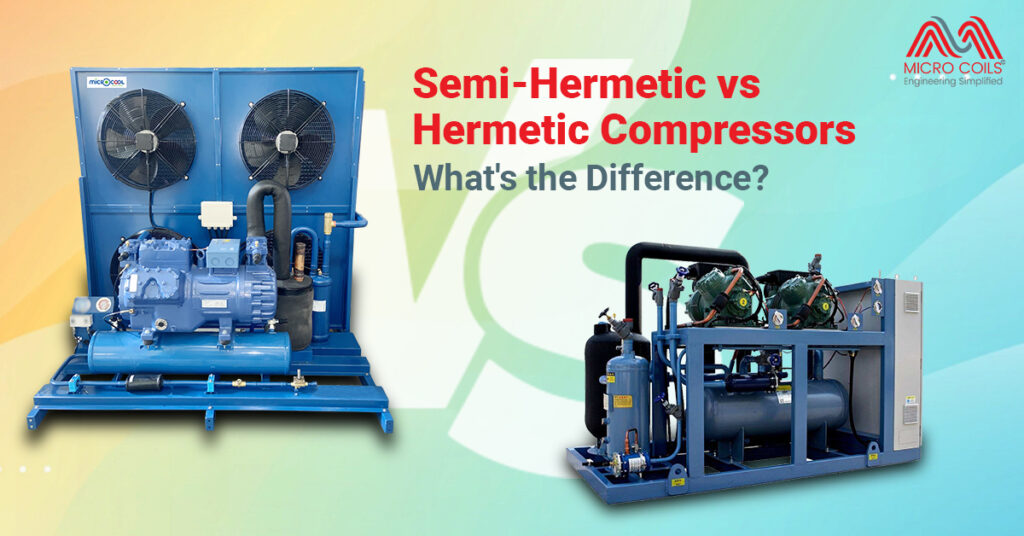
Choosing the right compressor is an important decision when designing or upgrading a refrigeration or air-conditioning system. The compressor is often described as the heart of a refrigeration system because it circulates refrigerant and helps move heat from one location to another. Among the commonly used options, hermetic and semi-hermetic compressors are two popular choices for commercial and industrial applications.
Although both compressor types perform the same basic function, their construction, serviceability, maintenance requirements, operating flexibility, and typical applications are different. Understanding these differences can help businesses select equipment that matches their cooling requirements, operating conditions, and maintenance strategy.
What Is a Hermetic Compressor?
A hermetic compressor has the compressor and electric motor enclosed inside a sealed housing. The casing is permanently sealed, which prevents the refrigerant and lubricating oil from escaping under normal operating conditions. Because the motor and compressor are contained within the same housing, the design is compact and relatively simple.
Hermetic compressors are widely used in refrigeration and air-conditioning equipment where compact construction and reliable operation are important. They are commonly found in household refrigerators, small commercial refrigeration units, air conditioners, and other systems with moderate cooling requirements.
What Is a Semi-Hermetic Compressor?
A semi-hermetic compressor also houses the motor and compressor within a common casing, but the housing can be opened for servicing. Bolted or removable sections allow qualified technicians to access internal components for inspection, repair, and replacement.
This serviceability makes semi-hermetic compressors particularly useful in commercial and industrial refrigeration applications. When a major internal component requires attention, technicians may be able to repair the compressor rather than replacing the entire unit, depending on the condition and design of the equipment.
How Do Hermetic and Semi-Hermetic Compressors Work?
Both compressor types operate using the same fundamental refrigeration principle. The compressor receives low-pressure refrigerant vapor from the evaporating side of the system and compresses it into a higher-pressure, higher-temperature vapor. The refrigerant then moves toward the condenser, where heat is rejected before the refrigerant continues through the system.
The main difference is not how they compress refrigerant but how they are constructed and serviced. A hermetic compressor is permanently sealed, whereas a semi-hermetic compressor is designed with service access. This distinction can have a major impact on maintenance planning and long-term operating costs.
Semi-Hermetic vs Hermetic Compressor: Key Differences
Feature | Hermetic Compressor | Semi-Hermetic Compressor |
Construction | Completely sealed housing | Enclosed housing with removable sections |
Serviceability | Generally not designed for internal repair | Designed to allow internal servicing |
Maintenance | Simpler external maintenance | More extensive maintenance possibilities |
Repairability | Often replaced if major internal failure occurs | Many internal components can potentially be repaired or replaced |
Initial Cost | Usually more economical for smaller systems | Generally higher |
Typical Applications | Domestic and smaller commercial systems | Commercial and industrial refrigeration |
Size Range | Commonly used for small to medium applications | Available for larger and demanding applications |
Downtime After Major Failure | Replacement may be necessary | Repair may reduce replacement requirements |
Accessibility | Internal components are inaccessible during normal servicing | Internal components are accessible to qualified technicians |
Long-Term Maintenance Strategy | Often focused on replacement | Can include component-level repair |
System Flexibility | Suitable for straightforward applications | Better suited to demanding refrigeration systems |
Best Choice For | Compact, cost-conscious cooling systems | Heavy-duty systems requiring serviceability |
Hermetic Compressor Advantages
One of the biggest advantages of a hermetic compressor is its compact construction. Because the motor and compressor are housed together, the unit does not require a separate shaft seal between the motor and compressor. This reduces the number of external components that could potentially develop leaks.
Hermetic compressors are also relatively simple to install and are suitable for applications where compressor replacement is more practical than internal repair. For smaller systems, their straightforward design can provide dependable performance without the additional service requirements associated with larger commercial compressors.
Semi-Hermetic Compressor Advantages
Semi-hermetic compressors offer a major benefit through their serviceable construction. Technicians can open the compressor housing and inspect internal components, which may make it possible to replace individual parts rather than the entire compressor.
This can be particularly valuable for commercial refrigeration systems where compressor replacement could be expensive or cause extended downtime. Businesses operating large refrigeration installations may therefore prefer semi-hermetic equipment because repairability can support long-term maintenance planning.
Which Compressor Is More Reliable?
Reliability depends on several factors, including compressor quality, system design, installation, operating conditions, refrigerant selection, lubrication, and maintenance. Neither compressor type can automatically be considered more reliable in every application.
Hermetic compressors can provide dependable operation in appropriately sized systems because their sealed construction reduces access points and simplifies the overall design. Semi-hermetic compressors can also provide long service life while offering the additional advantage of internal inspection and repair when maintenance is required.
Which Compressor Is Easier to Maintain?
For routine external maintenance, both types can be relatively straightforward when installed correctly. However, their approach to major repairs is very different.
A hermetic compressor is generally not designed to be opened for internal servicing. If a serious internal failure occurs, replacement is often the practical solution. A semi-hermetic compressor can be opened by qualified technicians, allowing internal components to be inspected, repaired, or replaced when economically and technically appropriate.
Which Compressor Is More Cost-Effective?
The most cost-effective choice depends on the size and operating requirements of the refrigeration system. Hermetic compressors can be an economical option for smaller applications where replacement is straightforward and the cost of major repairs would not justify opening the compressor.
Semi-hermetic compressors may offer greater long-term value in larger commercial applications. Although the initial investment can be higher, the ability to repair internal components may reduce replacement costs and help minimize downtime over the equipment’s operating life.
Energy Efficiency Considerations
Energy efficiency should be evaluated based on the complete refrigeration system rather than compressor construction alone. Compressor efficiency is influenced by operating pressure, refrigerant type, load conditions, motor efficiency, suction temperature, discharge temperature, and system controls.
Other refrigeration components also affect the overall efficiency of the system. For example, a clean evaporator coil can support effective heat absorption, while properly maintained heat rejection equipment helps the compressor operate under suitable conditions. Correct system sizing and regular maintenance are therefore just as important as choosing the compressor type.
Applications of Hermetic Compressors
Hermetic compressors are commonly selected for systems where compactness, simplicity, and lower initial cost are priorities. Their applications can include domestic refrigeration, display cases, small cold rooms, packaged air-conditioning equipment, and other relatively compact cooling systems.
They are particularly suitable when the refrigeration load is predictable and the system does not require frequent internal compressor servicing. For these applications, a sealed compressor can offer a practical combination of performance and simplicity.
Applications of Semi-Hermetic Compressors
Semi-hermetic compressors are commonly used in commercial and industrial refrigeration environments. Supermarkets, cold-storage facilities, food processing plants, commercial kitchens, and larger air-conditioning systems may use them when serviceability and higher capacity are important.
Their repairable construction is especially useful for businesses that cannot afford prolonged downtime. Instead of automatically replacing the compressor after every serious internal fault, a qualified technician may be able to diagnose and repair the affected components.
How Other Refrigeration Components Affect Compressor Performance?
A compressor does not operate independently. Its performance depends on the condition and design of the complete refrigeration circuit. Restrictions, poor airflow, incorrect refrigerant charge, inadequate heat rejection, and insufficient heat transfer can all increase the workload placed on the compressor.
Maintaining components such as the AC condenser coil can help the system reject heat effectively. Likewise, keeping the AC cooling coil clean and ensuring proper airflow can contribute to stable system operation. Regular maintenance across the complete system is therefore essential regardless of which compressor type is installed.
What Should You Consider Before Choosing?
The right compressor should be selected according to the application rather than simply based on price. Consider the required cooling capacity, operating temperature, refrigerant, expected operating hours, available maintenance support, and consequences of equipment downtime.
For smaller systems where straightforward replacement is acceptable, a hermetic compressor may be a practical solution. For larger installations where repairability and long-term serviceability are important, a semi-hermetic compressor may provide greater operational flexibility.
Hermetic vs Semi-Hermetic: Which One Should You Choose?
Choose a hermetic compressor when you need a compact, relatively simple, and cost-effective compressor for a small or medium cooling application. It is particularly suitable when internal compressor repair is not a major requirement.
Choose a semi-hermetic compressor when serviceability, repairability, and long-term maintenance are priorities. It can be a strong choice for commercial and industrial systems where compressor downtime can have a significant financial impact.
Final Thoughts
Hermetic and semi-hermetic compressors both have an important place in modern refrigeration and air-conditioning systems. The key difference lies in their construction and serviceability rather than their fundamental refrigeration function. Hermetic compressors provide a sealed, compact design that works well for many smaller applications, while semi-hermetic compressors offer greater access for professional inspection and repair.
Before making a decision, consider the system’s cooling capacity, operating environment, maintenance requirements, budget, and expected service life. Choosing a compressor that matches the application’s actual demands can improve reliability, simplify maintenance, and support efficient long-term operation.
Neither type is universally better. Hermetic compressors are often suitable for smaller systems where simplicity and compact design are important, while semi-hermetic compressors are better suited to applications where internal servicing and repairability are valuable.
Yes. One of the main benefits of a semi-hermetic design is that qualified technicians can access internal components. Depending on the fault, individual parts such as valves, bearings, or other components may be inspected and replaced instead of replacing the complete compressor.
Common causes of compressor failure can include overheating, inadequate lubrication, electrical problems, liquid refrigerant returning to the compressor, incorrect refrigerant charge, contamination, and operation outside the manufacturer’s recommended conditions. Proper system design and preventive maintenance can reduce these risks.
Compressor lifespan varies considerably depending on the equipment, operating conditions, maintenance, installation quality, and workload. A properly sized compressor operating within its recommended conditions and receiving regular maintenance can provide many years of service.
Not necessarily. Compressor replacement must match the system’s cooling capacity, refrigerant, voltage, operating temperatures, physical configuration, controls, and other technical requirements. A semi-hermetic compressor should not be substituted for a hermetic model without confirming compatibility with the complete refrigeration system.

