

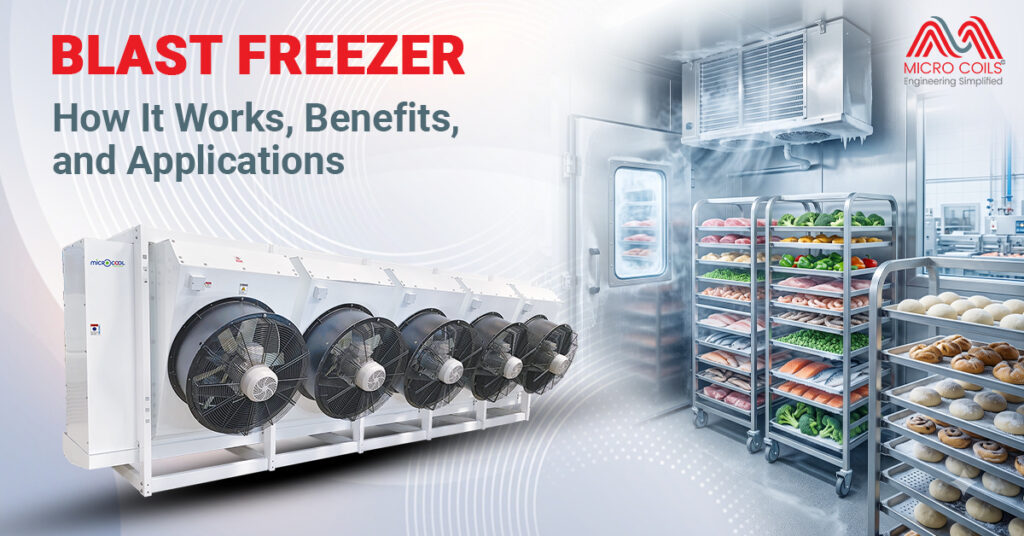
A blast freezer is an industrial refrigeration system designed to freeze food products rapidly by exposing them to very low temperatures and high-velocity air. Unlike conventional freezers, which may take several hours to freeze products, blast freezers can reduce product temperature much faster. This rapid freezing process helps preserve texture, appearance, moisture, and overall product quality.
Blast freezing is widely used in food processing, cold storage, hospitality, seafood processing, meat processing, bakeries, dairy operations, and prepared-food manufacturing. By controlling temperature, airflow, freezing time, and product loading, businesses can achieve consistent freezing results while maintaining food quality.
This article explains how blast freezers work, their benefits, major applications, system components, operating considerations, and maintenance requirements.
What Is a Blast Freezer?
A blast freezer is a specialized freezing system that rapidly removes heat from food products. It typically combines a low-temperature refrigeration system with powerful fans that circulate cold air around the products.
The objective is to lower the temperature of the food quickly enough to minimize the formation of large ice crystals. When freezing occurs slowly, water inside the product has more time to form larger ice crystals. These crystals can damage cellular structures and may affect the product’s texture after thawing.
Blast freezing reduces the time available for large crystals to develop. The result can be better retention of the product’s original characteristics.
Blast freezers can be designed as:
- Batch blast freezers
- Blast freezing rooms
- Tunnel blast freezers
- Continuous blast freezers
- Spiral freezing systems
- Cart or trolley-based blast freezers
- Compact blast freezer units
The right configuration depends on production volume, product type, available space, target temperature, and required freezing time.
How Does a Blast Freezer Work?
The basic principle behind blast freezing is straightforward: remove heat from the product as quickly as practical.
A typical blast freezer operates through several stages.
1. Product Loading
Fresh or cooked products are placed inside the freezing chamber. Products may be arranged on trays, racks, carts, conveyors, or specialized containers.
Spacing is important. Overloading the chamber or placing products too close together can restrict airflow and result in uneven freezing.
2. Cold Air Circulation
Fans circulate very cold air throughout the chamber. The high air velocity increases heat transfer between the product surface and the surrounding air.
This is one of the defining characteristics of blast freezing.
3. Heat Removal
Heat moves from the warmer food into the cold circulating air. The refrigeration system continuously removes this heat from the air and transfers it outside the freezing chamber.
4. Temperature Reduction
As heat is removed, the product temperature gradually falls. The freezing zone is particularly important because this is where a substantial portion of the product’s water content changes from liquid to ice.
5. Completion of Freezing
The freezing cycle continues until the product reaches the specified core temperature. The exact target depends on the product, processing requirements, storage conditions, and applicable food-safety procedures.
Once the required temperature is reached, the product can be transferred to cold storage or another controlled-temperature environment.
Main Components of a Blast Freezer
A blast freezer contains several components that work together to achieve rapid and controlled freezing.
Refrigeration Compressor
The compressor circulates refrigerant through the refrigeration system. It raises the refrigerant pressure and enables the system to reject heat through the condenser.
Condenser
The condenser removes heat from the high-pressure refrigerant and releases it to the surrounding environment or another heat-transfer medium.
Evaporator Coil
The evaporator coil is located within or connected to the blast freezer chamber. Refrigerant absorbs heat as it passes through the evaporator, helping produce the low-temperature air required for freezing.
Its design, surface area, fin spacing, and operating conditions can influence heat-transfer performance and defrost requirements.
Fans
High-capacity fans circulate cold air around the products. Air velocity is critical because faster and more uniform circulation can improve heat transfer.
However, fan selection must account for pressure drop, chamber layout, product arrangement, energy consumption, and desired airflow patterns.
Expansion Device
The expansion device reduces refrigerant pressure before it enters the evaporator. This allows the refrigerant to evaporate at a sufficiently low temperature to absorb heat from the freezer chamber.
Insulated Chamber
The freezer chamber uses insulated panels to limit heat transfer between the interior and surrounding environment.
Good insulation reduces unwanted heat gain and helps the refrigeration system maintain the required temperature.
Control System
Modern blast freezers can use digital controllers, temperature sensors, timers, alarms, and monitoring systems to manage the freezing cycle.
Advanced systems may also record temperature data for quality-control and traceability purposes.
Blast Freezing vs Conventional Freezing
The major difference between blast freezing and conventional freezing is the speed at which heat is removed.
Feature | Blast Freezing | Conventional Freezing |
Freezing speed | Rapid | Relatively slow |
Air movement | High velocity | Usually lower |
Ice crystal formation | Smaller crystals can be achieved | Larger crystals may develop |
Product quality | Often better preserved | May experience greater texture changes |
Energy demand | High during rapid freezing | Depends on system design |
Typical use | Commercial and industrial processing | Domestic and general storage |
The appropriate method depends on the product and production requirements. Blast freezing is particularly useful when rapid temperature reduction is important.
Benefits of Blast Freezing
1. Helps Preserve Product Quality
Rapid freezing can help minimize structural damage caused by large ice crystals. This is especially important for products where texture and appearance matter.
Fruits, vegetables, seafood, meat, bakery products, and prepared foods can benefit from controlled rapid freezing.
2. Better Texture After Thawing
The formation of smaller ice crystals can reduce cellular damage. Depending on the product and freezing conditions, this may help preserve texture after thawing.
This is particularly relevant for products such as seafood, fruits, vegetables, and prepared meals.
3. Faster Production Cycles
Blast freezers can reduce the time required to bring products down to the desired temperature.
For food manufacturers, faster freezing can improve production flow and allow products to move into storage more quickly.
4. Supports Food Quality and Safety
Rapid temperature reduction helps move food through the temperature range in which microbial growth can be a concern. However, blast freezing should be part of a properly designed food-safety system rather than treated as a substitute for good hygiene and temperature control.
5. Suitable for Large-Scale Processing
Industrial blast freezers can handle substantial quantities of food in a controlled environment. Larger facilities can use tunnel or continuous systems for high-volume production.
6. Reduces Moisture Loss
Properly controlled freezing can help limit undesirable moisture loss and dehydration. Packaging, airflow, temperature, product exposure time, and storage conditions all influence the final result.
7. Flexible Product Handling
Blast freezer systems can be configured for different products and production processes. Depending on the design, products can be frozen on trays, racks, carts, conveyors, or specialized freezing equipment.
Applications of Blast Freezers
Blast freezers are used in many industries where rapid freezing and controlled temperatures are important.
Meat Processing
Meat processors use blast freezing for products such as:
- Beef
- Chicken
- Pork
- Lamb
- Processed meat
- Burgers
- Sausages
- Ready-to-cook products
Rapid freezing helps processors maintain consistent product temperatures before long-term storage and distribution.
Seafood Processing
Seafood is highly temperature-sensitive, making rapid freezing particularly valuable.
Blast freezers are used for:
- Fish fillets
- Shrimp
- Prawns
- Squid
- Crab
- Processed seafood
- Prepared seafood meals
Fast freezing can help preserve appearance, texture, and product quality during storage.
Fruit and Vegetable Processing
Fruits and vegetables can undergo changes in texture, color, and moisture during freezing. Controlled blast freezing helps processors quickly reduce product temperature after preparation.
Applications include:
- Diced vegetables
- Berries
- Mango pieces
- Peas
- Corn
- Cut fruits
- Vegetable mixes
For products intended for further processing or retail sale, freezing conditions can be an important part of quality management.
Bakery Industry
Bakeries and food manufacturers use blast freezers to freeze:
- Dough
- Bread
- Cakes
- Pastries
- Croissants
- Pizza bases
- Filled bakery products
Rapid freezing can help businesses prepare products in advance and maintain inventory for later distribution or finishing.
Prepared and Ready-to-Eat Foods
Prepared food manufacturers use blast freezing for products such as:
- Ready meals
- Frozen curries
- Pasta dishes
- Rice-based meals
- Sauces
- Soups
- Frozen snacks
- Convenience foods
Blast freezing allows manufacturers to produce food in batches and maintain controlled frozen inventories.
Dairy Products
Certain dairy and frozen dessert applications require rapid and controlled cooling or freezing.
Depending on the product formulation and manufacturing process, blast freezing can be used for selected dairy-based products and frozen desserts.
Restaurants and Commercial Kitchens
Hotels, restaurants, catering companies, and institutional kitchens can use blast freezers to prepare food in advance.
A kitchen may cook a large batch of food, rapidly cool or freeze appropriate products, and store them for later use. This can support production planning and inventory management.
Cold Storage and Distribution
Distribution centers may use blast freezing before products enter long-term frozen storage. Rapidly bringing products to the desired storage temperature can help maintain the cold chain.
Factors Affecting Blast Freezing Performance
Simply installing a high-capacity freezer does not guarantee consistent freezing. Several variables affect system performance.
Product Thickness
Thicker products take longer to freeze because heat must travel farther from the center of the product to its surface.
Product Temperature
The initial temperature of the product affects the amount of heat that the refrigeration system must remove.
Product Composition
Water content, fat content, sugar concentration, salt concentration, and product structure can affect freezing behavior.
Air Velocity
Higher air movement generally improves convective heat transfer, but the appropriate airflow depends on product characteristics and equipment design.
Product Spacing
Adequate spacing allows cold air to reach product surfaces. Crowding can create airflow restrictions and uneven freezing.
Chamber Temperature
Lower chamber temperatures can increase the rate of heat removal, but operating conditions must remain within the equipment’s design limits.
Humidity
Humidity and moisture transfer can influence product dehydration and freezer performance. Proper chamber conditions and packaging can help control moisture loss.
Importance of Airflow in Blast Freezing
Airflow is one of the most important elements of blast freezer design.
Fans must distribute cold air consistently across the freezing chamber. If one section receives significantly more airflow than another, products may freeze at different rates.
Poor airflow can result from:
- Incorrect fan placement
- Overloaded racks
- Improper product spacing
- Blocked air passages
- Dirty heat-transfer surfaces
- Poor chamber design
- Incorrect fan selection
An effective airflow pattern should expose products to consistent cooling conditions while avoiding unnecessary pressure losses and energy consumption.
Role of Refrigeration Coils
Heat-transfer surfaces have a direct influence on freezer performance. Properly designed refrigeration coils provide the surface area required for refrigerant evaporation and heat absorption.
Coil selection should consider factors such as:
- Required refrigeration capacity
- Refrigerant type
- Operating temperature
- Airflow
- Fin spacing
- Defrost requirements
- Chamber humidity
- Expected frost accumulation
- Available installation space
Low-temperature applications can experience significant frost accumulation. Coil design and defrost strategy therefore need to be considered together.
Defrosting in Blast Freezers
Moisture in the air can freeze onto cold heat-transfer surfaces during operation. As frost accumulates, it can restrict airflow and reduce heat-transfer efficiency.
Blast freezers may use different defrost methods depending on their design and operating conditions.
Common methods include:
- Electric defrost
- Hot-gas defrost
- Off-cycle defrost
- Water-based defrost in suitable systems
The correct method depends on the equipment design and application.
A proper defrost schedule is important because excessive frost can increase energy consumption and extend freezing times.
Energy Efficiency Considerations
Blast freezing requires substantial refrigeration capacity because the system must remove a large quantity of heat within a relatively short period.
Several measures can improve energy performance:
Maintain Good Insulation
Damaged or poorly sealed insulation allows additional heat to enter the chamber.
Minimize Door Opening
Every time the freezer door opens, warm and humid air can enter. This increases the refrigeration load and may contribute to frost formation.
Maintain Heat-Transfer Surfaces
Dirty or heavily frosted surfaces reduce heat-transfer performance.
Optimize Fan Operation
Fans should provide the required airflow without consuming unnecessary energy.
Maintain Refrigeration Equipment
Compressors, condensers, expansion devices, fans, sensors, and controls should be inspected regularly.
Avoid Overloading
Loading the chamber beyond its intended capacity can increase freezing time and reduce system efficiency.
Maintenance of a Blast Freezer
Preventive maintenance can help improve reliability and maintain consistent freezing performance.
Inspect the Refrigeration System
Technicians should check operating pressures, refrigerant conditions, compressor operation, and other refrigeration parameters.
Clean Heat-Transfer Surfaces
Dirt, ice, and debris can reduce heat-transfer efficiency.
Check Fans and Motors
Fans must operate reliably because airflow is essential to blast freezing.
Inspect Door Seals
Damaged door gaskets can allow warm air and moisture into the chamber.
Check Temperature Sensors
Accurate sensors are essential for determining whether the required freezing conditions have been reached.
Monitor Defrost Performance
Incomplete or excessive defrost cycles can affect efficiency and product freezing times.
Inspect Insulated Panels
Damaged panels or gaps can increase heat infiltration.
How to Choose a Blast Freezer?
Selecting the right blast freezer requires more than comparing freezer dimensions.
Consider the following factors:
- Product type
- Product weight
- Product thickness
- Initial product temperature
- Target core temperature
- Required freezing time
- Daily production volume
- Batch size
- Available floor space
- Electrical capacity
- Refrigeration capacity
- Airflow requirements
- Defrost method
- Cleaning requirements
- Automation and monitoring needs
- Maintenance access
A freezer designed for a small commercial kitchen will have very different requirements from a continuous industrial freezing line.
Blast Freezer vs Blast Chiller
Blast freezers and blast chillers use similar principles but serve different purposes.
A blast chiller rapidly reduces the temperature of cooked or prepared food without necessarily freezing it. A blast freezer continues the temperature reduction until the product reaches a frozen state.
The choice depends on the intended storage and processing requirements.
For example, a commercial kitchen may use a blast chiller to rapidly cool prepared food before refrigerated storage, while a food manufacturer may use a blast freezer to produce frozen products for long-term distribution.
Common Blast Freezer Challenges
Uneven Freezing
Uneven product spacing, poor airflow, inconsistent product sizes, or inadequate refrigeration capacity can produce uneven freezing.
Excessive Frost
High humidity and frequent door opening can increase frost accumulation on heat-transfer surfaces.
Long Freezing Times
Long cycles may result from overloaded chambers, high product temperatures, restricted airflow, dirty coils, or inadequate refrigeration capacity.
Product Dehydration
Excessive exposure to cold, moving air can contribute to moisture loss, particularly when products are poorly packaged or remain exposed for extended periods.
High Energy Consumption
Poor insulation, inefficient equipment, excessive door openings, dirty heat-transfer surfaces, and improper operating practices can increase energy consumption.
Conclusion
Blast freezers play an important role in modern food processing and cold-chain operations by rapidly removing heat from products and bringing them to controlled frozen temperatures. Their combination of low-temperature refrigeration and high-velocity airflow allows businesses to shorten freezing cycles and help preserve product characteristics.
When properly designed and maintained, blast freezing equipment can become an important part of efficient and reliable cooling solutions for businesses that depend on controlled-temperature processing and storage.
The operating temperature varies according to the equipment design, product, and required freezing process. Industrial blast freezers often operate at substantially lower temperatures than standard storage freezers to achieve rapid heat removal.
Freezing time depends on product thickness, starting temperature, composition, airflow, chamber temperature, packaging, and equipment capacity. Small products can freeze much faster than large or densely packed items.
Yes. Blast freezers are commonly used for suitable cooked and prepared foods. The process should follow appropriate food-handling procedures, product specifications, and temperature-control requirements.
The effect depends on the food and freezing conditions. Rapid freezing can help preserve product characteristics by limiting the formation of large ice crystals, although packaging, storage duration, and thawing practices also influence quality.
Frost forms when moisture from the air freezes on surfaces that are below the freezing point. Frequent door opening, humid air infiltration, inadequate defrosting, and certain operating conditions can increase frost accumulation.
It can support longer-term preservation of suitable food products by rapidly bringing them to frozen temperatures. This may help businesses manage inventory and extend the usable storage period, subject to the product’s storage requirements.
Routine maintenance may include checking refrigeration performance, cleaning heat-transfer surfaces, inspecting fans and motors, checking door seals, verifying temperature sensors, maintaining defrost systems, and inspecting electrical components.
No. Freezing behavior varies significantly between products. Foods differ in water content, structure, composition, packaging, and required storage conditions, so the freezing process should be designed around the specific product.

