

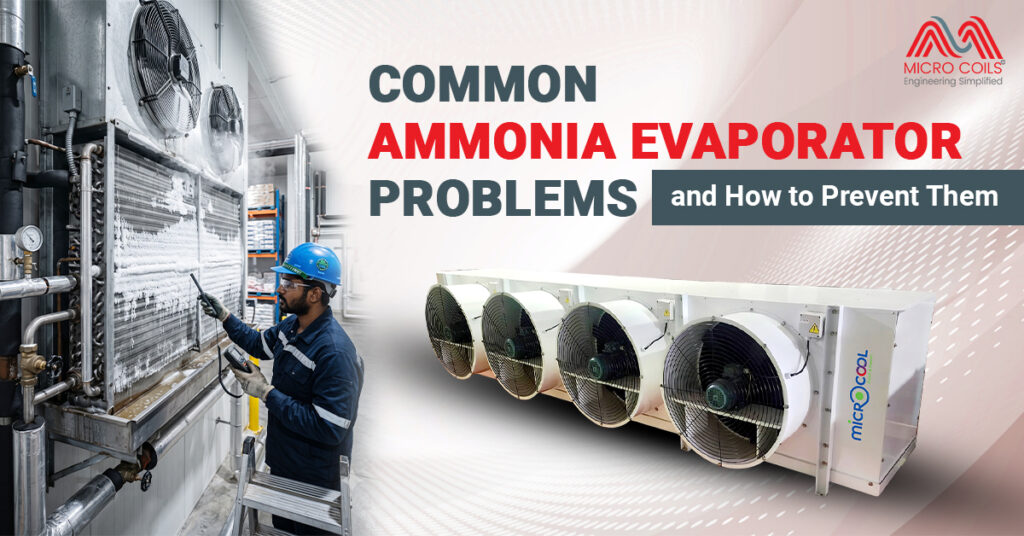
Ammonia evaporators are critical components in industrial refrigeration systems. They absorb heat from a refrigerated space or process and transfer that heat to the ammonia refrigerant, allowing the system to maintain the required temperature. They are widely used in cold storage facilities, food processing plants, beverage manufacturing, ice plants, meat and seafood processing, and other temperature-controlled environments.
Despite their robust design, ammonia evaporators can experience problems that affect cooling performance, energy efficiency, product quality, and equipment life. Issues such as frost buildup, poor oil return, refrigerant maldistribution, corrosion, excessive pressure drop, and inadequate airflow can develop when equipment is poorly selected, installed, operated, or maintained.
Early identification is important because a small evaporator problem can affect the entire refrigeration system. For example, excessive frost can restrict airflow, while poor refrigerant distribution can leave parts of the evaporator underutilized. These conditions can increase operating costs and place additional demands on compressors and other components.
This guide examines the most common ammonia evaporator problems, their causes, warning signs, prevention methods, and maintenance practices.
What Is an Ammonia Evaporator?
An ammonia evaporator is a heat exchanger used in an ammonia-based refrigeration system. Its primary function is to absorb heat from the surrounding environment, product, air, water, or another process fluid.
In a typical refrigeration cycle, liquid ammonia enters the evaporator at a low pressure and temperature. As the ammonia absorbs heat, it evaporates into a vapor. The vapor then returns to the compressor, where the refrigeration cycle begins again.
Depending on the application, an ammonia evaporator may be designed for:
- Cold storage rooms
- Freezing tunnels
- Food processing facilities
- Industrial process cooling
- Chilled water systems
- Ice production
- Meat processing
- Seafood processing
- Dairy facilities
- Beverage plants
The evaporator’s design must match the required cooling capacity, operating temperature, refrigerant flow, airflow, and environmental conditions.
Why Ammonia Evaporator Performance Matters?
The evaporator has a direct impact on refrigeration system performance. If heat transfer becomes inefficient, the refrigeration system may need to operate for longer periods to achieve the desired temperature.
A poorly performing evaporator can contribute to:
- Higher energy consumption
- Longer cooling cycles
- Uneven temperatures
- Product quality problems
- Excessive frost
- Compressor stress
- Increased maintenance requirements
- Reduced refrigeration capacity
- Unplanned downtime
Maintaining the evaporator therefore involves more than keeping its surfaces clean. Refrigerant flow, airflow, defrosting, oil management, temperature control, and system operating conditions all need attention.
Common Ammonia Evaporator Problems
1. Excessive Frost Buildup
Frost accumulation is one of the most common problems in low-temperature refrigeration systems.
When humid air enters a cold refrigeration space, moisture can condense and freeze on the evaporator surface. Over time, this frost layer becomes thicker and restricts airflow across the heat-transfer surface.
A heavy frost layer acts as an insulating barrier. The evaporator then has greater difficulty absorbing heat, causing cooling performance to decline.
Common Causes
- Frequent opening of freezer doors
- High humidity
- Damaged door seals
- Inadequate defrosting
- Incorrect defrost settings
- Excessive moisture entering the room
- Poor airflow
How to Prevent It?
A suitable defrost strategy should be established according to the evaporator design and operating conditions. Door seals should remain in good condition, and unnecessary door openings should be minimized.
Operators should also monitor frost accumulation instead of relying solely on fixed defrost intervals. In some applications, demand-based defrost control can help prevent unnecessary cycles.
2. Poor Refrigerant Distribution
Ammonia must reach the evaporator surfaces in an appropriate quantity to achieve effective heat transfer.
Poor refrigerant distribution can cause some areas of the evaporator to receive insufficient refrigerant while other areas receive excessive flow.
This can reduce the usable heat-transfer area and create inconsistent temperatures.
Possible Causes
- Incorrect system design
- Improper expansion or control devices
- Blockages
- Incorrect piping arrangement
- Uneven pressure distribution
- Poorly adjusted refrigerant controls
Prevention
The evaporator should be selected and installed according to the manufacturer’s specifications. Refrigerant piping should be properly sized, and control components should be configured for the intended operating conditions.
Regular monitoring of operating pressures and temperatures can help identify distribution problems early.
3. Oil Accumulation
Oil is required to lubricate compressors and other moving components in the refrigeration system. However, oil can travel through the refrigerant circuit and accumulate in evaporators.
Excessive oil inside the evaporator can reduce effective heat transfer because oil creates an additional resistance between the refrigerant and the heat-transfer surface.
Warning Signs
- Reduced refrigeration capacity
- Increasing temperature difference
- Longer operating cycles
- Unusual system behavior
- Declining evaporator efficiency
Prevention
Effective oil management should be incorporated into the refrigeration system design. Oil separators, appropriate piping arrangements, proper refrigerant velocities, and scheduled inspection can help reduce oil accumulation.
Any oil-handling procedure in an ammonia system should be performed by trained personnel following the equipment manufacturer’s procedures and applicable safety requirements.
4. Corrosion
Ammonia refrigeration systems operate in environments where moisture, chemicals, salts, cleaning agents, and temperature fluctuations may be present.
External corrosion can affect evaporator surfaces, supports, fins, piping, and connections. Internal corrosion can also become a concern depending on system conditions and contamination.
Common Causes
- Moisture exposure
- Aggressive cleaning chemicals
- High humidity
- Poor protective coatings
- Contaminated system conditions
- Damaged surfaces
Prevention
Regular visual inspections can help identify corrosion before it becomes severe.
Cleaning procedures should use methods and chemicals compatible with the evaporator materials. Damaged protective coatings should be addressed appropriately, and areas exposed to water or chemicals should receive additional attention.
5. Inadequate Airflow
Airflow is especially important in forced-air ammonia evaporators.
Fans must move air across the heat-transfer surfaces and distribute cooled air throughout the room. If airflow decreases, the evaporator may not transfer heat effectively.
Causes of Poor Airflow
- Dirty heat-transfer surfaces
- Frost accumulation
- Fan motor problems
- Damaged fan blades
- Blocked air passages
- Incorrect fan rotation
- Improper product loading
- Poor evaporator placement
Prevention
Fans should be inspected regularly. Operators should also ensure that products, racks, pallets, and other equipment do not obstruct designed airflow paths.
Keeping heat-transfer surfaces free from excessive frost and contamination is equally important.
6. Fan and Motor Failures
Evaporator fans often operate for long periods. Mechanical wear, electrical faults, bearing problems, or overheating can eventually cause fan failure.
When one or more fans stop operating, airflow becomes uneven and cooling capacity can decline.
Preventive Measures
Routine inspections should include:
- Motor condition
- Electrical connections
- Bearing condition
- Fan blade condition
- Vibration
- Rotation direction
- Unusual noise
- Motor temperature
Replacing worn components before failure can reduce unexpected downtime.
7. Excessive Pressure Drop
Pressure drop occurs as ammonia flows through piping, valves, heat exchangers, and other system components.
Excessive pressure drop through the evaporator or connected piping can reduce system efficiency and affect the evaporating conditions.
Potential Causes
- Undersized piping
- Blocked passages
- Incorrect valves
- Poor piping layout
- Excessive refrigerant velocity
- Improper component selection
Prevention
System components should be sized according to the required mass flow rate and operating conditions. Pressure and temperature readings should be monitored to identify unusual changes.
8. Liquid Ammonia Carryover
Liquid carryover occurs when liquid refrigerant reaches components or piping where primarily vapor should be present.
This condition can be dangerous for the compressor because liquid is not readily compressible. Liquid entering a reciprocating or screw compressor can cause severe mechanical and operational problems.
Causes
- Improper refrigerant control
- Incorrect liquid level
- Poor separation
- Sudden load changes
- Incorrect operating conditions
- Control system malfunction
Prevention
Proper liquid separation, level control, suction piping design, and operating procedures are essential.
Operators should monitor system conditions and investigate unexpected liquid carryover immediately. Ammonia refrigeration systems should only be serviced by personnel trained in ammonia refrigeration safety.
9. Uneven Temperature Distribution
An evaporator can operate correctly while still producing uneven temperatures throughout a refrigeration room if airflow and system design are inadequate.
For example, products positioned near the evaporator may experience different conditions from those located farther away.
Causes
- Poor airflow distribution
- Incorrect fan arrangement
- Product overloading
- Improper rack placement
- Inadequate evaporator capacity
- Refrigerant maldistribution
Prevention
Temperature sensors should be positioned strategically throughout the space. Mapping temperature variations can help identify cold and warm zones.
Product loading patterns should also be standardized to maintain adequate air circulation.
10. Blocked or Dirty Heat-Transfer Surfaces
Dirt, dust, food particles, packaging debris, ice, and other contaminants can accumulate on evaporator surfaces.
Even a relatively thin layer of contamination can interfere with heat transfer and airflow.
Prevention
Cleaning schedules should reflect the environment in which the evaporator operates. Food-processing environments may require more frequent inspection and cleaning than controlled industrial spaces.
Cleaning should be performed according to the evaporator manufacturer’s recommendations and the facility’s hygiene procedures.
How to Prevent Ammonia Evaporator Problems?
Preventive maintenance is more effective when it combines equipment inspection, operating data, cleaning, and staff training.
Conduct Regular Inspections
Visual inspections can identify early signs of:
- Frost buildup
- Corrosion
- Oil accumulation
- Damaged fans
- Loose components
- Refrigerant leakage
- Insulation damage
- Unusual vibration
Small abnormalities should be investigated before they develop into major equipment failures.
Monitor Temperature and Pressure
Temperature and pressure data provide valuable information about evaporator performance.
Operators can compare current readings with established operating ranges to identify deviations.
Sudden changes may indicate:
- Refrigerant flow problems
- Fouling
- Blockages
- Fan failures
- Control problems
- Changes in system load
Maintain Proper Airflow
Keep air passages clear and ensure fans operate according to design specifications.
Product racks should not be placed directly against evaporators or in locations that block return-air paths.
Establish an Effective Defrost Schedule
Defrost should occur when necessary rather than simply following an arbitrary schedule.
Facilities should monitor frost accumulation and review defrost frequency when humidity, production levels, or operating conditions change.
Keep Evaporators Clean
Cleaning should remove dirt and other contaminants without damaging heat-transfer surfaces.
Cleaning chemicals must be compatible with the materials used in the evaporator. In food-processing facilities, cleaning should also comply with the site’s sanitation procedures.
Manage Refrigerant and Oil Properly
Ammonia charge, oil levels, and refrigerant flow should be managed according to system design and manufacturer specifications.
Oil accumulation should be investigated if evaporator performance begins to deteriorate without an obvious airflow or frost problem.
Train Operators
Operators are often the first people to notice changes in refrigeration equipment.
Training should help them recognize:
- Unusual sounds
- Temperature changes
- Excessive frost
- Fan problems
- Pressure deviations
- Alarm conditions
- Unusual vibration
- Other abnormal operating conditions
Importantly, ammonia is a hazardous refrigerant. Leak response, isolation, evacuation, and repair procedures should be handled according to the facility’s emergency plan and applicable safety requirements.
Role of Condensers in Overall System Performance
Although the evaporator is responsible for absorbing heat, the condenser must reject that heat effectively. A poorly performing condenser can increase condensing pressure and affect the overall refrigeration cycle. Depending on the refrigeration system, different heat-rejection configurations may be used.
For systems that use air-cooled equipment, the AC condenser coil must remain clean and have adequate airflow to maintain efficient heat rejection. This illustrates an important principle: refrigeration components should not be evaluated in isolation. Compressor performance, condenser operation, expansion control, evaporator capacity, piping, airflow, and system controls all interact.
Ammonia Evaporator Maintenance Checklist
A structured maintenance program can help facilities identify problems early.
Daily Checks
- Review room temperature
- Check refrigeration alarms
- Observe unusual sounds or vibration
- Look for excessive frost
- Check fan operation
- Review operating pressures where applicable
Weekly Checks
- Inspect evaporator surfaces
- Check fans and guards
- Examine door seals
- Look for corrosion
- Inspect visible piping and connections
- Review temperature trends
Monthly Checks
- Examine electrical connections
- Inspect fan motors
- Review defrost performance
- Check insulation
- Review refrigeration performance
- Examine system controls
Periodic Professional Inspection
Qualified refrigeration personnel should conduct more detailed inspections based on the system design, applicable regulations, manufacturer requirements, and facility risk assessment.
Warning Signs That an Evaporator Needs Attention
Certain symptoms should not be ignored.
Cooling Takes Longer Than Normal
A gradual increase in cooling time can indicate declining heat-transfer performance, airflow problems, frost accumulation, or refrigerant-related issues.
Frost Appears Excessive
A sudden increase in frost can indicate humidity infiltration, defrost problems, door leakage, or abnormal operating conditions.
Temperature Becomes Uneven
Warm zones may indicate airflow restrictions, fan problems, product loading issues, or insufficient evaporator capacity.
Energy Consumption Increases
A sustained increase in energy consumption may signal declining refrigeration efficiency.
Fans Become Noisy
Changes in fan noise can indicate bearing wear, blade damage, motor problems, or vibration.
Pressure Readings Change Unexpectedly
Unexpected pressure changes should be investigated because they can indicate changes in refrigerant flow, system load, or component performance.
The Role of Refrigeration Coils in Heat Transfer
The design and condition of refrigeration coils can significantly affect the efficiency of heat exchange within a refrigeration system. Coil surface area, material, fin configuration, refrigerant distribution, airflow, and operating temperature all influence performance.
For ammonia evaporators, coil design must also account for the operating environment, frost formation, cleaning requirements, and defrost strategy. Choosing an appropriate coil configuration during system design can help reduce operational problems later.
Conclusion
Ammonia evaporators are essential for maintaining effective temperature control in industrial refrigeration systems. Problems such as frost accumulation, poor refrigerant distribution, oil buildup, corrosion, airflow restrictions, fan failure, pressure drop, liquid carryover, and uneven temperatures can reduce system performance and increase operating costs.
Most evaporator problems can be managed more effectively when facilities combine correct equipment selection with preventive maintenance, regular inspections, temperature and pressure monitoring, proper airflow management, and appropriate defrost practices.
A complete refrigeration strategy should also consider compressors, condensers, piping, controls, heat-transfer surfaces, and operating procedures. When these elements work together, businesses can maintain reliable and efficient cooling solutions for demanding industrial applications.
Inspection frequency depends on the application, operating conditions, manufacturer recommendations, and facility risk assessment. High-use industrial systems may require frequent operator checks alongside scheduled professional inspections.
Common causes include high humidity, frequent door opening, inadequate defrosting, restricted airflow, incorrect operating conditions, and problems with refrigerant flow.
Yes. Excessive oil accumulation can create resistance to heat transfer and reduce the effective performance of the evaporator.
Airflow allows heat to move efficiently from the refrigerated space or product toward the evaporator. Poor circulation can create temperature variations and increase cooling times.
A failed fan reduces air circulation across the heat-transfer surface. Depending on the system design, this can reduce cooling capacity, create uneven temperatures, and increase the time required to reach the target temperature.

