

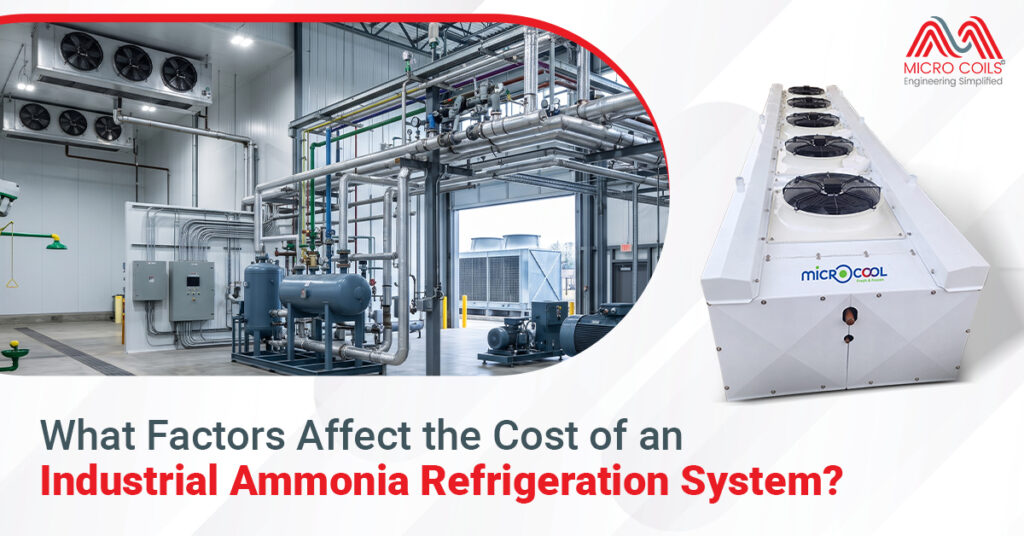
Cold storage warehouses, food processing plants, dairy facilities, breweries, pharmaceutical manufacturers, and chemical processing units depend on refrigeration systems to maintain product quality and support uninterrupted operations.
However, selecting an industrial refrigeration system involves more than comparing equipment prices. Businesses must account for cooling capacity, operating temperatures, equipment configuration, installation requirements, energy consumption, safety measures, and long-term maintenance.
Ammonia refrigeration systems are widely used in industrial applications because ammonia offers favourable thermodynamic properties and can support efficient cooling in appropriately designed installations. However, their total cost varies significantly depending on the facility, refrigeration load, system design, and applicable safety requirements.
Understanding these cost factors helps businesses prepare realistic budgets, compare supplier quotations, and make informed investment decisions.
This guide explores the major factors that affect the cost of an industrial ammonia refrigeration system, from equipment selection and installation to energy efficiency and lifecycle expenses.
What Is an Industrial Ammonia Refrigeration System?
An industrial ammonia refrigeration system uses ammonia, also known as R717, as its refrigerant. It removes heat from a process, product, or storage area and transfers that heat to the surrounding environment.
The system typically includes compressors, heat exchangers, refrigerant piping, pressure vessels, control valves, pumps where required, and safety equipment. The exact configuration depends on the cooling application and operating conditions.
These systems are commonly used in:
- Cold storage warehouses and distribution centres
- Meat, poultry, seafood, and food processing facilities
- Dairy plants and ice cream manufacturing units
- Breweries and beverage production facilities
- Ice manufacturing and industrial freezing plants
- Chemical and selected pharmaceutical processing facilities
Ammonia has zero ozone depletion potential and zero direct global warming potential. It also offers favourable heat transfer and thermodynamic properties, making it an established choice for many large refrigeration installations.
However, ammonia is toxic at hazardous concentrations and requires appropriate engineering controls, ventilation, detection, operator training, and emergency planning. These requirements form an important part of the overall project budget.
10 Factors That Affect the Cost of an Industrial Ammonia Refrigeration System
1. Refrigeration Capacity and Cooling Load
The required refrigeration capacity is one of the biggest factors affecting the initial system cost.
Capacity is determined by the amount of heat the system must remove within a specified period. It is commonly expressed in kilowatts (kW) or refrigeration tons (TR).
A small cold room used to store packaged products has different cooling requirements from a large distribution warehouse or a facility that freezes products rapidly.
Engineers calculate the cooling load by considering several variables:
- Size and layout of the refrigerated space
- Required storage or process temperature
- Heat entering through walls, ceilings, floors, and doors
- Temperature and quantity of incoming products
- Heat generated by lighting, equipment, and personnel
- Infiltration of warm air through frequently opened doors
- Operating hours and peak production demand
A higher cooling load generally requires greater compressor capacity, larger heat exchangers, and potentially larger piping and electrical infrastructure.
However, oversizing the system can increase capital costs and lead to inefficient operation at partial loads. Accurate load calculations help identify the right balance between equipment capacity, reliability, and energy use.
2. Type and Configuration of the Refrigeration System
The system architecture has a direct impact on equipment requirements and installation costs.
Depending on the application, an industrial ammonia refrigeration system may use a single-stage, two-stage, or economised compression arrangement. Larger facilities may also require multiple compressors, separate temperature levels, or a cascade configuration involving another refrigerant.
For example, a facility operating both chilled storage rooms and low-temperature freezing equipment may need different suction pressure levels to meet its cooling requirements.
The design may also include:
- Direct-expansion or flooded evaporator arrangements
- Pumped liquid recirculation systems
- Low-charge ammonia configurations
- Multiple refrigeration circuits
- Heat recovery equipment
- Automated capacity control and monitoring
A more complex design may require additional vessels, valves, instrumentation, piping, and engineering work. A simpler configuration may reduce the initial investment but might not offer the same flexibility or performance under changing loads.
The best option depends on the required temperature range, production schedule, facility layout, and future expansion plans.
3. Compressor Selection and Capacity
Compressors consume a significant share of the electricity used by a refrigeration system. Their type, capacity, efficiency, and control method therefore influence both the initial investment and ongoing operating costs.
Industrial ammonia systems commonly use screw or reciprocating compressors, depending on the application and capacity requirements.
The total compressor cost depends on:
- Required refrigeration capacity
- Suction and discharge operating pressures
- Single-stage or multistage compression requirements
- Motor size and efficiency
- Variable-speed drives and capacity control
- Redundancy requirements
- Manufacturer, materials, and control features
A high-efficiency compressor may cost more initially but reduce electricity consumption over years of operation.
For facilities that run continuously, even a modest improvement in compressor efficiency can produce meaningful savings. Businesses should therefore compare compressor options using performance data at their actual design conditions rather than relying solely on purchase price.
4. Condenser Design and Heat Rejection Requirements
After absorbing heat from the refrigerated space, the refrigerant must release that heat through the condenser. The type and capacity of the heat rejection equipment affect the overall system cost.
Common options include evaporative condensers, water-cooled arrangements, and air-cooled condensers where technically suitable.
Each option has different requirements for equipment space, water consumption, fan power, maintenance, and performance under local weather conditions.
For example, evaporative condensers can provide effective heat rejection but require water management, cleaning, and appropriate control of scale and biological growth. Air-cooled options may reduce water requirements but can face efficiency challenges in hot ambient conditions.
The size and design of the condenser coil also influence heat transfer performance, equipment dimensions, and material costs.
When comparing condenser options, businesses should assess:
- Peak ambient temperature and humidity
- Required condensing temperature
- Water availability and quality
- Electricity consumption
- Installation space and structural support
- Cleaning and maintenance requirements
The lowest-cost condenser is not necessarily the most economical option over the system’s operating life.
5. Evaporator Design and Required Operating Temperature
The evaporator absorbs heat from the product, process fluid, or refrigerated space. Its design affects cooling capacity, energy consumption, moisture removal, and temperature uniformity.
Different applications require different evaporator arrangements. A cold storage warehouse may use air-cooling units, while a food processing plant may require plate heat exchangers, shell-and-tube equipment, or specialised process cooling arrangements.
The cost depends on the heat transfer area, material selection, operating temperature, airflow requirements, defrost method, and refrigerant distribution system.
The evaporator coil must be sized to meet the cooling load without creating unnecessary temperature differences or excessive pressure losses.
Low-temperature applications may require additional insulation, specialised defrost systems, and more demanding operating conditions. These requirements can increase both equipment and installation costs.
Businesses should also consider the product being cooled. Freezing packaged food, chilling milk, and maintaining a warehouse at a controlled temperature involve different heat transfer and process requirements.
6. Piping, Pressure Vessels, and Installation Complexity
Industrial refrigeration systems require a network of pipes, valves, receivers, separators, and other components to circulate refrigerant safely.
The quantity, dimensions, materials, and routing of these components affect the total installed cost.
For example, a large facility with several temperature zones may require extensive piping and multiple control stations. A plant with a compact layout may need less material and installation labour.
Other cost considerations include:
- Refrigerant piping materials and pressure ratings
- Insulation and vapour barriers where required
- Refrigerant receivers and liquid separators
- Oil management equipment
- Pumps and associated controls
- Pipe supports and structural modifications
- Welding, inspection, and pressure testing
- Access for future maintenance
Existing facilities can be more expensive to retrofit if equipment rooms are small, pipe routes are difficult, or production must continue during installation.
A detailed site assessment helps identify these challenges before the project begins.
7. Safety Equipment and Regulatory Compliance
Safety is a fundamental cost consideration in industrial ammonia refrigeration projects.
Ammonia can pose serious health risks if released, particularly in enclosed or poorly ventilated spaces. Systems therefore require appropriate design safeguards, operating procedures, and emergency arrangements.
Depending on the facility and applicable regulations, safety-related costs may include:
- Ammonia leak detection systems
- Mechanical ventilation and emergency exhaust
- Emergency shutdown controls
- Pressure-relief devices and safe discharge arrangements
- Emergency alarms and communication systems
- Personal protective equipment
- Operator training and emergency response planning
- Risk assessments, inspections, and documentation
The specific requirements depend on the jurisdiction, ammonia inventory, system design, and facility risk assessment. These measures add to the project budget but are essential for protecting workers, facilities, and surrounding areas.
8. Automation and Control Systems
Modern industrial refrigeration installations may use automated controls to regulate compressor operation, monitor temperatures and pressures, manage refrigerant flow, and coordinate defrost cycles.
The cost of automation depends on the number of controlled components, required monitoring points, integration needs, and level of redundancy.
Basic systems may include temperature sensors, pressure switches, and local control panels. More advanced installations may feature:
- Programmable logic controllers (PLCs)
- Supervisory control and data acquisition (SCADA)
- Remote monitoring and alarm notifications
- Variable-frequency drives
- Automated load management
- Energy consumption tracking
- Integration with building or plant management systems
Automation can improve visibility into system performance and help operators respond to faults more quickly. It can also support energy savings by adjusting equipment operation to match demand. However, the financial benefit depends on operating hours, control strategy, maintenance practices, and the actual load profile.
9. Energy Consumption and Long-Term Operating Costs
The purchase price is only one part of the total cost of an industrial refrigeration system. Electricity, water, maintenance, and downtime can account for a substantial share of its lifecycle expenses. Energy consumption depends on several factors, including compressor efficiency, evaporating and condensing temperatures, condenser performance, insulation, and control settings.
For example, a system operating at an unnecessarily low evaporating temperature may consume more electricity than one designed to meet the same cooling requirement with a suitable temperature difference.
Businesses can evaluate operating costs by estimating:
- Annual compressor electricity consumption
- Fan and pump power requirements
- Condenser water consumption, where applicable
- Routine maintenance and servicing expenses
- Expected component replacement costs
- Production losses associated with downtime
A lifecycle cost analysis compares the initial investment with the expected operating and maintenance expenses over a defined period. This approach can reveal why a system with a higher purchase price may offer better long-term value.
10. Maintenance, Service Support, and Future Expansion
Maintenance requirements influence the total cost of owning an industrial refrigeration system. Regular inspections, cleaning, lubrication, testing, and component servicing help maintain performance and reduce the risk of unexpected failures.
The budget should account for qualified refrigeration technicians, spare parts, safety inspections, instrumentation calibration, and periodic equipment overhauls. Service support is particularly important for facilities that operate around the clock. Delayed access to specialist technicians or critical spare parts can extend downtime and affect production.
Future expansion should also be considered during the design stage. A business planning to increase production or add cold storage rooms may benefit from a modular system or a design that allows additional capacity to be installed later. Planning for expansion early can reduce the cost and disruption of major modifications.
How Can Businesses Reduce the Cost of an Industrial Ammonia Refrigeration System?
Reducing costs does not mean choosing the cheapest equipment or cutting essential safety measures. It means designing the system to meet operational requirements with minimal waste.
Conduct an Accurate Cooling Load Assessment
Avoid sizing the system using room dimensions alone. Include product loads, ambient conditions, operating schedules, door openings, and process requirements.
Compare System Designs
Evaluate suitable compression arrangements, condenser options, evaporator configurations, and refrigerant distribution methods. Compare both capital and operating costs.
Prioritise Energy Efficiency
Assess compressor performance, heat exchanger sizing, insulation, variable-speed controls, and automated load management.
Improve Facility Insulation
Well-insulated walls, ceilings, floors, and doors help reduce heat gain and the refrigeration capacity required to maintain the target temperature.
Plan Installation Carefully
Review equipment access, piping routes, electrical infrastructure, structural requirements, and commissioning activities before work begins.
Include Safety and Maintenance in the Budget
Account for the safety equipment, training, inspections, and servicing needed to operate the installation responsibly.
Evaluate Total Cost of Ownership
Compare the expected cost of purchasing, installing, operating, maintaining, and eventually replacing the system. This provides a more reliable basis for investment decisions than upfront price alone.
Conclusion
The cost of an industrial ammonia refrigeration system depends on far more than its refrigeration capacity. System configuration, compressor efficiency, heat exchanger design, piping, installation complexity, safety provisions, automation, and long-term maintenance all influence the final investment.
Businesses should assess these factors together rather than selecting equipment based only on the initial quotation. A properly engineered system can deliver reliable cooling, support energy efficiency, and reduce avoidable maintenance and operating expenses.
Before requesting quotations, define the cooling load, temperature requirements, operating schedule, site conditions, safety expectations, and future capacity needs. Providing these details helps refrigeration suppliers prepare more accurate proposals and makes it easier to compare technically equivalent solutions.
The answer depends on system capacity, refrigerant choice, equipment configuration, installation requirements, and operating conditions. Ammonia can be economically attractive for large industrial facilities because of its thermodynamic properties and low refrigerant cost. However, safety provisions, specialist installation, and maintenance must also be included in the comparison.
It can be used safely when the system is properly engineered, installed, operated, and maintained. Facilities need suitable leak detection, ventilation, emergency procedures, staff training, and safeguards based on the applicable codes and risk assessment. The design should also consider the consequences of a refrigerant release near food production or occupied areas.
Service life varies with equipment quality, operating conditions, maintenance, corrosion control, and component replacement. Individual components may have different service lives, so regular inspections and condition assessments are important when planning major repairs or system replacement.
Suppliers typically need the required cooling capacity, operating and storage temperatures, product details, facility layout, ambient conditions, operating hours, and preferred equipment configuration. Information about available electrical power, water supply, existing infrastructure, safety requirements, and future expansion also helps improve quotation accuracy.
A low-charge system is designed to reduce the amount of ammonia contained in the refrigeration circuit compared with a conventional design for a comparable application. Depending on the technology, it may use specialised equipment and refrigerant distribution arrangements. Its suitability depends on the cooling load, operating temperatures, facility layout, and engineering requirements.
Yes, some existing systems can be upgraded through compressor replacement, control improvements, heat exchanger modifications, insulation improvements, or other targeted changes. A technical assessment should determine whether the existing equipment is suitable for continued use and whether upgrades can meet current performance and safety requirements.
Start by estimating annual electricity consumption for compressors, fans, pumps, and other equipment. Multiply the expected consumption in kilowatt-hours by the applicable electricity tariff. Add water, maintenance, inspection, and other recurring costs to estimate the annual operating expense. Supplier performance data and the facility’s expected load profile help improve the estimate.

