

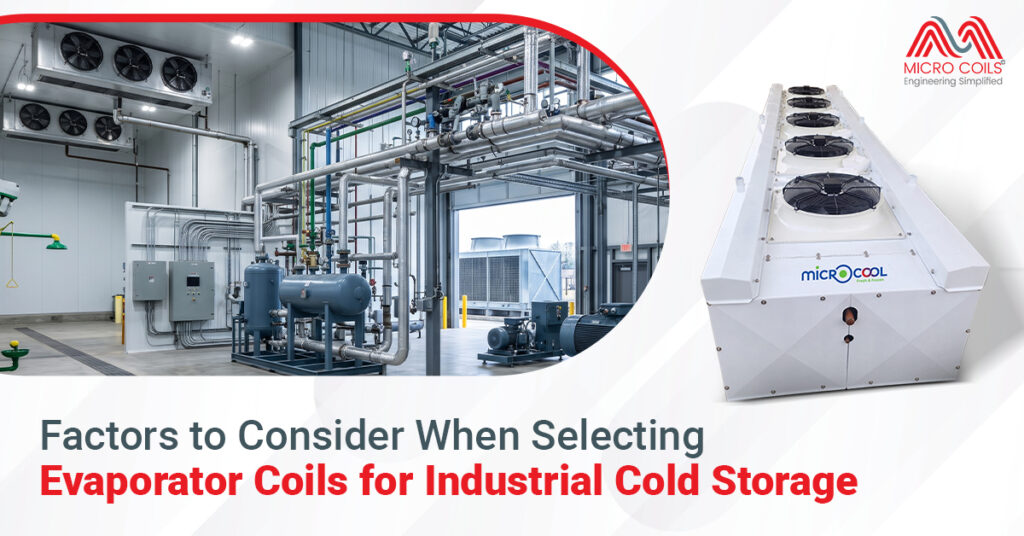
Industrial cold storage facilities rely on efficient refrigeration systems to maintain product quality, control temperature, and reduce spoilage. From frozen food warehouses and seafood processing plants to pharmaceutical storage facilities and agricultural distribution centres, every application has specific cooling requirements. Selecting the right refrigeration components is essential to meeting these requirements while controlling energy consumption and maintenance costs.
One of the most important decisions is choosing the right evaporator for the facility. Its design affects cooling capacity, airflow, temperature uniformity, moisture removal, and the frequency of defrost cycles. A poorly selected unit can create uneven temperatures, excessive frost buildup, and higher operating costs.
Choosing the right evaporator coil requires a careful assessment of the storage temperature, cooling load, product characteristics, room dimensions, and operating conditions. Businesses must also consider equipment materials, defrost requirements, energy efficiency, and long-term maintenance.
This guide explores the key factors to consider when selecting evaporators for industrial cold storage and explains how the right choice supports reliable refrigeration performance.
What Is an Evaporator in an Industrial Cold Storage System?
An evaporator is a heat exchanger that absorbs heat from the refrigerated space or a process fluid. It forms part of the refrigeration cycle and helps maintain the temperature required for storing products.
Inside the evaporator, low-pressure refrigerant absorbs heat and changes from a liquid or liquid-vapour mixture into vapour. Fans or pumps help transfer heat from the storage environment to the refrigerant, depending on the system design.
In cold storage facilities, air-cooling evaporators are commonly installed inside refrigerated rooms. Fans circulate room air across the heat transfer surfaces, allowing the system to remove heat from the space and its contents.
Different facilities require different evaporator designs. A chilled food warehouse may need high airflow and careful humidity control, while a frozen food facility may require low-temperature equipment with a suitable defrost system.
The selection process should therefore begin with the facility’s actual operating requirements rather than equipment size or price alone.
10 Factors to Consider When Selecting Evaporators for Industrial Cold Storage
1. Cooling Capacity and Refrigeration Load
Cooling capacity is one of the first factors to evaluate when selecting refrigeration equipment. The evaporator must provide sufficient heat transfer capacity to meet the facility’s cooling requirements under the expected operating conditions.
The refrigeration load includes heat entering through the walls, ceiling, floor, and doors, along with heat generated by lighting, equipment, and personnel. It also includes the heat introduced by incoming products.
For example, a facility that receives warm produce may have a different cooling load from a warehouse storing products that arrive already chilled or frozen.
When calculating the required capacity, consider:
- Storage room dimensions and insulation quality
- Required room temperature
- Product type, quantity, and incoming temperature
- Door-opening frequency and air infiltration
- Internal equipment and lighting loads
- Operating hours and peak demand
- Required product pull-down or freezing time
Accurate load calculations help prevent undersizing, which can result in inadequate cooling, and oversizing, which can increase capital costs and contribute to inefficient operation.
The evaporator’s rated capacity must also be checked at the intended refrigerant temperature, room temperature, and operating conditions. A nominal capacity rating alone may not reflect its actual performance in the facility.
2. Required Storage Temperature
Different products require different storage temperatures. The evaporator must operate effectively within the temperature range needed to preserve the stored goods.
Chilled storage generally operates above the freezing point of water, although the exact temperature depends on the product. Frozen storage requires much lower temperatures and places different demands on the refrigeration system.
Temperature requirements affect the evaporator’s heat transfer area, refrigerant operating conditions, fan selection, and defrost requirements.
For example, a frozen food warehouse may require an evaporator designed to operate at a low refrigerant temperature and withstand frequent frost formation. A chilled produce room may need greater attention to humidity and airflow to prevent excessive moisture loss.
Selecting equipment without accounting for the required temperature can lead to inadequate performance, excessive energy consumption, or product damage.
3. Evaporator Type and Design
Industrial cold storage facilities use different evaporator configurations depending on their cooling requirements and refrigeration system design.
Common options include the following.
- Air-cooling evaporators: These units use fans to circulate air across heat transfer surfaces. They are widely used in cold rooms, food warehouses, and distribution facilities.
- Finned-tube evaporators: These use tubes and attached fins to increase the surface area available for heat transfer. They are commonly found in commercial and industrial refrigeration equipment.
- Plate heat exchangers: These transfer heat between fluids through a series of plates. They may be suitable for secondary coolant systems or specific process refrigeration applications.
- Shell-and-tube heat exchangers: These are used in various industrial applications where heat must be transferred between refrigerant and another fluid.
The appropriate design depends on the cooling medium, temperature range, available space, airflow requirements, and maintenance needs.
Businesses should consult refrigeration engineers or equipment suppliers to determine which configuration best matches their application.
4. Airflow and Temperature Distribution
Uniform airflow is essential for maintaining consistent temperatures throughout a cold storage facility. The evaporator must circulate air effectively without creating excessive temperature differences between different areas of the room.
Insufficient airflow can result in warm spots, uneven cooling, and reduced heat transfer. Excessive airflow or poorly directed air can also create problems, particularly when products are sensitive to moisture loss or direct cold air exposure.
When assessing airflow, consider:
- Fan capacity and air throw
- Room dimensions and ceiling height
- Storage rack arrangement
- Product stacking and pallet placement
- Distance between the evaporator and stored goods
- Air return paths and potential obstructions
For large warehouses, evaporator placement is just as important as the equipment specification. The layout should allow conditioned air to reach the intended storage areas while returning warmer air to the unit.
Proper airflow design supports temperature uniformity and helps the refrigeration system operate more consistently.
5. Defrost Requirements and Frost Management
Frost forms when moisture from the air freezes on cold heat transfer surfaces. As frost accumulates, it restricts airflow and reduces heat transfer efficiency.
This issue is particularly important in low-temperature storage facilities, where evaporators may operate well below the freezing point of water.
Several defrost methods are used in industrial refrigeration systems.
- Electric defrost: Electric heating elements melt accumulated frost. This method is common in suitable low-temperature applications but consumes additional electricity during defrost.
- Hot-gas defrost: Hot refrigerant gas is directed through the evaporator to provide the heat needed to remove frost. This method requires appropriate system design and control.
- Off-cycle defrost: The refrigeration cycle is stopped temporarily to allow frost to melt. It is generally more suitable for applications where room temperatures permit effective natural defrosting.
The best method depends on the storage temperature, moisture load, operating schedule, and refrigeration system configuration.
Defrost cycles should be properly configured. Too little defrost allows ice to accumulate, while unnecessary or excessively long cycles waste energy and may raise room temperatures.
6. Material Selection and Corrosion Resistance
Industrial cold storage environments can expose refrigeration equipment to moisture, cleaning chemicals, salts, and other corrosive substances.
The materials used for tubes, fins, frames, drain pans, and protective coatings influence equipment durability and maintenance requirements.
Aluminium and copper are common heat transfer materials, while stainless steel may be used in selected applications where hygiene or corrosion resistance is important.
However, material selection should account for the complete operating environment. For example, seafood processing facilities may expose equipment to salt and frequent washdowns, while food processing plants may use cleaning chemicals that affect certain metals or protective finishes.
When selecting materials, consider:
- Exposure to moisture and condensation
- Cleaning agents and sanitation procedures
- Salt or chemical contamination
- Operating temperatures
- Compatibility between dissimilar metals
- Requirements for hygienic design
Corrosion-resistant materials can improve service life, but they may increase the initial purchase price. Businesses should compare this cost against expected maintenance, repair, and replacement expenses.
7. Energy Efficiency and Operating Costs
Energy consumption is a major consideration for industrial cold storage facilities, particularly those that operate continuously.
Evaporator performance affects the refrigeration system’s energy requirements through heat transfer efficiency, airflow resistance, fan power, and the operating temperature difference between the room and refrigerant.
The system should provide the required cooling without forcing compressors or fans to consume unnecessary energy.
Several design features can influence efficiency:
- Adequate heat transfer surface area
- Efficient fan motors
- Appropriate fan speed control
- Low air pressure drop
- Correct refrigerant distribution
- Suitable defrost scheduling
- Properly designed condensate drainage
The performance of the entire refrigeration system must be considered, not just the evaporator. The condenser coil and associated heat rejection equipment also affect operating pressures, compressor workload, and total energy consumption.
A lifecycle cost assessment should include equipment purchase, electricity, cleaning, maintenance, defrost energy, and expected component replacement.
An evaporator with a higher initial price may offer better long-term value if it reduces energy use and maintenance requirements.
8. Humidity Control and Product Requirements
Temperature is not the only factor that determines storage quality. Relative humidity also influences moisture loss, product appearance, texture, and shelf life.
Fruits and vegetables often require different humidity conditions from frozen meat or packaged products. A system that removes too much moisture may cause produce to lose weight and become shrivelled.
Humidity performance depends on factors such as the temperature difference between the room air and the evaporator surface, airflow, refrigeration control, and moisture entering through doors.
For products sensitive to dehydration, a design with an appropriate temperature difference and airflow pattern may help limit unnecessary moisture loss.
However, high humidity must be managed carefully to avoid condensation, ice formation, and microbial growth where these conditions are relevant.
Businesses should specify the storage temperature and humidity requirements before selecting equipment. The refrigeration design must then balance cooling capacity, moisture management, and energy consumption.
9. Installation Space and Equipment Layout
The physical arrangement of the cold storage facility affects which evaporator models can be installed and how effectively they will operate.
Ceiling height, available mounting space, service access, structural capacity, and the location of doors and racks all influence equipment selection.
The evaporator should be positioned to provide suitable air circulation while allowing technicians to access fans, drain pans, electrical components, and other serviceable parts.
Installation planning should also account for:
- Required clearance around the equipment
- Refrigerant and electrical connections
- Condensate drainage routes
- Access for cleaning and defrost maintenance
- Structural support for the unit
- Potential interference with storage racks or handling equipment
Poor placement can create airflow restrictions, increase maintenance difficulty, and reduce cooling effectiveness.
For existing cold rooms, a site assessment can help determine whether the selected equipment will fit without costly structural modifications.
10. Maintenance, Reliability, and Supplier Support
Industrial cold storage equipment must operate reliably to protect inventory and maintain production schedules. Evaporator selection should therefore include an assessment of maintenance requirements and available technical support.
Equipment that is difficult to clean or service may increase labour costs and extend maintenance downtime.
Before purchasing, evaluate:
- Ease of access to fans and heat transfer surfaces
- Availability of replacement parts
- Manufacturer warranty and service coverage
- Defrost system reliability
- Ease of cleaning and inspection
- Expected maintenance intervals
- Supplier experience with industrial refrigeration
A reliable supplier should provide technical specifications, installation guidance, operating instructions, and maintenance recommendations.
For critical storage facilities, businesses should also consider whether the refrigeration design needs redundant capacity or backup equipment to protect products during component failures.
Common Mistakes to Avoid When Selecting Cold Storage Evaporators
Even well-established businesses can experience refrigeration problems when equipment selection does not reflect actual operating conditions.
Choosing Equipment Based Only on Price
The lowest-priced unit may not provide the required cooling capacity, corrosion resistance, or energy performance. Compare technical specifications and lifecycle costs before making a decision.
Ignoring the Product Load
Incoming products can introduce significant heat into a cold room. Failing to account for product loading may lead to insufficient cooling during busy periods.
Overlooking Defrost Requirements
Frost accumulation can reduce airflow and cooling performance. Select a suitable defrost method and ensure the control strategy matches the facility’s operating conditions.
Neglecting Airflow Design
Blocked air paths, poor unit placement, and tightly packed products can create uneven temperatures even when the equipment has sufficient nominal capacity.
Failing to Consider Maintenance Access
Difficult access can increase servicing time and make routine cleaning less effective. Ensure the installation allows safe and convenient maintenance.
Using Inappropriate Materials
Equipment exposed to salt, moisture, or aggressive cleaning chemicals may deteriorate rapidly if its materials and protective finishes are unsuitable.
How to Improve the Performance of Industrial Cold Storage Evaporators?
Once the equipment has been selected and installed, proper operating practices help maintain performance.
- Clean heat transfer surfaces according to the manufacturer’s recommendations.
- Inspect fans and motors for wear, vibration, and abnormal noise.
- Monitor room temperatures and investigate unexplained fluctuations.
- Check for excessive frost and verify defrost operation.
- Keep storage racks and products clear of critical airflow paths.
- Inspect drain pans and condensate lines to prevent blockages.
- Check door seals and minimise unnecessary door openings.
- Schedule preventive maintenance with qualified refrigeration technicians.
Regular monitoring can help identify declining performance before it affects product quality or leads to a system failure.
Conclusion
Selecting the right evaporator for industrial cold storage requires a detailed understanding of the facility’s cooling load, storage temperature, airflow requirements, humidity conditions, and product characteristics. Equipment design, material selection, defrost arrangements, energy efficiency, and maintenance access also influence the decision.
A correctly selected unit supports consistent temperature control, protects stored products, and helps reduce avoidable energy and maintenance costs. However, no single evaporator design is suitable for every application.
Businesses should work with experienced refrigeration specialists to assess the operating conditions, calculate the required capacity, and compare suitable equipment options. By considering both initial investment and long-term performance, industrial facilities can make better decisions and build a more reliable cold storage operation.
A unit cooler is typically a packaged air-cooling assembly that contains an evaporator, fans, and associated components. An evaporator is the heat transfer component itself. In industrial cold rooms, the terms are sometimes used interchangeably, but they do not always refer to exactly the same equipment.
There is no universal best refrigerant. Ammonia, carbon dioxide, and various synthetic or alternative refrigerants are used depending on the required temperature, system size, safety requirements, environmental considerations, and local regulations. A refrigeration engineer should assess the application before recommending a refrigerant.
Cleaning frequency depends on the product stored, dust levels, hygiene requirements, operating conditions, and the manufacturer’s recommendations. Facilities handling food or products that generate debris may require more frequent inspections and cleaning than sealed-product warehouses.
A single refrigeration system can serve multiple rooms, but whether one evaporator can serve them all depends on the layout, cooling loads, temperature requirements, and control arrangement. Rooms with different temperature requirements often need separate evaporators or independently controlled cooling circuits.
Excessive frost or ice can result from humid air entering the room, frequent door openings, incorrect defrost settings, blocked airflow, or control problems. A qualified technician should identify the underlying cause rather than relying only on repeated manual defrosting.
Provide the room dimensions, target temperature, product type, expected product load, incoming product temperature, ambient conditions, door-opening frequency, available mounting space, and preferred refrigeration system. These details help suppliers recommend equipment with suitable capacity and operating characteristics.
In many cases, yes. However, the replacement must be compatible with the refrigerant, operating pressures, capacity requirements, control system, and available installation space. An engineering assessment is important to confirm that the new equipment will operate correctly with the existing refrigeration plant.
No. A larger heat transfer surface may improve performance under suitable conditions, but equipment selection must also account for airflow, refrigerant distribution, fan power, humidity, and system compatibility. The goal is to match the evaporator to the calculated cooling load and required operating conditions rather than simply selecting the largest available model.

