

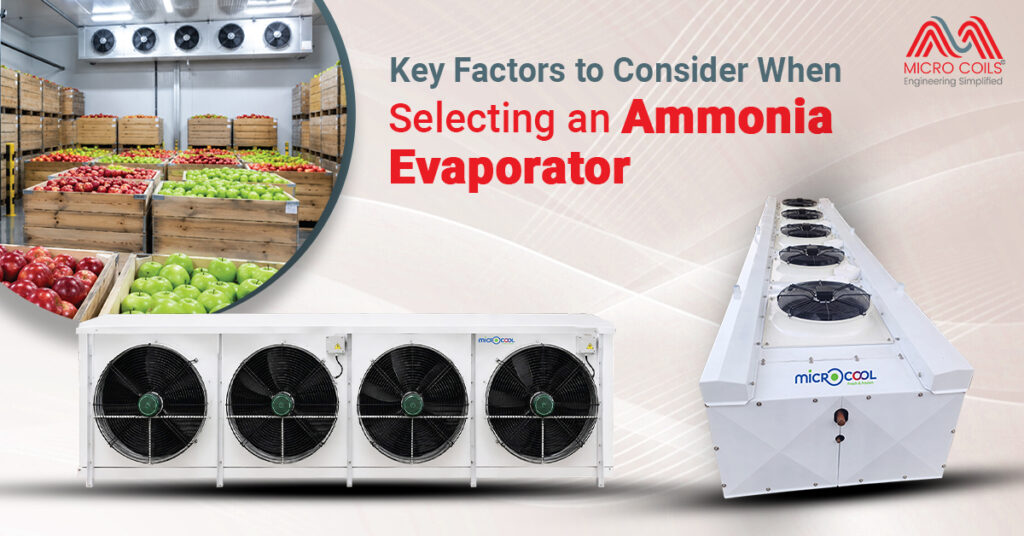
Selecting the right ammonia evaporator is essential for maintaining efficient heat transfer, stable refrigeration temperatures, and reliable system performance. The choice depends on factors such as cooling capacity, operating temperature, ammonia flow, construction materials, space limitations, and maintenance requirements. A properly selected evaporator can improve energy efficiency, reduce operating costs, and support consistent cooling performance.
In industrial refrigeration systems, the evaporator works as a critical heat exchange component. It absorbs heat from the room, product, process fluid, or surrounding environment and transfers that heat to the ammonia refrigerant. Because ammonia systems often operate in demanding industrial environments, evaporator selection requires more than simply matching cooling capacity. Engineers must consider the complete operating conditions and long-term requirements of the application.
1. Cooling Capacity and Heat Load
Cooling capacity is one of the first factors to evaluate when selecting an ammonia evaporator. The evaporator must be capable of removing the required amount of heat under the actual operating conditions of the refrigeration system. Undersizing can result in insufficient cooling, while excessive capacity may increase equipment costs and create inefficient operating conditions. A proper heat-load calculation therefore provides the foundation for selecting the right evaporator size.
The heat load can come from several sources, including products entering a cold room, transmission through walls, doors opening, lighting, people, fans, and other equipment. Process refrigeration applications may have additional heat sources that need to be included in the calculation. The design should also account for peak loads rather than relying only on average operating conditions. Accurate load calculations help ensure that the evaporator delivers the required performance without unnecessary oversizing.
2. Operating Temperature
The required evaporating temperature has a direct effect on evaporator selection. Applications such as chilled storage, frozen food processing, blast freezing, and industrial process cooling can operate at very different temperature ranges. The selected evaporator must provide adequate heat transfer at the system’s intended evaporating temperature. A mismatch can reduce capacity and affect overall refrigeration efficiency.
Temperature difference between the refrigerant and the cooled medium is another important consideration. A larger temperature difference can increase heat-transfer capacity, but it may also affect product quality, humidity, and energy consumption. For food applications, excessive temperature differences can contribute to dehydration or unwanted surface drying. The evaporator should therefore be selected based on both thermal performance and the requirements of the product or process.
3. Ammonia Flow and Refrigerant Circuit Design
Ammonia flow characteristics play an important role in evaporator performance. The refrigerant must circulate through the heat exchanger at a rate that supports effective boiling and heat transfer. The circuit configuration should match the refrigeration system, whether it uses flooded, direct-expansion, or another ammonia refrigeration arrangement. Poor circuit design can create uneven refrigerant distribution and reduce the usable heat-transfer area.
Engineers should also consider pressure drop across the evaporator. Excessive pressure drop can reduce system efficiency and affect the operating conditions at the compressor. Refrigerant distribution becomes especially important in larger evaporators with multiple circuits or complex piping arrangements. A well-designed circuit balances refrigerant flow, heat transfer, pressure drop, and system stability.
4. Evaporator Type and Application
Different industrial applications require different evaporator configurations. Air-cooling systems commonly use finned heat exchangers, while liquid cooling and process applications may use shell-and-tube, plate, or other specialized designs. The correct configuration depends on what needs to be cooled and how heat must be transferred. Selecting an evaporator based solely on capacity without considering the application can lead to operational problems.
For cold rooms and warehouses, airflow and product storage conditions are particularly important. Process applications may instead prioritize fluid-side heat transfer, compact construction, or precise temperature control. In applications involving direct contact with products or food-processing environments, hygiene and cleanability also become important. The evaporator design should therefore be matched to the physical and operational conditions of the installation.
5. Heat Transfer Surface Area
Heat transfer surface area determines how effectively the evaporator can absorb heat from the surrounding medium. A larger surface provides more area for heat exchange, although the relationship between surface area and performance also depends on materials, refrigerant flow, airflow, and temperature difference. Manufacturers typically optimize tube arrangements and surface configurations to achieve the required capacity within the available footprint. The goal is to achieve sufficient heat transfer without unnecessarily increasing equipment size.
Fin spacing is particularly important in air-cooling applications. Systems operating at temperatures above freezing may use relatively close fin spacing, while low-temperature applications can require wider spacing to reduce the effects of frost accumulation. If frost builds up between fins, airflow can decrease and heat transfer can deteriorate. Evaporator selection should therefore consider both clean-surface performance and performance under actual operating conditions.
6. Material Compatibility and Construction
Ammonia refrigeration requires materials that are compatible with the refrigerant and the operating environment. Carbon steel is widely used in industrial ammonia systems because of its compatibility and mechanical properties. Other materials may be selected for specific components or applications depending on pressure, temperature, corrosion exposure, and hygiene requirements. Material selection should always follow the applicable engineering standards and manufacturer’s specifications.
Construction quality also affects the service life of the evaporator. Tube thickness, welding quality, pressure ratings, connection design, and structural support all contribute to equipment reliability. Industrial refrigeration equipment may experience significant temperature changes, vibration, and mechanical stress throughout its operating life. A robust construction approach helps reduce the likelihood of leaks, premature failure, and unplanned downtime.
7. Frost Formation and Defrost Requirements
For low-temperature refrigeration, frost formation can significantly affect evaporator performance. Moisture in the air can freeze on the heat-transfer surface, creating an insulating layer that restricts heat transfer. As the frost layer becomes thicker, airflow may also decrease, reducing the evaporator’s effective capacity. The defrost strategy should therefore be considered during evaporator selection rather than treated as a separate operational issue.
The required defrost method depends on the application and operating temperature. Hot-gas defrost, water defrost, electric defrost, and other approaches may be suitable in different situations. Ammonia industrial systems often require careful coordination between refrigeration and defrost cycles to prevent unnecessary energy consumption. The evaporator should be compatible with the selected defrost method and designed to withstand the associated thermal conditions.
8. Airflow and Fan Performance
In forced-air systems, airflow has a major influence on evaporator capacity. Fans must move enough air across the heat-transfer surface to distribute cooling throughout the space. However, excessive airflow can increase fan power consumption, product moisture loss, or unwanted temperature variation. The evaporator and fan combination should therefore be evaluated as a complete system.
Fan selection should consider airflow volume, static pressure, motor efficiency, noise, and operating temperature. Fan placement can also affect how evenly the cooled air reaches different areas of a room. Poor air distribution can create warm spots even when the evaporator has sufficient nominal capacity. A suitable design balances heat transfer with effective and controlled air circulation.
9. Energy Efficiency
Energy efficiency should be evaluated over the expected operating life of the evaporator rather than only at the time of purchase. Heat-transfer efficiency, fan power, refrigerant pressure drop, defrost requirements, and operating temperature can all influence total energy consumption. A more efficient evaporator may have a higher initial cost but can reduce operating expenses over time. Lifecycle cost analysis can help compare different designs.
The evaporator should also support efficient compressor operation. Lower pressure drops and appropriate evaporating temperatures can help reduce the amount of energy required to provide the desired cooling. Fouling, frost, poor airflow, and improper refrigerant distribution can gradually reduce efficiency. Selecting equipment that is easy to maintain can therefore contribute to long-term energy performance.
10. Space and Installation Requirements
Available installation space is another practical consideration. An evaporator with excellent thermal performance may not be suitable if it cannot fit within the available ceiling, wall, machinery, or process area. Dimensions, connection locations, service clearances, fan orientation, and mounting arrangements should all be reviewed before final selection. Early coordination between the evaporator manufacturer and installation team can prevent costly modifications.
The surrounding environment should also be considered. Equipment installed in food-processing facilities may face frequent cleaning, moisture, chemicals, or washdown conditions. Outdoor or semi-outdoor installations may require additional protection against environmental exposure. The selected design should suit the physical conditions where the evaporator will operate.
11. Maintenance and Accessibility
Maintenance requirements can have a major impact on the long-term cost of an ammonia refrigeration system. Components should be accessible for inspection, cleaning, fan servicing, defrost maintenance, and leak detection. If an evaporator is difficult to access, routine maintenance may be delayed or performed less frequently. This can gradually affect system performance and reliability.
Consider the cleaning requirements of the application before finalizing the equipment. In food and beverage facilities, evaporator surfaces may require regular cleaning to maintain hygiene and heat-transfer efficiency. Drainage arrangements should prevent standing water and help reduce contamination risks. A design that simplifies routine maintenance can contribute to longer service life and more consistent performance.
12. Safety and Pressure Rating
Safety is particularly important when selecting equipment for ammonia refrigeration. Ammonia is an efficient industrial refrigerant, but it requires appropriately designed equipment, piping, controls, ventilation, and safety systems. The evaporator must be rated for the pressures and temperatures expected during normal operation and relevant abnormal conditions. Applicable codes, standards, and local regulatory requirements should be considered during equipment selection.
Manufacturers should provide appropriate documentation covering pressure ratings, materials, testing, connections, and operating limits. Relief and isolation arrangements should also be compatible with the overall refrigeration system. The evaporator cannot be evaluated independently from the safety architecture of the installation. A complete engineering review is essential before commissioning the system.
13. Corrosion Resistance
Industrial refrigeration environments can expose equipment to moisture, chemicals, cleaning agents, salts, and other corrosive substances. Corrosion can gradually reduce heat-transfer performance and compromise mechanical integrity. The evaporator’s materials, surface treatments, coatings, and construction should therefore match the environment where it will operate.
This consideration becomes especially important in food processing, seafood facilities, chemical plants, and coastal environments. Cleaning chemicals can also affect exposed surfaces if the equipment is not designed for the application. Discussing environmental conditions with the manufacturer can help determine suitable materials and protective measures. Regular inspection should then be incorporated into the maintenance program.
14. Controls and System Integration
An evaporator should work effectively with the refrigeration system’s controls. Temperature sensors, pressure controls, expansion devices, solenoid valves, fan controls, and defrost systems may all interact with evaporator operation. Poor coordination between these components can cause unstable temperatures or inefficient cycling. Control requirements should therefore be considered before selecting the final configuration.
Modern industrial refrigeration systems may also incorporate monitoring and automation. Data from temperature, pressure, airflow, and operating hours can help identify performance changes and maintenance requirements. Compatibility with the site’s control architecture can make operation easier to manage. It can also provide useful information for troubleshooting and preventive maintenance.
Key Selection Criteria to Check While Selecting Ammonia Evaporators
Before finalizing an ammonia evaporator, engineers should review the following factors:
- Cooling capacity: Confirm the evaporator can handle the calculated design and peak heat load.
- Operating temperature: Match the evaporator to the required room, product, or process temperature.
- Refrigerant configuration: Verify compatibility with flooded, DX, or other ammonia system arrangements.
- Heat-transfer area: Check that the surface area supports the required capacity under actual operating conditions.
- Fin spacing: Select suitable spacing based on operating temperature and expected frost formation.
- Airflow: Ensure the fan and coil arrangement provides adequate and uniform air circulation.
- Pressure drop: Keep refrigerant and air-side pressure losses within acceptable limits.
- Materials: Confirm that construction materials are suitable for ammonia and the surrounding environment.
- Defrost system: Ensure the evaporator supports the required defrost method and cycle.
- Installation space: Check dimensions, mounting, piping connections, and service clearances.
- Maintenance access: Provide sufficient access for cleaning, inspection, and component replacement.
- Safety rating: Verify pressure ratings, testing requirements, and applicable standards.
- Corrosion protection: Consider moisture, chemicals, salt exposure, and cleaning conditions.
- Controls: Confirm compatibility with sensors, valves, fans, automation, and monitoring systems.
- Lifecycle cost: Compare purchase price with energy, maintenance, downtime, and replacement costs.
15. Manufacturer Support and Customisation
The manufacturer’s technical expertise can be valuable when selecting an ammonia evaporator for a complex installation. Standard equipment may work well for common applications, but some industrial systems require customized dimensions, connection arrangements, materials, circuiting, or airflow configurations. A manufacturer with experience in ammonia refrigeration can help match the evaporator design to the system’s operating conditions. Technical documentation also makes installation and future maintenance easier.
After-sales support is another factor worth considering. Spare parts availability, service support, warranty terms, technical documentation, and troubleshooting assistance can affect the equipment’s total lifecycle value. A refrigeration system may operate for many years, making long-term support more important than the initial purchase price alone. Evaluating the supplier alongside the equipment helps create a more reliable procurement decision.
Evaporator Coil vs Other Cooling Components
It is important to distinguish industrial ammonia equipment from components used in comfort air-conditioning systems. An evaporator coil is generally designed to absorb heat from air or another medium as refrigerant evaporates inside the heat exchanger. An AC evaporator coil is typically designed around the requirements of air-conditioning applications, which can differ considerably from heavy-duty industrial refrigeration.
Industrial ammonia systems require equipment designed around ammonia compatibility, pressure requirements, operating temperatures, refrigerant circulation, and application-specific heat loads. Refrigeration coils can be configured for different refrigerants and operating environments, so their suitability should always be verified against the intended application. Using terminology interchangeably without checking the actual design specifications can result in selecting equipment that does not meet the system’s requirements.
Conclusion
Selecting an ammonia evaporator requires a detailed evaluation of thermal, mechanical, operational, and safety requirements. Cooling capacity, operating temperature, refrigerant flow, heat-transfer surface, airflow, frost formation, materials, pressure rating, and maintenance access all influence the final choice. Energy efficiency and lifecycle costs should also be considered alongside the initial equipment price.
The right evaporator should work as part of the complete refrigeration system rather than as an isolated component. Reviewing the application with an experienced manufacturer or refrigeration engineer can help confirm the required specifications and avoid costly sizing or installation problems. With careful selection, the evaporator can support reliable cooling, efficient operation, and long-term industrial refrigeration performance.
An ammonia evaporator is a heat exchanger used in industrial refrigeration systems to absorb heat from air, water, products, or other process fluids. Ammonia evaporates inside the system as it absorbs this heat, producing the required cooling effect.
Consider cooling capacity, operating temperature, ammonia flow, heat-transfer area, airflow, pressure drop, defrost requirements, available space, materials, and maintenance needs. The evaporator should be selected based on the actual heat load and operating conditions.
Heat-transfer surface area determines how effectively the evaporator can absorb heat from the surrounding medium. Adequate surface area helps achieve the required cooling capacity while maintaining suitable operating temperatures and energy efficiency.
Carbon steel is commonly used in industrial ammonia refrigeration systems because of its compatibility with ammonia and its mechanical strength. Material selection may vary depending on pressure, temperature, corrosion exposure, hygiene requirements, and the specific application.
An appropriately sized evaporator can improve heat transfer while minimizing unnecessary pressure drop and energy consumption. Proper refrigerant distribution, airflow, defrost management, regular cleaning, and suitable operating temperatures can further support efficient system performance.

