

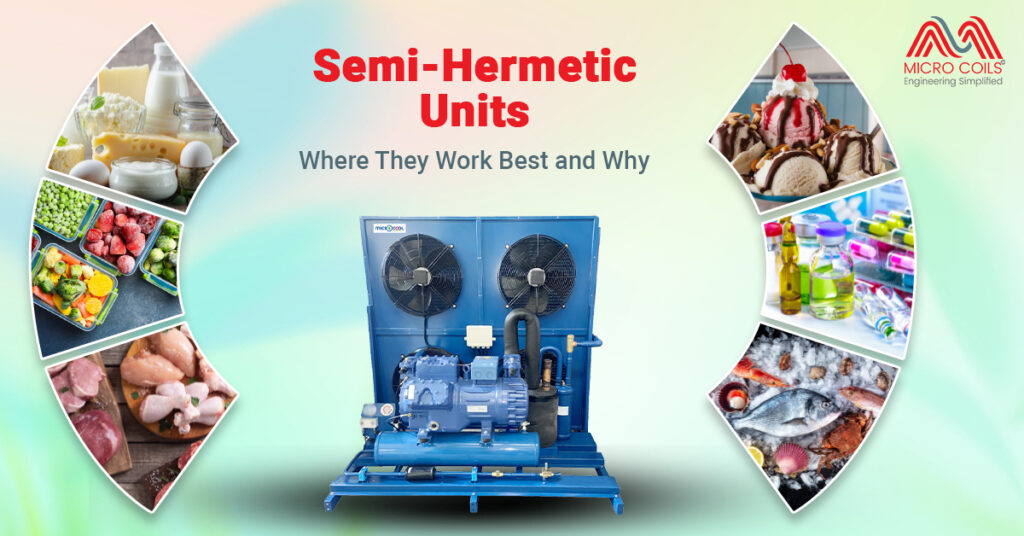
Semi-hermetic units are widely used in commercial refrigeration, industrial cooling, food processing, cold storage, and selected HVAC applications. They combine a compressor and motor within a bolted housing that can be opened for inspection and repair. This serviceable design makes them different from fully hermetic compressors, which are permanently sealed and are generally replaced when major internal failures occur. For businesses that depend on reliable temperature control, semi-hermetic units can offer a practical balance between performance, durability, maintenance, and long-term serviceability.
The choice of compressor technology depends on the requirements of the complete refrigeration system. Cooling capacity, refrigerant type, evaporating temperature, condensing temperature, electrical supply, ambient conditions, and operating hours all influence compressor selection. Maintenance requirements and access to spare parts are also important when equipment is installed in commercial or industrial facilities. Understanding where semi-hermetic units work best can therefore help businesses select equipment that matches their operational needs.
What Is a Semi-Hermetic Unit?
A semi-hermetic unit is a refrigeration compressor assembly in which the compressor and electric motor are enclosed within a common housing. The housing is secured with bolts rather than being permanently welded or sealed, allowing qualified technicians to access internal components. Depending on the compressor design, service personnel may inspect or replace valves, pistons, bearings, gaskets, electrical components, and other parts. This construction provides a significant maintenance advantage in applications where refrigeration equipment must remain operational for long periods.
Semi-hermetic compressors are available in several capacities and configurations to suit different refrigeration requirements. Reciprocating designs are commonly found in commercial refrigeration, while other configurations may be used for larger or specialized systems. The compressor is selected according to the required refrigeration capacity and operating conditions rather than simply its physical size. When correctly matched with the condenser, evaporator, expansion device, controls, and piping, a semi-hermetic unit can form part of a reliable refrigeration system.
How Does a Semi-Hermetic Unit Work?
A semi-hermetic compressor operates as part of the vapor-compression refrigeration cycle. Low-pressure refrigerant vapor enters the compressor through the suction side, where the compressor increases its pressure and temperature. The high-pressure vapor then travels to the condenser, where heat is rejected and the refrigerant changes into a high-pressure liquid. After passing through the expansion device, the refrigerant enters the evaporator at a lower pressure and absorbs heat before returning to the compressor.
The compressor is responsible for maintaining refrigerant circulation throughout the system. Its operation creates the pressure difference required for the refrigerant to move between the evaporator and condenser. The compressor must operate within its specified pressure and temperature range to maintain reliable performance. Conditions such as excessive discharge pressure, inadequate suction pressure, poor lubrication, or liquid refrigerant return can affect compressor operation.
Where Do Semi-Hermetic Units Work Best?
Semi-hermetic units are particularly useful in applications where refrigeration systems operate for extended periods and maintenance access is important. They are commonly found in commercial refrigeration, cold storage, food processing, industrial cooling, and selected HVAC installations. Their serviceable construction can be valuable where replacing an entire compressor after every major internal failure would be costly or disruptive. The best application is therefore one where the benefits of repairability and robust construction justify the equipment and maintenance requirements.
The operating environment also influences whether a semi-hermetic unit is appropriate. Facilities with high refrigeration loads, long operating hours, and established maintenance teams can benefit from serviceable compressor designs. Equipment selection should still be based on engineering calculations and manufacturer performance data rather than application type alone. A semi-hermetic compressor that is incorrectly sized or operated outside its specified conditions may not deliver the expected reliability.
Semi-Hermetic Units in Supermarkets
Supermarkets rely on refrigeration systems to protect food products across multiple temperature zones. Refrigeration equipment may serve display cases, walk-in coolers, freezers, dairy sections, beverage areas, meat counters, and frozen-food storage. Semi-hermetic compressors can be used in suitable central refrigeration systems where long operating hours and serviceability are important. Their ability to be opened for inspection can help maintenance teams address certain mechanical problems without automatically replacing the complete compressor.
Retail refrigeration loads can change throughout the day as doors open, products are added, customers enter the store, and ambient conditions fluctuate. Multiple compressors can sometimes be used to provide greater flexibility when refrigeration demand changes. Compressor capacity should be selected according to the actual load profile and operating conditions. Proper condenser performance, evaporator capacity, refrigerant control, and airflow are equally important for maintaining the required temperatures.
Semi-Hermetic Units in Cold Storage
Cold storage warehouses require dependable refrigeration because stored products may need controlled temperatures for extended periods. These facilities can handle food, pharmaceuticals, frozen products, and other temperature-sensitive materials. Semi-hermetic units can be used in suitable systems where capacity, durability, and serviceability are important. Their application may range from medium-temperature storage rooms to low-temperature freezing environments, depending on the compressor specification.
Cold storage systems often experience varying loads when products enter the facility at different temperatures. Door openings can also introduce warm and humid air, increasing the refrigeration load and potentially contributing to frost formation. Compressor selection should therefore account for product load, room size, infiltration, ambient temperature, storage temperature, and operating schedule. Proper insulation and temperature monitoring are also essential for maintaining efficient operation.
Semi-Hermetic Units in Food Processing
Food processing plants frequently require refrigeration during manufacturing, preparation, freezing, and storage. Meat, seafood, dairy products, bakery goods, beverages, frozen foods, and prepared meals may all require controlled temperatures at different production stages. Semi-hermetic units can support suitable refrigeration systems where reliable operation and maintenance access are important. Their serviceable design can be particularly useful when refrigeration equipment supports continuous production activities.
A refrigeration failure in a food processing facility can disrupt production and affect temperature-sensitive products. Preventive maintenance can help identify issues with compressors, fans, controls, refrigerant flow, and heat-transfer surfaces before they result in significant downtime. The compressor should be selected according to the actual process load rather than the facility’s general refrigeration capacity. Hygiene requirements, cleaning procedures, ambient conditions, and equipment accessibility should also be considered during system design.
Semi-Hermetic Units in Commercial Kitchens
Hotels, restaurants, catering companies, and institutional kitchens depend on refrigeration for food preparation and storage. Applications may include walk-in refrigerators, freezers, cold rooms, beverage systems, and preparation equipment. Semi-hermetic compressors can be appropriate for larger commercial systems where serviceability and extended operation are important. Smaller appliances may use different compressor technologies depending on their capacity, size, and design requirements.
Commercial kitchens can experience significant variations in refrigeration demand throughout the day. Frequent door openings and the introduction of warm food can increase the heat load placed on refrigeration equipment. A properly designed system must therefore account for both normal operating conditions and expected peak loads. Regular cleaning, condenser maintenance, proper airflow, and temperature monitoring can help maintain reliable refrigeration performance.
Semi-Hermetic Units in Industrial Refrigeration
Industrial facilities may require refrigeration for process cooling, temperature-controlled manufacturing, storage, or equipment protection. These applications can involve long operating hours and demanding environmental conditions. Semi-hermetic units may be suitable when their capacity and operating range match the requirements of the industrial system. Their serviceability can also make them useful in facilities where maintenance access and equipment longevity are important considerations.
Industrial refrigeration systems should be evaluated as complete installations rather than based on compressor specifications alone. Piping design, refrigerant flow, heat-transfer surfaces, controls, insulation, and heat rejection all affect overall performance. Operating conditions can also vary significantly between different production processes. Engineering calculations and manufacturer performance data should therefore guide compressor selection.
Major Benefits of Semi-Hermetic Units
Serviceability
Serviceability is one of the main reasons semi-hermetic units remain relevant in commercial and industrial refrigeration. Their bolted housing allows qualified technicians to access internal components for inspection and repair. Depending on the type of failure, individual components may be replaced rather than discarding the complete compressor. This can be particularly valuable for large systems where compressor replacement involves significant equipment, labor, and downtime costs.
Durability
Semi-hermetic compressors are commonly designed for demanding refrigeration environments. Their robust construction can support applications involving long operating periods and substantial refrigeration loads. However, durability depends on correct installation, lubrication, refrigerant conditions, electrical supply, and operating temperatures. A well-built compressor can still experience premature failure if the surrounding refrigeration system is poorly designed or maintained.
Capacity Flexibility
Semi-hermetic compressors are available in various capacities to meet different refrigeration requirements. This allows designers to select equipment based on calculated cooling loads and operating conditions. Multiple compressors may also be used in suitable systems to provide capacity staging and operational flexibility. This can help refrigeration systems respond to changes in demand throughout the day.
The Role of the Condenser
The condenser plays an important role in determining overall refrigeration performance. It removes heat from the high-pressure refrigerant leaving the compressor and transfers that heat to the surrounding environment or another heat-transfer medium. If the condenser cannot reject heat effectively, condensing pressure may increase and place additional demand on the compressor. Regular cleaning and adequate airflow are therefore important for air-cooled systems.
In air-cooled refrigeration equipment, the AC condenser coil must have suitable heat-transfer capacity for the application. Dust, dirt, debris, and restricted airflow can reduce condenser performance and increase operating pressure. Regular inspection helps maintain heat rejection and can prevent unnecessary compressor stress. The condenser should always be evaluated as part of the complete refrigeration system rather than as an isolated component.
The Role of Evaporators
The evaporator absorbs heat from the refrigerated space, product, or process. It works with the compressor to maintain the pressure and temperature conditions required for the refrigeration cycle. Evaporator capacity, airflow, refrigerant distribution, and surface condition can all influence compressor operating conditions. A problem in the evaporator can therefore affect the performance of the entire system.
The selection of refrigeration coils should consider cooling capacity, refrigerant type, operating temperature, airflow, environmental conditions, and defrost requirements. Coil design can influence heat-transfer efficiency and the ability of the system to maintain stable temperatures. In low-temperature applications, frost accumulation can also restrict airflow and reduce heat-transfer performance. Regular inspection and appropriate defrost practices can help maintain system efficiency.
How to Select the Right Semi-Hermetic Unit?
Selecting a semi-hermetic compressor should begin with an accurate assessment of the refrigeration load. The required capacity depends on factors such as product load, room dimensions, heat infiltration, ambient conditions, operating temperature, and expected usage. The compressor should then be evaluated at the actual evaporating and condensing conditions expected during operation. Manufacturer performance tables and selection software can provide important information during this process.
Refrigerant compatibility is another essential consideration during selection. The compressor, lubricant, seals, valves, controls, and other system components must be compatible with the chosen refrigerant. Electrical requirements such as voltage, phase, frequency, motor rating, and starting characteristics must also be checked. Maintenance access and spare-parts availability should be considered because they directly affect long-term serviceability.
Conclusion
Semi-hermetic units work best in commercial and industrial refrigeration applications where durability, serviceability, capacity flexibility, and extended operating periods are important. Their bolted construction allows qualified technicians to access internal components, making inspection and repair possible when appropriate. This characteristic can be valuable in supermarkets, cold storage warehouses, food processing facilities, commercial kitchens, industrial plants, and selected HVAC systems. Their performance, however, depends on correct selection, installation, operating conditions, and maintenance.
Regular maintenance can help prevent problems related to lubrication, overheating, refrigerant conditions, electrical faults, and mechanical wear. When these factors are managed properly, semi-hermetic units can provide dependable performance for demanding cooling solutions.
A semi-hermetic unit has a bolted housing that can be opened for internal inspection and servicing. A fully hermetic compressor has a permanently sealed housing that generally cannot be opened for conventional internal repair. This difference makes semi-hermetic designs more serviceable in many larger refrigeration applications. The appropriate compressor type depends on the capacity, application, maintenance strategy, and system design.
Yes, specific semi-hermetic models are designed for low-temperature refrigeration applications. However, the compressor must be selected according to the required evaporating temperature, refrigerant, condensing conditions, and cooling capacity. Operating outside the manufacturer’s specified range can increase mechanical and thermal stress. Proper system design is therefore essential for reliable low-temperature operation.
Regular preventive maintenance is one of the most effective ways to support compressor longevity. Maintaining correct lubrication, refrigerant conditions, suction pressure, discharge pressure, condenser performance, and electrical supply can reduce unnecessary stress. Operators should also investigate unusual vibration, temperature, noise, and pressure changes promptly. Following the manufacturer’s maintenance and operating recommendations is essential.
Overheating can result from high condensing pressure, excessive compression ratios, inadequate cooling, electrical problems, insufficient refrigerant flow, or unsuitable operating conditions. Poor condenser performance can also cause the compressor to operate at higher discharge pressures. Incorrect lubrication or refrigerant-related problems may contribute to excessive operating temperatures. The underlying cause should be diagnosed before making system adjustments.
Yes, suitable semi-hermetic units can be used in refrigeration systems serving food processing facilities. They can support applications involving cold rooms, storage areas, processing spaces, freezing systems, and other temperature-controlled environments. Selection should consider the facility’s refrigeration load, operating temperatures, hygiene requirements, and production schedule. Professional system design is important because refrigeration requirements can vary significantly between food-processing operations.

