

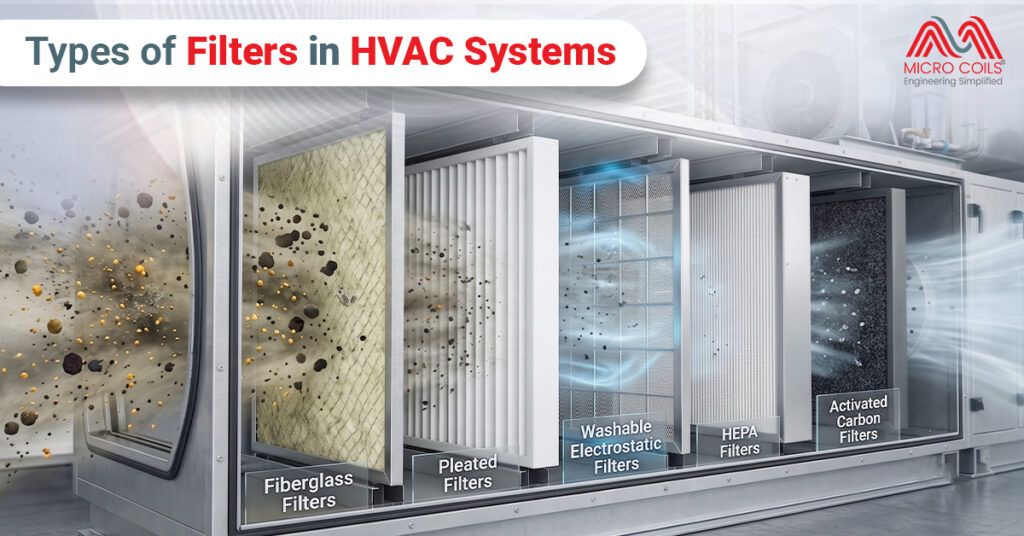
HVAC (Heating, Ventilation, and Air Conditioning) filters play a vital role in keeping heating, ventilation, and air conditioning systems running efficiently. They capture dust, pollen, pet dander, and other airborne particles before they circulate through your indoor space. A good filter not only improves indoor air quality but also protects HVAC components from dirt buildup, helping the system perform better and last longer.
With several types of HVAC filters available, choosing the right one can be confusing. Each filter is designed to meet different air quality needs, efficiency levels, and maintenance requirements. Some are ideal for homes, while others are better suited for commercial buildings, healthcare facilities, or industrial environments. Understanding the features and benefits of each type will help you select a filter that delivers the right balance of performance, cost, and protection.
What is an HVAC Filter?
An HVAC filter is a key component of a heating, ventilation, and air conditioning system. It is designed to capture dust, dirt, pollen, pet dander, mold spores, and other airborne particles before they pass through the system and circulate indoors. Positioned within the airflow path, the filter helps keep the air cleaner while protecting important HVAC components such as the blower, coils, and ducts from dust buildup.
The primary purpose of an HVAC filter is to improve system performance and maintain healthy indoor air quality. Without a filter, dust and debris can accumulate inside the equipment, reducing airflow and forcing the system to work harder. Over time, this can increase energy consumption, reduce efficiency, and lead to costly repairs or premature equipment failure.
HVAC filters are available in different materials and filtration ratings, with each type suited for specific applications. Basic filters are effective at trapping larger particles, while advanced filters can capture microscopic contaminants, making them ideal for hospitals, laboratories, commercial spaces, and homes with allergy sufferers.
Regular filter maintenance is equally important. A clogged or dirty filter restricts airflow, lowers system efficiency, and affects indoor comfort. Replacing or cleaning the filter at recommended intervals helps ensure consistent performance, lower energy costs, and a longer lifespan for the HVAC system. Choosing the right filter and maintaining it properly are simple steps that contribute to cleaner air and a more efficient heating and cooling system.
Why HVAC Filters Matter?
Filters do more than just trap dust. They protect the internal components of your HVAC system from particles that could cause damage or reduce efficiency. When a filter gets clogged or is simply the wrong type for your setup, the whole system has to work harder to push air through, and that extra strain adds up fast.
Each filter’s performance is measured using a MERV rating, which stands for Minimum Efficiency Reporting Value, and this number goes from 1 to 20. The higher the number, the better the filter is at capturing smaller particles. That said, a very high MERV rating can also restrict airflow, so balance matters just as much as filtration power.
How Filters Connect to Your Cooling System?
Filters and coils work closely together inside your HVAC unit, and the connection between them is more important than most people realize. As experienced HVAC coil manufacturers, we recommend using the right filter to protect condenser and evaporator coils, improve airflow, and extend the lifespan of the entire HVAC system. When air passes through a dirty or poorly matched filter, it directly affects the coils that do the actual cooling work. The AC condenser coil, which releases heat from the refrigerant to the outside air, can overheat or underperform when airflow is restricted by a clogged filter over time.
The same principle applies to the evaporator coil, which absorbs heat from the indoor air to bring the temperature down. A filter that is too dirty reduces the airflow reaching this coil, and that drop in airflow can cause it to freeze over and stop cooling altogether. Think of the filter as the first line of defense for these components. Replacing it on time is one of the most straightforward ways to protect your system and avoid expensive repairs down the road.
MERV Rating in HVAC Filters Explained
MERV, or Minimum Efficiency Reporting Value, is the standard rating system used to measure how effectively an HVAC filter captures airborne particles. Developed by the American Society of Heating, Refrigerating and Air-Conditioning Engineers (ASHRAE), the MERV rating helps users compare different filters based on their filtration efficiency.
The MERV scale ranges from 1 to 20. In general, the higher the MERV rating, the smaller the particles the filter can capture. Filters with lower ratings are designed to trap larger particles such as dust, lint, and pollen. Higher-rated filters can remove finer contaminants, including mold spores, bacteria, smoke particles, and some airborne viruses.
Here is a quick breakdown of MERV ratings:
- MERV 1 to 4: Basic filters that capture large dust particles, carpet fibers, and lint. Commonly used in residential systems with minimal filtration needs.
- MERV 5 to 8: Suitable for most homes and small commercial buildings. They effectively trap dust, pollen, mold spores, and pet dander while maintaining good airflow.
- MERV 9 to 12: Ideal for offices, schools, healthcare clinics, and homes where better indoor air quality is required. These filters capture finer particles, including lead dust and auto emissions.
- MERV 13 to 16: High-efficiency filters used in hospitals, laboratories, and commercial facilities. They remove bacteria, smoke, and other microscopic particles.
- MERV 17 to 20: HEPA-level filtration used in cleanrooms, pharmaceutical facilities, and specialized healthcare environments where the highest level of air cleanliness is essential.
While a higher MERV rating provides better filtration, it is important to choose a filter that is compatible with your HVAC system. Filters that are too restrictive can reduce airflow, forcing the system to work harder and potentially increasing energy consumption. Always select a filter that balances filtration efficiency with your system’s airflow requirements and the indoor air quality needs of your space.
Different Types of HVAC Filters Explained
Fiberglass Filters
Fiberglass filters are among the most commonly used and cost-effective options available. They are made from layered fiberglass strands reinforced with a metal grate to hold their shape. Their biggest advantage is affordability, and they are widely available in most hardware and home improvement stores.
With a low MERV rating of 1 to 4, fiberglass filters allow smaller particles to pass through, making them less suitable for individuals with allergies or respiratory conditions. They need to be replaced roughly once a month, which is more frequent than most other filter types. A fiberglass HVAC filter may be right for you if you do not have any pets, allergies, or chronic respiratory conditions. For households with moderate or higher air quality concerns, it makes more sense to look at other options.
Pleated Filters
Pleated filters are rated between MERV 5 and 8 and trap a majority of airborne pollen, pet dander, and dust mites measuring as small as 5 microns. The folded design gives them a much larger surface area compared to flat fiberglass filters, and that extra surface area means they can capture more particles before they need replacing. Pleated air filters are most commonly used in residential HVAC systems and are able to catch around 45% of debris, lasting up to 90 days.
Filters with MERV ratings between 9 and 12 are more efficient, capable of capturing smaller particles including some bacteria and viruses, making them suitable for commercial or medical office settings. The furnace has to work a little harder to push air through a pleated filter, but the resulting improvement in indoor air quality is usually worth the small increase in energy costs. For most homes, pleated filters offer a sensible middle ground between cost and performance.
HEPA Filters
A HEPA filter can remove up to 99.97 percent of airborne contaminants and allergens including dust, pollen, mold, smoke particles, pet dander, and bacteria. These filters are built from multiple layers of dense fiber that catch even the tiniest particles moving through the air. With a MERV rating of 17 to 20, HEPA filters are considered the highest-performing in terms of particle filtration.
The trade-off is that HEPA filters are significantly more expensive than other types and can also restrict airflow more heavily. The problem with HEPA filters is that they drastically restrict airflow, and you may need to have your system modified to ensure compatibility. They are commonly used in laboratories, clean rooms, and operating rooms where air quality standards are essential. For standard residential use, they are rarely necessary unless someone in the home has a severe respiratory condition.
Electrostatic Filters
Electrostatic filters are very effective because they use an electric charge to trap particles of different sizes, and they generally carry a MERV rating between 1 and 4. The static charge is generated naturally as air flows through small cotton and paper fibers inside the filter. This mechanism works a bit like a magnet, pulling particles out of the air rather than simply blocking them.
Unlike other types of filters, electrostatic filters come in washable versions, which cost more upfront but usually pay for themselves over time since you can clean and reuse them. They are a practical choice for households with pets or mild allergy concerns. One thing to keep in mind is that electrostatic filters are not as effective at capturing smoke particles, so homes with smokers may still need a different solution.
Activated Carbon Filters
Activated carbon filters typically carry a MERV value between 8 and 12 and work through a process called adsorption, where contaminants adhere to the surface of the material rather than being absorbed into it. Because of its porous structure, activated carbon has an extremely large surface area that is very effective at neutralizing gases, odors, and chemical substances in the air. This makes them especially useful in kitchens, homes near industrial areas, or spaces with persistent odor problems.
What sets activated carbon filters apart is that they target things other filters simply cannot handle. Dust and pollen are easy enough to catch with mesh or fiber-based filters, but volatile organic compounds and cooking smells require a different approach entirely. Activated carbon filters are often used alongside other filter types for this reason. On their own, they may not capture solid particles as effectively, so pairing them with a pleated or HEPA filter gives you more complete air cleaning coverage.
Bag Filters
Bag filters are a less commonly discussed option but are worth knowing about, particularly for commercial settings. They are made from synthetic fibers shaped into a bag-like form that extends into the airstream, giving them a much larger holding capacity than flat filters. Because of their design, they can hold onto more debris before they need to be changed, which makes them a cost-effective option for high-traffic environments.
In commercial HVAC setups, bag filters are often used in the later stages of a multi-filter system. They are positioned after a pre-filter that catches larger particles, allowing the bag filter to focus on finer debris. Their extended lifespan and high dirt-holding capacity make them a practical choice for offices, shopping centers, and other large spaces. For residential use, they are rarely standard but can be used in custom installations where air quality demands are higher than average.
The Role of Filters Around the AC Cooling Coil
Every filter type in this list ultimately serves the same broader purpose: protecting the core components of your HVAC system. The AC cooling coil sits right at the heart of the cooling process, and it is especially vulnerable to the effects of poor filtration. When dust and debris bypass the filter, they settle directly on this coil, forming a layer of buildup that reduces its ability to transfer heat efficiently.
Over time, a coated coil has to work harder and longer to achieve the same level of cooling, which drives up energy costs and shortens the system’s lifespan. Regular filter changes are therefore not just about air quality. They are about protecting a component that is expensive to repair or replace. Matching the right filter to your system and replacing it on schedule keeps the coil clean and the whole system performing the way it should.
How to Choose the Right Filter for Your Home?
- Assess your household needs first. Homes with pets, young children, or anyone with allergies or asthma need a higher-performing filter, typically in the MERV 8 to 13 range, to properly manage airborne particles. A single-person home with no pets and good base air quality can get by with a mid-range pleated filter without much trouble.
- Match the MERV rating to your system’s capacity. Not every HVAC unit can handle a dense, high-MERV filter without losing efficiency or straining the motor. Checking your system’s manual or consulting a technician before upgrading to a higher-rated filter helps you avoid doing more harm than good.
- Factor in how often you can realistically change the filter. Fiberglass filters need replacing every 30 days, pleated ones every 60 to 90 days, and washable electrostatic filters need monthly cleaning. If you travel frequently or have a busy household schedule, opting for a longer-lasting filter type keeps you from falling behind on maintenance.
- Consider pairing filter types for better coverage. Using an activated carbon filter alongside a standard pleated filter, or adding a UV filter to your ductwork, gives you protection against both particles and microorganisms. This layered approach is common in homes where multiple air quality concerns are present at the same time.
How Often Should You Change Your Filter?
The average home needs to change its filter every 90 days, but if there is a dog or cat in the home, the filter needs to be replaced every 60 days. Homes with multiple animals or someone with allergies may need to change the filter even more frequently, sometimes every 20 to 45 days. A simple way to remember is to check the filter once a month and replace it whenever it looks visibly grey or clogged.
Seasonal changes are also a good reminder to inspect your filter. When you switch from heating to cooling mode in spring or from cooling to heating in the fall, that is a natural moment to check and replace the filter if needed. Regular HVAC filter replacement and maintenance is crucial to the health of your air conditioner, heat pump, or furnace, since clogged filters can make even the most well-engineered system struggle to heat and cool your home. Staying on top of this one small task makes everything else in your system work better.
Conclusion
Picking the right HVAC filter is not a one-size-fits-all decision. It depends on your household setup, your system’s capacity, and what air quality concerns matter most to you. Whether you go with a basic fiberglass filter for a low-demand space or a HEPA filter for a home with severe allergy concerns, the key is staying consistent with replacements and choosing a filter that matches your system’s needs. Clean filters mean cleaner air, healthier coils, and a system that lasts longer without needing costly repairs.
The recommended MERV rating for homes is between 8 and 13, with filters above 13 being best for highly sanitized spaces such as hospitals or surgery centers.
Yes, it can. A filter with a very high MERV rating restricts airflow more than some systems can handle, which puts extra strain on the motor and can reduce overall efficiency over time. Always check compatibility with your system before upgrading.
Washable filters are more economical over the long term since you do not need to keep buying replacements. However, they must be cleaned thoroughly and dried completely before being reinstalled, otherwise moisture can encourage mold growth inside the unit.
Each HVAC system uses different-sized filters depending on the size of the area it is ventilating. When purchasing a new filter, make sure you get the correct size for your system, as the entire area of the opening needs to be completely covered to catch particles effectively.

